. 2020 Jul;14(7):1743-1754.
doi: 10.1038/s41396-020-0638-y. Epub 2020 Apr 9.

Narnaviruses: novel players in fungal-bacterial symbioses

Affiliations

Narnaviruses: novel players in fungal-bacterial symbioses

Astrid N Espino-Vázquez et al. ISME J. 2020 Jul.

Abstract

Rhizopus microsporus is an early-diverging fungal species with importance in ecology, agriculture, food production, and public health. Pathogenic strains of R. microsporus harbor an intracellular bacterial symbiont, Mycetohabitans (formerly named Burkholderia). This vertically transmitted bacterial symbiont is responsible for the production of toxins crucial to the pathogenicity of Rhizopus and remarkably also for fungal reproduction. Here we show that R. microsporus can live not only in symbiosis with bacteria but also with two viral members of the genus Narnavirus. Our experiments revealed that both viruses replicated similarly in the growth conditions we tested. Viral copies were affected by the developmental stage of the fungus, the substrate, and the presence or absence of Mycetohabitans. Absolute quantification of narnaviruses in isolated asexual sporangiospores and sexual zygospores indicates their vertical transmission. By curing R. microsporus of its viral and bacterial symbionts and reinfecting bacteria to reestablish symbiosis, we demonstrate that these viruses affect fungal biology. Narnaviruses decrease asexual reproduction, but together with Mycetohabitans, are required for sexual reproductive success. This fungal-bacterial-viral system represents an outstanding model to investigate three-way microbial symbioses and their evolution.


Conflict of interest statement

The authors declare that they have no conflict of interest.

Figures

Fig. 1
Fig. 1. Discovery of narnaviruses in Rhizopus microsporus.
a Distribution of RNA-Seq reads in libraries of strain 813 wt and 814 wt by GC content and organism. b Percentage of reads mapping to Burkholderia sensu lato, Rhizopus, RmNV-20S and RmNV-23S narnaviruses, RNA-dependent RNA polymerases (RdRp), and unmapped reads across all libraries, each with two biological replicates. c Phylogenetic tree of selected viral RdRp proteins. The evolutionary history was inferred using MrBayes under a mixed amino acid model. The posterior probability support is shown next to each node. Two independent chains were used along with 10 M Monte Carlo Markov chain generations. The analysis involved 32 amino acid sequences.
Fig. 2
Fig. 2. Quantification of RmNV-20S and RmNV-23S along development and reproduction of R. microsporus.
a Absolute quantification of RmNV-20S and RmNV-23S by RT-qPCR in 814 wt and 814 b− strains grown on potassium acetate agar (low nutrient) and half-strength PDA (high nutrient). On the x axis, fungal development from lag (1) to decline (4). Each dot corresponds to a single viral measurement. Bars indicate the arithmetical mean, dotted lines show the tendency, letters and letters with prime symbol above dots represent statistical differences between development stages in RmNV-20S (20S) or RmNV-23S (23S), respectively, by one-way ANOVA followed by Tukey’s post-hoc test, P < 0.05, n = 5 to 31. b Vertical transmission of narnaviruses through asexual and sexual spores. No statistical differences between Narnavirus species were found in sporangiospores or zygospores, but in viral loads in sporangiospores produced in different nutrient conditions by one-way ANOVA, *P < 0.05, n = 3. c Micrographs of reproductive fungal structures. From left to right: sporangiophore, isolated sporangiospore, zygospores formed by mating, and isolated zygospore. All pictures are from 814 wt, except zygospores formed by mating that includes 813 wt strain. Scale bars = 50 µm.
Fig. 3
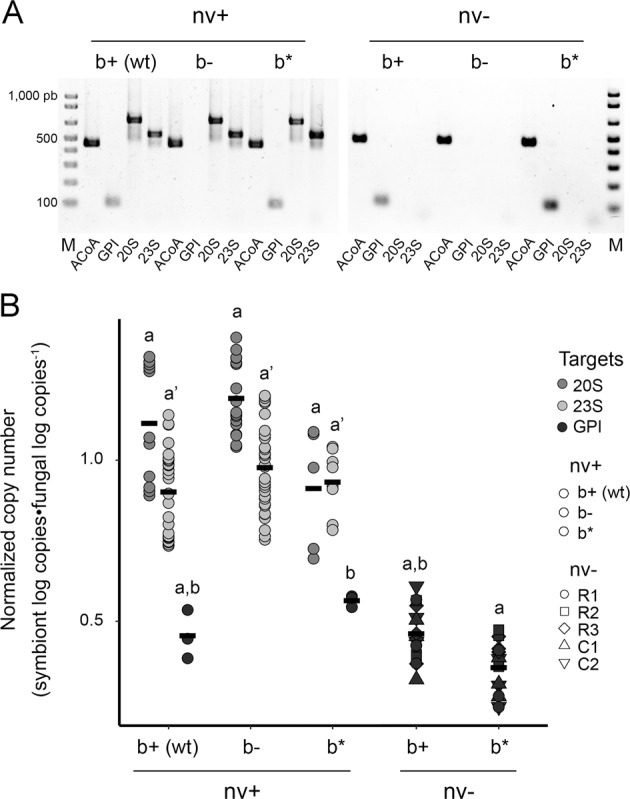
Fig. 3. Generation and characterization of narnaviruses-free (nv−), bacteria-free (b−), and bacteria-reinfected (b*) fungal strains.
a Molecular genotyping of strain 814 wt and all its variants. M molecular marker, ACoA fungal housekeeping acetyl-CoA transporter gene (392 pb), GPI bacterial housekeeping glucose-6-phosphate isomerase gene (87 pb), 20S and 23S represent the RmNV-20S (683 pb) and RmNV-23S (537 pb) genomes, respectively. b Absolute quantification of housekeeping fungal and bacterial genes by qPCR (using genomic DNA) and viral load by RT-qPCR (using cDNA). Log10 copies of each symbiont was determined per ng of total nucleic acids extracted. To offset the variation in symbionts proportion per ng of nucleic acids, the fungal gen ACoA was used for normalization of strain-to-strain differences. Nucleic acids were extracted at 6-old day cultures on half-strength PDA at 30 °C. Each symbol corresponds to a single gene measurement and bars indicate the arithmetical mean. Different letters denote statistical differences between strains for each target by one-way ANOVA followed by Tukey’s post-hoc test, P < 0.05, n = 3 to 65 for each strain type.
Fig. 4
Fig. 4. Effect of narnaviruses in the asexual and sexual reproduction of R. microsporus.
a Sporangiospores produced by 814 wt and its variants on half-strength PDA at 30 °C, after 6 days of culture. b Zygospores produced by the mating of strain 813 wt and 814 wt and its variants on MEA medium at 30 °C. Each symbol represents spores quantified from a single agar plate. Bars indicate the arithmetical mean. Different letters denote statistical differences between strains by one-way ANOVA followed by Tukey’s post-hoc test, P < 0.05, n = 4–6, for each strain as described in Table 1. * most strains nv−b− did not produce zygospores.

References

    1. Bonfante P, Desirò A. Who lives in a fungus? The diversity, origins and functions of fungal endobacteria living in Mucoromycota. ISME J. 2017;11:1727–35. - PMC - PubMed
    1. Pawlowska TE, Gaspar ML, Lastovetsky OA, Mondo SJ, Real-Ramirez I, Shakya E, et al. Biology of fungi and their bacterial endosymbionts. Annu Rev Phytopathol. 2018;56:289–309. - PubMed
    1. Partida-Martínez LP. The fungal holobiont: evidence from early diverging fungi. Environ Microbiol. 2017;19:2919–23. - PubMed
    1. Partida-Martinez LP, Groth I, Schmitt I, Richter W, Roth M, Hertweck C. Burkholderia rhizoxinica sp. nov. and Burkholderia endofungorum sp. nov., bacterial endosymbionts of the plant-pathogenic fungus Rhizopus microsporus. Int J Syst Evol Microbiol. 2007;57:2583–90. - PubMed
    1. Lackner G, Möbius N, Scherlach K, Partida-Martinez LP, Winkler R, Schmitt I, et al. Global distribution and evolution of a toxinogenic Burkholderia-Rhizopus symbiosis. Appl Environ Microbiol. 2009;75:2982–6. - PMC - PubMed

Publication types

Supplementary concepts