. 2020 Mar 25:11:417.
doi: 10.3389/fpsyg.2020.00417. eCollection 2020.

A World Unto Itself: Human Communication as Active Inference

Affiliations

A World Unto Itself: Human Communication as Active Inference

Jared Vasil et al. Front Psychol. .

Abstract

Recent theoretical work in developmental psychology suggests that humans are predisposed to align their mental states with those of other individuals. One way this manifests is in cooperative communication; that is, intentional communication aimed at aligning individuals' mental states with respect to events in their shared environment. This idea has received strong empirical support. The purpose of this paper is to extend this account by proposing an integrative model of the biobehavioral dynamics of cooperative communication. Our formulation is based on active inference. Active inference suggests that action-perception cycles operate to minimize uncertainty and optimize an individual's internal model of the world. We propose that humans are characterized by an evolved adaptive prior belief that their mental states are aligned with, or similar to, those of conspecifics (i.e., that 'we are the same sort of creature, inhabiting the same sort of niche'). The use of cooperative communication emerges as the principal means to gather evidence for this belief, allowing for the development of a shared narrative that is used to disambiguate interactants' (hidden and inferred) mental states. Thus, by using cooperative communication, individuals effectively attune to a hermeneutic niche composed, in part, of others' mental states; and, reciprocally, attune the niche to their own ends via epistemic niche construction. This means that niche construction enables features of the niche to encode precise, reliable cues about the deontic or shared value of certain action policies (e.g., the utility of using communicative constructions to disambiguate mental states, given expectations about shared prior beliefs). In turn, the alignment of mental states (prior beliefs) enables the emergence of a novel, contextualizing scale of cultural dynamics that encompasses the actions and mental states of the ensemble of interactants and their shared environment. The dynamics of this contextualizing layer of cultural organization feedback, across scales, to constrain the variability of the prior expectations of the individuals who constitute it. Our theory additionally builds upon the active inference literature by introducing a new set of neurobiologically plausible computational hypotheses for cooperative communication. We conclude with directions for future research.

Keywords: active inference; adaptive prior; circular causality; cooperative communication; development; evolution; free energy; mental state alignment.


Figures

FIGURE 1
FIGURE 1
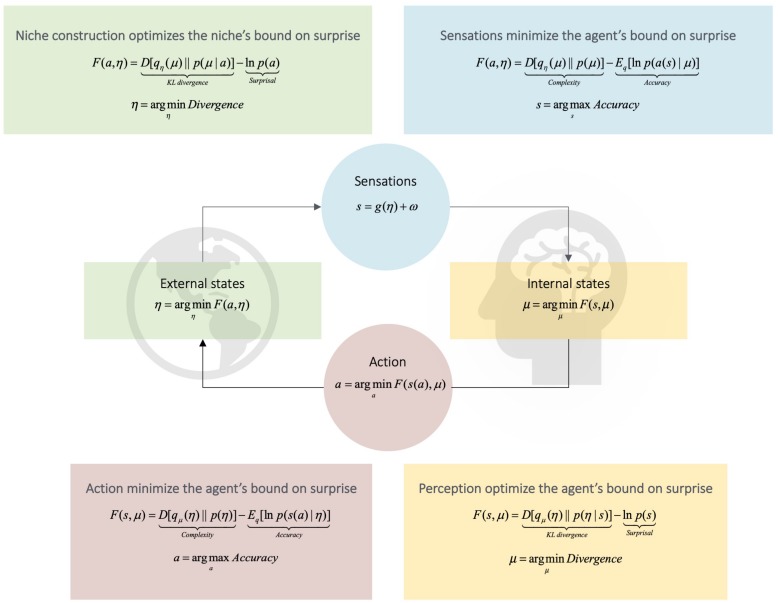
Active inference. This Figure schematizes active inference. It depicts the coupling of an agent’s internal states (the dynamics of which entail predictions or beliefs about the niche, μ) to its external states (the dynamics of the agent’s niche, η). Middle Panel: The influence of the niche on the agent is given by the dynamics of the agent’s sensations, s. Reciprocally, the influence of the agent upon its niche is given by the agent’s action, a, upon the niche. This means that the niche is not directly observable from the perspective of an agent’s internal states; and the agent’s internal states are not directly observable from the perspective of the niche. From an agent’s perspective, the niche is thus described as a set of hidden variables. Hidden variables must be inferred (i.e., predicted) from sensory observations. Thus, to minimize the probability of sampling surprising sensory states, the task for the agent is to attune the dynamics of internal states to those of the niche; or attune the dynamics of the niche to those of internal states. Attunement renders the agent an approximate (predictive) model of the hidden causes of its sensations. We can quantify the degree of attunement between organism and niche with a quantity called variational free energy (Bruineberg et al., 2018a; Constant et al., 2018). Free energy F bounds (i.e., is greater or equal to) the surprisallnp(s) associated with a sensation (Friston, 2010). Importantly, free energy is a function of two quantities to which the organism has access, namely, its sensations and predictions (for discussion, see Bruineberg et al., 2018a). Lower Panel: The bottom right details how perception optimizes free energy by implicitly minimizing a Kullback–Leibler (KL) divergence term D. The KL divergence tracks the statistical similarity of two distributions (Cover and Thomas, 1991); e.g., the similarity of prior beliefs about the state of the niche with posterior beliefs (Friston, 2012). Because the KL divergence provides an upper bound on surprisal, minimizing it renders the agent a model of the niche and thus implicitly bounds the surprise of sensory states. Upper Panel: These expressions define the relationship of the niche to the agent. Note the kind of ‘mirror image’ relationship between the equations in the (upper panel) with the equations in the lower. This relationship is a consequence of the mathematics of free energy minimization (see Bruineberg et al., 2018b; Constant et al., 2018). It means that the niche ‘sees’ and ‘learns’ about the agent (i.e., via the agent’s action) in the same way an agent sees and learns about their niche (i.e., via the niche’s ‘action’). This insight is extended in Figure 2. Adapted with permission from Veissière et al. (forthcoming).
FIGURE 2
FIGURE 2
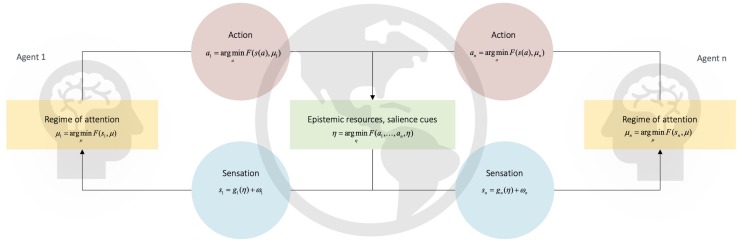
Thinking through other minds. This Figure depicts a set of heuristic equations that describe the kind of free energy minimization hypothesized to underwrite the acquisition and production of learned cultural behaviors via the coupled dynamics sketched in the main text (full equations in Figure 1). In the context of human communication, coupled dynamics are energized by an adaptive prior for alignment. The adaptive prior for alignment specifies the characteristically enhanced precision of the hypothesis that ‘we’ exist. This prior motivates similar agents to actively couple their respective actions an and sensations sn. Via the processes discussed in the main text, this statistical coupling of sensation and action enables each individual to reliably align with (i.e., infer) the hidden states μn of conspecific n. This circular process brings about a process of cultural niche construction that creates, maintains, and modifies a set of predictable epistemic (i.e., deontic) resources, η. These specify a set of high value (i.e., predictable) observation-policy mappings, which are used to disambiguate the mental states of conspecifics (Veissière et al., forthcoming). One important class of deontic resource is the set of observation-policy mappings that underwrite a system of communicative constructions (i.e., form-meaning pairings). This means that the use of communicative constructions plays a critical role in enabling agents with an adaptive prior for alignment to effectively disambiguate external states. This is because an agent’s external states are constituted, in part, by the internal, mental states of another agent (and vice versa). This follows from the fact that external states cause sensation; for an agent equipped with an adaptive prior for alignment, inferring the motion of external states entails inferring other agents’ hidden states. The production and observation of communicative constructions is useful because it effectively and flexibly guides ‘regimes’ of attention that enable species unique forms of cultural learning (see Ramstead et al., 2016; Veissière et al., forthcoming). Diachronically, communicative constructions are finessed by a community of agents via the inheritance and (intended or unintended) modification of constructions during either learning or usage. Adapted with permission from Veissière et al. (forthcoming).
FIGURE 3
FIGURE 3
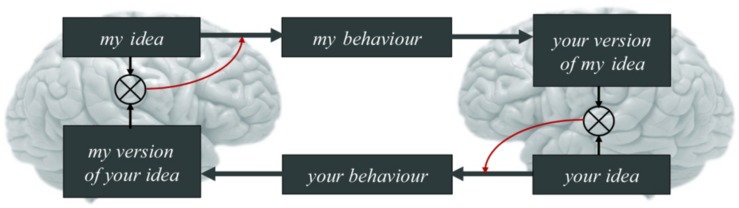
One canonical ‘loop’ of the coupled action-perception cycle. This example is ‘canonical’ in the sense that the manifestation of the coupled action-perception cycle in a given instance may vary as a function of context and the experience of its constituent members (e.g., an infant’s communicative needs with an adult are different than a pair of adults’). With this in mind, for two agents A and B expecting to reliably infer each other’s mental states, the beliefs of A (‘my idea’) generate A’s observable actions (‘my behavior’). The actions of A, in turn, cause the (attended) sensory states of B. Attention directed toward agent A by agent B in turn enables the observations generated by A to entrain the hidden states of B (‘your version of my idea’). This is just some hypothesis entertained by B about the causes of B’s observations (i.e., about the mental states generating A’s actions). To increase or maintain the reliability of B’s hypothesis, B must then act on the niche (‘your behavior’) to test B’s hypothesis about hidden causes, as it were (that is, to check for mutual understanding, for instance; e.g., Clark and Wilkes-Gibbs, 1986). B thereby causes A’s attended observations and, hence, A’s mental states (‘my version of your idea’). This looping dynamics continues until both agents infer alignment (Friston and Frith, 2015a). Central here is that A is attending to the sensory states generated by B (and vice versa) because the only way to gather evidence for the adaptive prior that mental states are aligned is to attend to the sensory effects of one’s actions; and evidence for hypotheses about the sensory effects of one’s actions can only be given (in the present context) by the actions of the other agent. Working backwards, because the actions of another agent are generated by their mental states; and their mental states are entrained by (attended) sensory observations; and their sensory observations are generated by one’s own actions; we thus arrive at the claim, given at the start of this section, that “A central part of the content of the prior belief prescribing the alignment of mental states among conspecifics is that the actions of agents (e.g., oneself) modulate the mental states (prior beliefs) of other agents.” Adapted with permission from Friston and Frith (2015a).
FIGURE 4
FIGURE 4
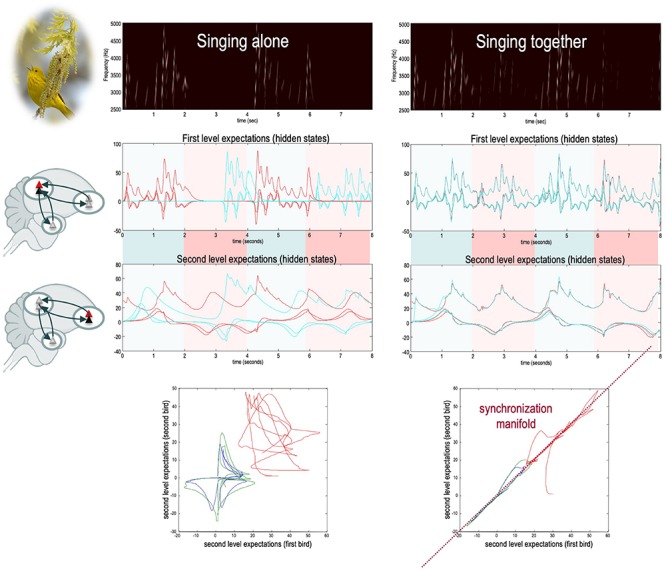
A simulation of free-energy minimization of the sort implied by the coupled action-perception cycle. Two birds – endowed with prior expectations about the hidden states generating a shared (birdsong) narrative – sing for 2 s and then listen for a response. The posterior expectations for the first bird are shown in red; and the equivalent expectations for the second bird are shown in blue (both as a function of time). The left panel shows chaotic and uncoupled dynamics when the birds cannot hear each other (‘singing alone’), while the right panel shows the synchrony in hidden states that emerges when the birds exchange sensory signals (‘singing together’). The different colors correspond to the three hidden states for each bird. When singing alone, the birds cannot hear each other (because they are too far apart). Consequently, the dynamics diverge due to the sensitivity to initial conditions implicit in their (chaotic) generative models. The sonogram heard by the first bird is given in the upper panel. Because this bird can only hear itself, the sonogram reflects the predictions about action based upon its (first- and second-level) posterior expectations. Compare this to the case when the two birds can hear each other (‘singing together’). Here, the posterior expectations encoded by internal states show (identical) synchrony at both the sensory and extrasensory levels, as shown in the middle panels (e.g., Pérez et al., 2017). Note that the sonogram is now continuous over the successive 2 s epochs, because the first bird can hear itself and the second bird. The ensuing synchronization manifold (i.e., the part of the joint state space that contains the generalized synchronization) is shown in the lower panels. These plot the second-level expectations in the second bird against the equivalent expectations in the first. The synchronization manifold for identical synchronization corresponds to the (broken) diagonal line. For details, see Friston and Frith (2015a). Obtained and adapted with permission from Constant et al. (2018).
FIGURE 5
FIGURE 5
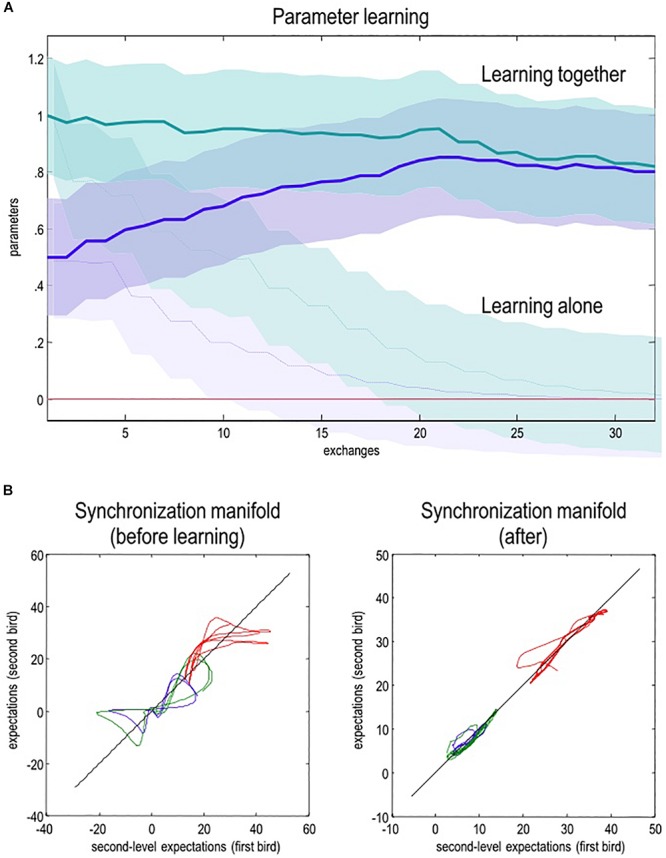
A duet for one. This Figure depicts learning and communication via repeated engagement in coupled action-perception cycles in the context of an adaptive prior to align with conspecifics’ hidden states. (A) Shows changes in the posterior expectations of an order parameter of the first bird (blue) and second bird (green) determining the chaotic structure of the songs depicted in Figure 4 (by number of reciprocal sensory exchanges). The shaded areas correspond to 90% (prior Bayesian) confidence intervals. The broken lines (and intervals) report the results of the same simulation, but when the birds could not hear each other. (B) Shows the synchronization of posterior expectations encoded by extrasensory areas for the first (i) and subsequent (ii) exchanges, respectively. This synchronization is shown by plotting a mixture of expectations and their temporal derivatives from the second bird against the equivalent expectations of the first bird. This mixture is optimized by assuming a linear mapping between the birds’ hidden states. In this example, the second (green) bird had more precise beliefs about its order parameter and, therefore, effectively, ‘taught’ the first bird. Parameter estimation (learning) converges toward the same value resulting in (generalized) synchrony between the two birds. For details, see Friston and Frith (2015b). Adapted with permission from Friston and Frith (2015b).

References

    1. Adams R. A., Shipp S., Friston K. J. (2013). Predictions not commands: active inference in the motor system. Brain Struct. Funct. 218 611–643. 10.1007/s00429-012-0475-5 - DOI - PMC - PubMed
    1. Anderson M. L. (2010). Neural reuse: a fundamental organizational principle of the brain. Behav. Brain Sci. 33 245–266; discussion 266–313. 10.1017/S0140525X10000853 - DOI - PubMed
    1. Angus S. D., Newton J. (2015). Emergence of shared intentionality is coupled to the advance of cumulative culture. PLoS Comput. Biol. 11:e1004587. 10.1371/journal.pcbi.1004587 - DOI - PMC - PubMed
    1. Apps M. A. J., Rushworth M. F. S., Chang S. W. C. (2016). The anterior cingulate gyrus and social cognition: tracking the motivation of others. Neuron 90 692–707. 10.1016/j.neuron.2016.04.018 - DOI - PMC - PubMed
    1. Ashley J., Tomasello M. (1998). Cooperative problem-solving and teaching in preschoolers. Soc. Dev. 7 143–163. 10.1111/1467-9507.00059 - DOI

LinkOut - more resources