


Sternal Wound Complications: Results of Routine Use of Negative Pressure Wound Therapy
- PMID: 32270960
- PMCID: PMC7089751
- DOI: 10.21470/1678-9741-2019-0242
Sternal Wound Complications: Results of Routine Use of Negative Pressure Wound Therapy
Abstract
Introduction: Negative pressure wound therapy (NPWT) has significantly improved outcomes in individuals with superficial and deep sternal wound dehiscence (SWD). We report our experience with NPWT to evaluate factors influencing effectiveness, duration of treatment and postoperative hospital stay.
Methods: We reviewed 92 patients with postoperative SWD following a median sternotomy. Patients were divided into 2 groups: those with a superficial SWD (Group 1; 72, 78%) and those with a deep SWD (Group 2; 20, 28%). Group 1 was further divided into 3 subgroups based on NPWT duration.
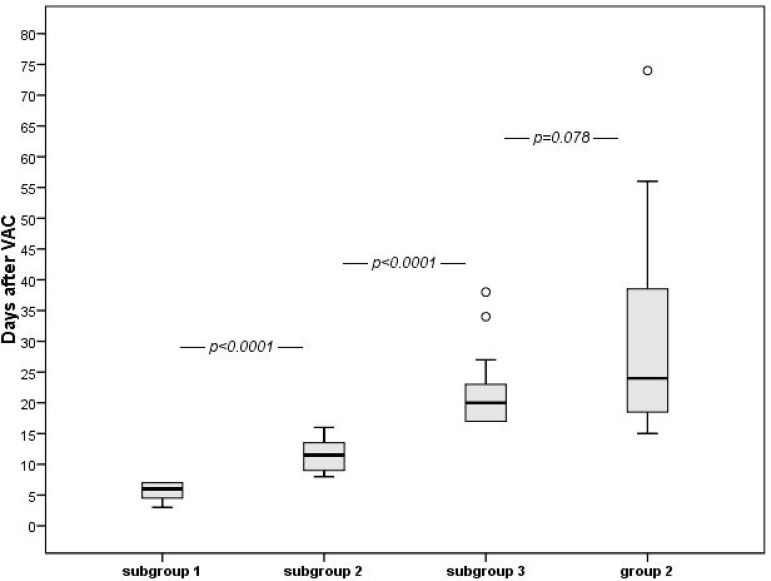
Results: In both groups, none of the preoperative characteristics examined showed a significant association with longer NPWT duration. In Group 2, there was a trend for postoperative bleeding and neurological complications to be associated with longer treatment duration. In the entire series, staph infection resulted a weak predictor of NPWT duration. In each Group 1 subgroup and in Group 2, treatment days were compared with duration of hospitalization until discharge. Mean post-NPWT hospital stay was 6 days in subgroup 1, 12 days in subgroup 2 and 20 days in subgroup 3 (P<0.0001). At a median 3-year follow-up, there were 4 late deaths, none related to wound complications. No cases of SWD recurrence were observed.
Conclusion: Our results confirm the effectiveness of NPWT in SWD management, while excessive treatment duration might have a negative impact on the length of hospital stay. Further studies are needed to define an optimal use of NPWT protocol.
Keywords: Duration of Therapy; Hospitalization; Infections; Patient Discharge; Postoperative Complications; Sternotom; Sternum.
Conflict of interest statement
No conflict of interest.
Figures
References
MeSH terms
LinkOut - more resources
Full Text Sources