Designing and implementing an all Wales postpartum haemorrhage quality improvement project: OBS Cymru (the Obstetric Bleeding Strategy for Wales)
- PMID: 32273281
- PMCID: PMC7326295
- DOI: 10.1136/bmjoq-2019-000854
Designing and implementing an all Wales postpartum haemorrhage quality improvement project: OBS Cymru (the Obstetric Bleeding Strategy for Wales)
Abstract
Background: Postpartum haemorrhage (PPH) contributes to substantial maternal morbidity. Research into PPH has led to improvements in care which have been incorporated into the Obstetric Bleeding Strategy for Wales.
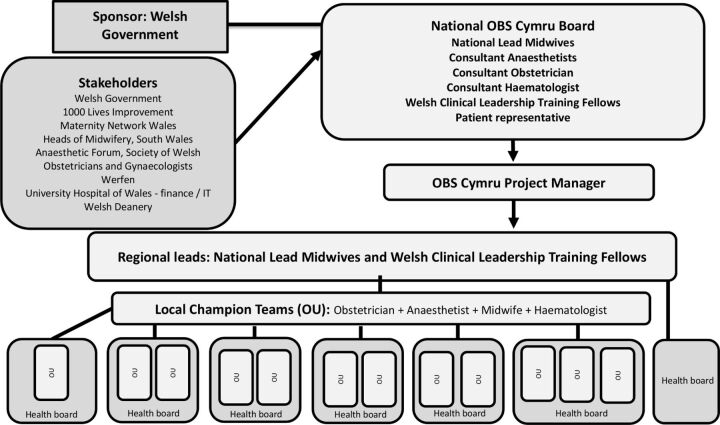
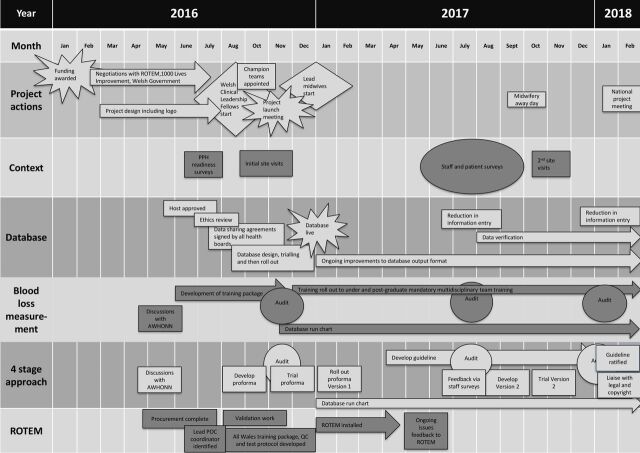
Intervention: A national quality improvement team supported local teams in implementing multiple interventions including risk assessment, objective measurement of blood loss, multiprofessional assessment (at the bedside at 1000 mL blood loss) and point-of-care (POC) testing of coagulation to guide blood product resuscitation during PPH. The project was rolled out to all 12 obstetric units in 2017. The interventions were reinforced by an All Wales Guideline, PPH proforma and standardised training. A national database, biannual audits, and patient and staff surveys reported process and outcome measures.
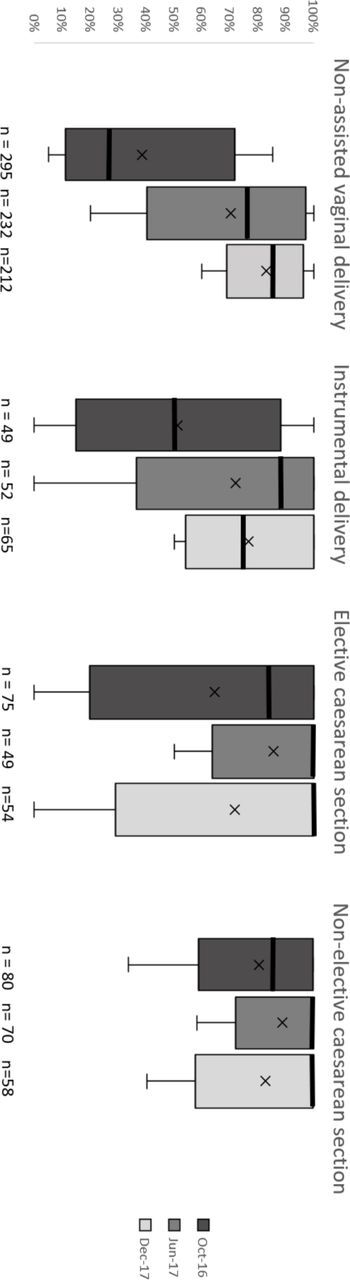
Results: Process measures: during 2017, there was an increase in the percentage of maternities with documented risk assessment (0%-76%), objective measurement of blood loss (52%-88%) and POC testing for coagulation for PPH ≥1500 mL (38%-59%). Maternity staff survey indicated that 94% were aware of the project and 87% stated that it had changed their unit's management of PPH. Interim outcome measures: the incidence (95% CI) of PPH ≥2500 mL per 1000 maternities in 2017 was 6.03 (5.23-6.95). The annual number of women receiving any red blood cell transfusion, level 3 intensive care admission and hysterectomy for PPH was 19.7 (18.2 to 21.3), 0.702 (0.464 to 1.06) and 0.255 (0.129 to 0.504) per 1000 maternities, respectively.
Conclusions: A high level of project awareness across Welsh maternity units has been achieved. Measurement of blood loss was reported to be the most important early change in practice, while PPH documentation and POC testing continue to be embedded. Combining qualitative and quantitative measures to inform implementation has improved project delivery and allowed teams to adapt to local contexts.
Keywords: healthcare quality improvement; obstetrics and gynecology; teamwork.
© Author(s) (or their employer(s)) 2020. Re-use permitted under CC BY-NC. No commercial re-use. See rights and permissions. Published by BMJ.
Conflict of interest statement
Competing interests: PC has received support for research from CSL Behring and Haemonetics. He has acted as a paid consultant to Werfen and Haemonetics. RC has received support for research from CSL Behring.
Figures
References
-
- WHO WHO recommendations for the prevention and treatment of postpartum haemorrhage. Italy: World Health Organization, 2012. - PubMed
-
- Knight M, Bunch K, Tuffnell D, et al. on behalf of MBRRACE-UK. Saving Lives, Improving Mothers’ Care - Lessons learned to inform maternity care from the UK and Ireland Confidential Enquiries into Maternal Deaths and Morbidity 2014. National Perinatal Epidemiology Unit, University of Oxford: Oxford, 2018.
-
- Royal College of Obstetricians and Gynaecologists Post haemorrhage, prevention and management, Green-top guideline No. 52. Available: https://www.rcog.org.uk/en/guidelines-research-services/guidelines/gtg52/ [Accessed 28 Nov 2017].
Publication types
MeSH terms
LinkOut - more resources
Full Text Sources