Modified SEIR and AI prediction of the epidemics trend of COVID-19 in China under public health interventions
- PMID: 32274081
- PMCID: PMC7139011
- DOI: 10.21037/jtd.2020.02.64
Modified SEIR and AI prediction of the epidemics trend of COVID-19 in China under public health interventions
Abstract
Background: The coronavirus disease 2019 (COVID-19) outbreak originating in Wuhan, Hubei province, China, coincided with chunyun, the period of mass migration for the annual Spring Festival. To contain its spread, China adopted unprecedented nationwide interventions on January 23 2020. These policies included large-scale quarantine, strict controls on travel and extensive monitoring of suspected cases. However, it is unknown whether these policies have had an impact on the epidemic. We sought to show how these control measures impacted the containment of the epidemic.
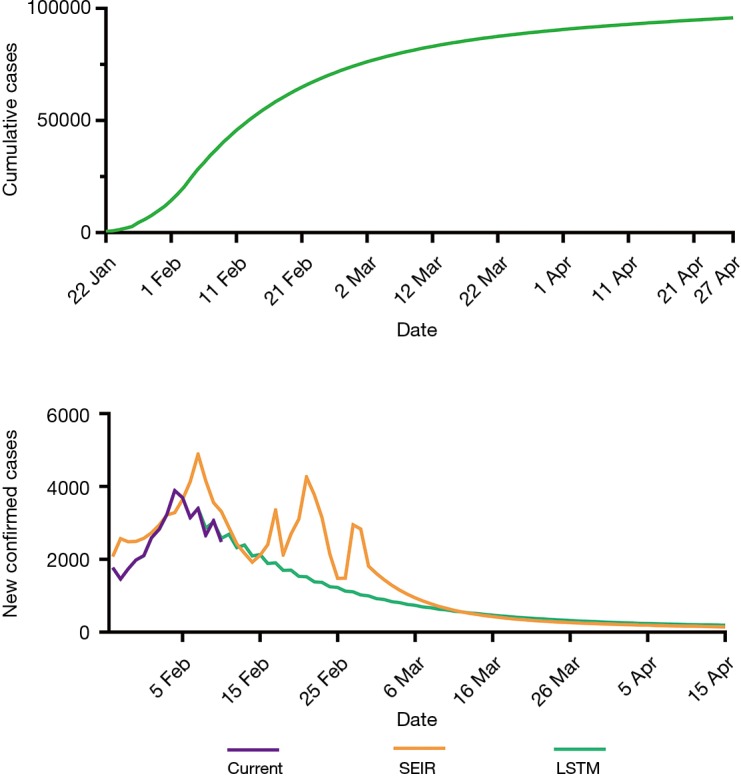
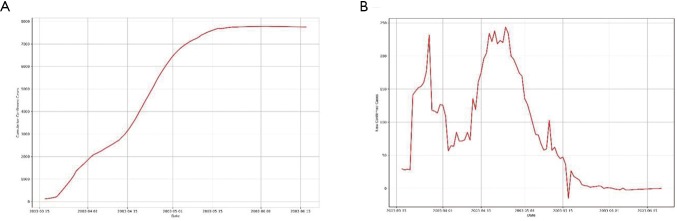
Methods: We integrated population migration data before and after January 23 and most updated COVID-19 epidemiological data into the Susceptible-Exposed-Infectious-Removed (SEIR) model to derive the epidemic curve. We also used an artificial intelligence (AI) approach, trained on the 2003 SARS data, to predict the epidemic.
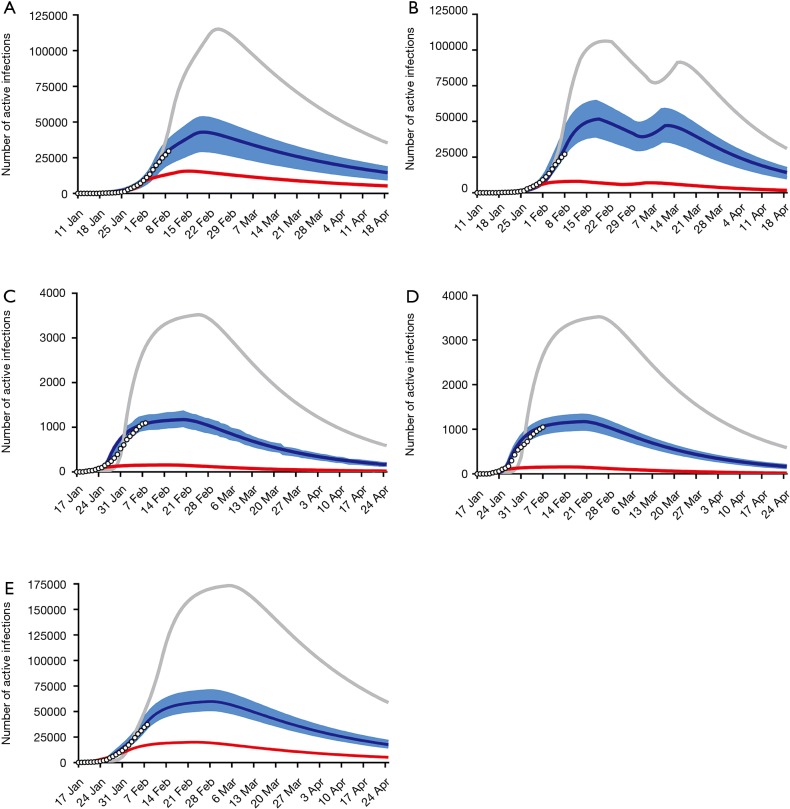
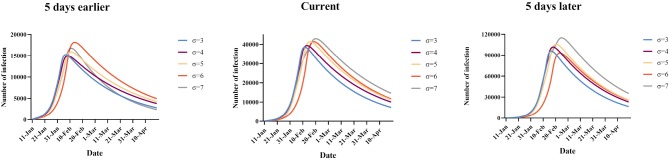
Results: We found that the epidemic of China should peak by late February, showing gradual decline by end of April. A five-day delay in implementation would have increased epidemic size in mainland China three-fold. Lifting the Hubei quarantine would lead to a second epidemic peak in Hubei province in mid-March and extend the epidemic to late April, a result corroborated by the machine learning prediction.
Conclusions: Our dynamic SEIR model was effective in predicting the COVID-19 epidemic peaks and sizes. The implementation of control measures on January 23 2020 was indispensable in reducing the eventual COVID-19 epidemic size.
Keywords: Coronavirus disease 2019 (COVID-19); Susceptible-Exposed-Infectious-Removed (SEIR); epidemic; modeling; severe acute respiratory syndrome coronavirus 2 (SARS-CoV-2).
2020 Journal of Thoracic Disease. All rights reserved.
Conflict of interest statement
Conflicts of Interest: NZ serves as the unpaid Editor-in Chief of Journal of Thoracic Disease. JH serves as the unpaid Executive Editor-in-Chief of Journal of Thoracic Disease. WL serves as an unpaid Editorial Board Member (Thoracic Surgery) of Journal of Thoracic Disease. The other authors have no conflicts of interest to declare.
Figures



Comment in
-
Modelling-based evaluation of the effect of quarantine control by the Chinese government in the coronavirus disease 2019 outbreak.Sci China Life Sci. 2020 Aug;63(8):1257-1260. doi: 10.1007/s11427-020-1717-9. Epub 2020 May 8. Sci China Life Sci. 2020. PMID: 32394245 Free PMC article. No abstract available.
-
Forecasting of COVID-19: transmission models and beyond.J Thorac Dis. 2020 May;12(5):1762-1765. doi: 10.21037/jtd-20-1692. J Thorac Dis. 2020. PMID: 32642080 Free PMC article. No abstract available.
-
Mathematical models for COVID-19: applications, limitations, and potentials.J Public Health Emerg. 2020 Jun;4:9. doi: 10.21037/jphe-2020-05. Epub 2020 Jun 25. J Public Health Emerg. 2020. PMID: 32724894 Free PMC article. No abstract available.
-
Advancements and lingering challenges in addressing public health disasters.J Thorac Dis. 2020 Oct;12(10):5254-5258. doi: 10.21037/jtd.2020.04.52. J Thorac Dis. 2020. PMID: 33209357 Free PMC article. No abstract available.
References
-
- Real-time big data report on the epidemic (in Chinese) 2020. Available online: https://voice.baidu.com/act/newpneumonia/newpneumonia/?from=osari_aladin...
-
- Coronavirus disease 2019 (COVID-19) Situation Report–25 2020. Available online: https://www.who.int/docs/default-source/coronaviruse/situation-reports/2...
-
- Situation Updates - SARS: Update 95 - Chronology of a serial killer 2003. Available online: https://www.who.int/csr/don/2003_06_18/en/
LinkOut - more resources
Full Text Sources
Other Literature Sources
Miscellaneous