Review
. 2020 Mar;12(3):1022-1030.
doi: 10.21037/jtd.2020.01.15.

Management of anastomotic leaks after esophagectomy and gastric pull-up

Affiliations
Review

Management of anastomotic leaks after esophagectomy and gastric pull-up

Amber Famiglietti et al. J Thorac Dis. 2020 Mar.

Abstract

Anastomotic leak is one of the most feared complications of esophagectomy, leading to prolonged hospital stay, increased postoperative mortality, and additional cost both to the patient and the hospital. Historically, anastomotic leaks have been treated with several techniques including conservative measures, percutaneous or operative drainage, primary surgical repair with buttressing, T-tube drainage, or excision of the esophageal replacement conduit with end esophagostomy. With advances in treatment modalities, including endoscopic stenting, clips and suturing, endoluminal vacuum-assisted closure (EVAC), such leaks increasingly are being managed without operative re-intervention and with salvage of the esophageal replacement conduit. For the purposes of this review, we identified studies analyzing the management of postoperative leak after esophagectomy. We then compared the efficacy of the various newer modalities for closure of anastomotic leaks and gastric conduit defects. We found both esophageal stent and EVAC sponges are effective treatments for closure of anastomotic leak. The chosen treatment modality for salvage of the esophageal replacement conduit is entirely dependent on the patient's clinical status and the surgeon's preference and experience. Emerging endoscopic and endoluminal therapies have increased the armamentarium of tools the esophageal surgeon has to facilitate successful resolution of anastomotic leaks following esophagectomy with reconstruction. While some literature suggests that EVACs have a slightly superior result in conduit success, we question this endorsement as EVACs mostly are utilized for contained leaks, many of which may have healed with conservative measures. This poses a challenge as there is clearly a bias given patient selection.

Keywords: Esophagectomy; anastomotic leak; endoluminal stent; endoluminal suturing; endoluminal vacuum-assisted closure (EVAC); over-the-scope clips (OTSCs).


Conflict of interest statement

Conflicts of Interest: The authors have no conflicts of interest to declare.

Figures
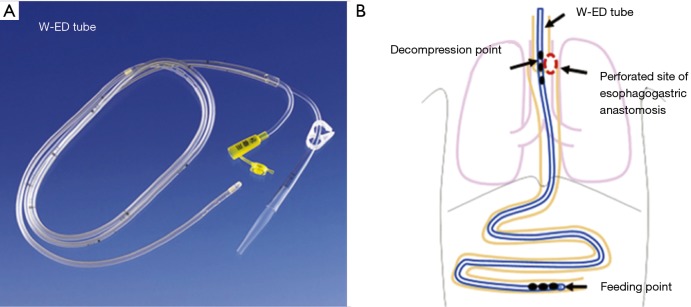
Figure 1
Figure 1
Double elementary tube (W-ED tube) used to manage an anastomotic leak proximally while feeding distally. The tube has two lumens, one that allows for suction and depression of the anastomotic leak site and one that allows the delivery of tube feeds. Reprinted with permission of Dr. Takeyuki Wada and Elsevier publishing.
Figure 2
Figure 2
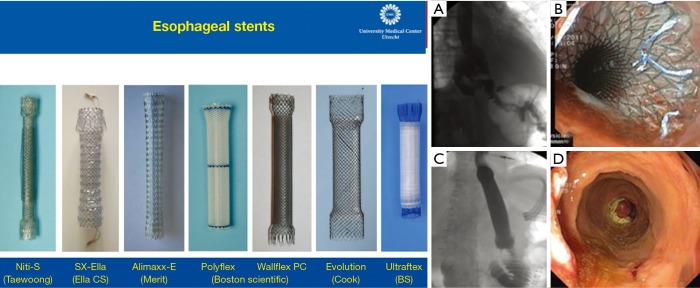
Popularly used stents in the management of esophageal strictures, anastomotic leaks, and esophageal perforation. They are either made of plastic (Polyflex) or metal, can be covered or uncovered, and non-absorbable or biodegradable. Reprinted with permission of Peter D. Siersema, MD, PhD, Radboud University, The Netherlands. The panel of four figures on the right demonstrates the detection of an anastomotic leak and endoscopic and fluoroscopic view of the stent to close the leak site. Final completion endoscopy demonstrates complete closure of the leak after stent removal. No stricture is seen here. Reprinted with permission of Dr. Alberto Fernández, POVISA Hospital, Vigo, Spain and Rev Esp Enferm Dig.
Figure 3
Figure 3
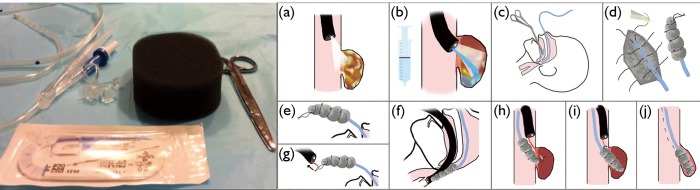
Endovac therapy is based on principles of applying suction to a cavity to allow for granulation tissue to form and thus allow closure of the cavity from inside-out. Left most panel (a, e, g): the apparatus is rather simple and uses a nasogastric tube (NGT) sutured to a black sponge. Reprinted with permission of Dr. Nathan R. Smallwood, Texas Oncology, Sherman, TX and SAGES. Middle panel (b, f): after visualizing the defect, the cavity is cleaned and irrigated. An NGT is passed via the nares and pulled out through the mouth. It is then sutured to a sponge, which is then directed into appropriate place using the endoscope. Negative suction is applied once in position. Reprinted from ANZ Journal of Surgery 2016 with permission granted by John Wiley and Sons. Right most panel (c, d, h, i, j): various mechanisms have been proposed to explain the healing of the leaking bed. Reprinted with permission of Dr. Damien Loh, Melbourne Gastro Oesophageal Surgery, Australia.
Figure 4
Figure 4
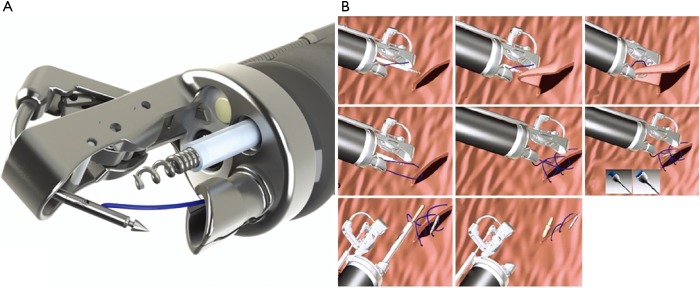
Endoluminal suturing (Apollo Endo-surgery, Austin, Texas, panel A) allows for closure of full-thickness defects by using a helix and pulling in tissue into the jaws of the suturing device and then passing the needle from one edge of the perforated site to the other with final cinching of the defect (panel B). Reprinted with permission of Apollo Endosurgery (both panels).

References

    1. Flanagan JC, Batz R, Saboo SS, et al. Esophagectomy and Gastric Pull-through Procedures: Surgical Techniques, Imaging Features, and Potential Complications. Radiographics 2016;36:107-21. 10.1148/rg.2016150126 - DOI - PubMed
    1. Souche R, Nayeri M, Chati R, et al. Thoracoscopy in prone position with two-lung ventilation compared to conventional thoracotomy during Ivor Lewis procedure: a multicenter case-control study. Surg Endosc 2020;34:142-52. 10.1007/s00464-019-06742-w - DOI - PubMed
    1. Kuwabara S, Kobayashi K, Kubota A, et al. Comparison of perioperative and oncological outcome of thoracoscopic esophagectomy in left decubitus position and in prone position for esophageal cancer. Langenbecks Arch Surg 2018;403:607-14. 10.1007/s00423-018-1674-1 - DOI - PubMed
    1. Raymond D. Surgical Clinics of North America. Surg Clin N Am 2012;92:1299-313. 10.1016/j.suc.2012.07.007 - DOI - PubMed
    1. Brown AM, Pucci MJ, Berger AC, et al. A standardized comparison of peri-operative complications after minimally invasive esophagectomy: Ivor Lewis versus McKeown. Surg Endosc 2018;32:204-11. 10.1007/s00464-017-5660-4 - DOI - PubMed