


Impact of Medication Regimen Simplification on Medication Administration Times and Health Outcomes in Residential Aged Care: 12 Month Follow Up of the SIMPLER Randomized Controlled Trial
- PMID: 32276360
- PMCID: PMC7231224
- DOI: 10.3390/jcm9041053
Impact of Medication Regimen Simplification on Medication Administration Times and Health Outcomes in Residential Aged Care: 12 Month Follow Up of the SIMPLER Randomized Controlled Trial
Abstract
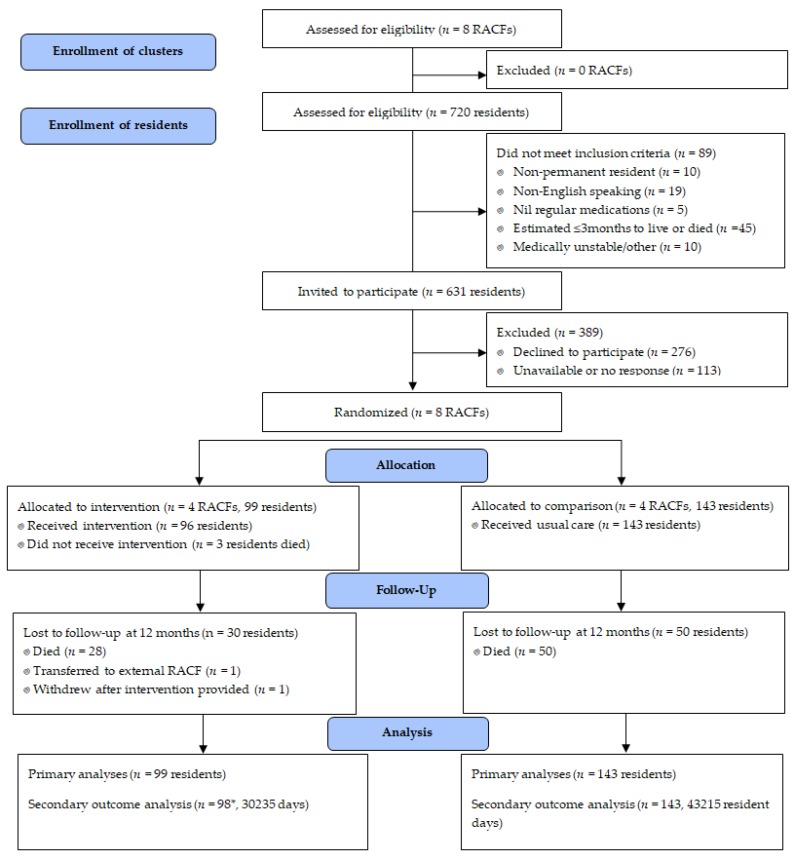
In the SImplification of Medications Prescribed to Long-tErm care Residents (SIMPLER) cluster-randomized controlled trial, we evaluated the impact of structured medication regimen simplification on medication administration times, falls, hospitalization, and mortality at 8 residential aged care facilities (RACFs) at 12 month follow up. In total, 242 residents taking ≥1 medication regularly were included. Opportunities for simplification among participants at 4 RACFs were identified using the validated Medication Regimen Simplification Guide for Residential Aged CarE (MRS GRACE). Simplification was possible for 62 of 99 residents in the intervention arm. Significant reductions in the mean number of daily medication administration times were observed at 8 months (-0.38, 95% confidence intervals (CI) -0.69 to -0.07) and 12 months (-0.47, 95%CI -0.84 to -0.09) in the intervention compared to the comparison arm. A higher incidence of falls was observed in the intervention arm (incidence rate ratio (IRR) 2.20, 95%CI 1.33 to 3.63) over 12-months, which was primarily driven by a high falls rate in one intervention RACF and a simultaneous decrease in comparison RACFs. No significant differences in hospitalizations (IRR 1.78, 95%CI 0.57-5.53) or mortality (relative risk 0.81, 95%CI 0.48-1.38) over 12 months were observed. Medication simplification achieves sustained reductions in medication administration times and should be implemented using a structured resident-centered approach that incorporates clinical judgement.
Keywords: cluster-randomized controlled trial; falls; hospitalization; incidents; long-term care; medication administration; medication regimen simplification; mortality; nursing homes; residential aged care.
Conflict of interest statement
J.K.S. is supported by an NHMRC Early Career Fellowship. J.S.B. is supported by a Boosting Dementia Research Fellowship. E.Y.C. was supported by a postgraduate research scholarship funded by the NHMRC CDPC and the Monash University Faculty of Pharmacy and Pharmaceutical Sciences. M.C., J.V.E., M.H. and T.C. are employed by the organization providing residential aged care services to study participants. There are no other conflicts of interest to declare. The funders had no role in the design of the study; in the collection, analyses, or interpretation of data; in the writing of the manuscript, or in the decision to publish the results.
Figures


References
-
- Chen E., Bell J., Ilomäki J., Keen C., Corlis M., Hogan M., Van Emden J., Hilmer S.N., Sluggett J.K. Medication regimen complexity in 8 Australian residential aged care facilities: Impact of age, length of stay, comorbidity, frailty, and dependence in activities of daily living. Clin. Interv. Aging. 2019;14:1783–1795. doi: 10.2147/CIA.S216705. - DOI - PMC - PubMed
-
- Herson M., Bell J.S., Tan E.C.K., Emery T., Robson L., Wimmer B.C. Factors associated with medication regimen complexity in residents of long-term care facilities. Eur. Geriatr. Med. 2015;6:561–564. doi: 10.1016/j.eurger.2015.10.003. - DOI
Grants and funding
LinkOut - more resources
Full Text Sources
Medical
