


Influence of socioeconomic status on the referral process to cardiac rehabilitation following acute coronary syndrome: a cross-sectional study
- PMID: 32276957
- PMCID: PMC7170636
- DOI: 10.1136/bmjopen-2019-036088
Influence of socioeconomic status on the referral process to cardiac rehabilitation following acute coronary syndrome: a cross-sectional study
Abstract
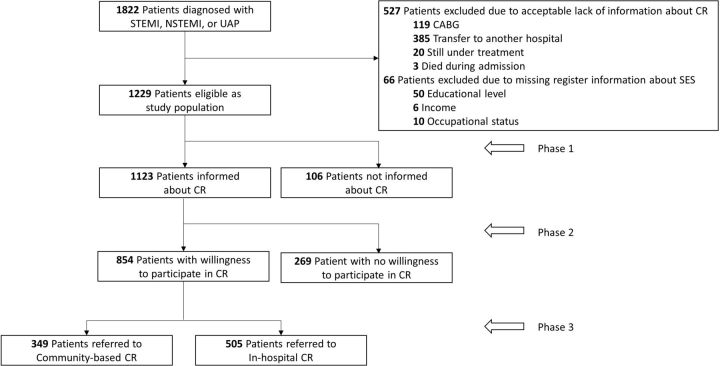
Objective: To evaluate the association between socioeconomic status (SES) and referral to cardiac rehabilitation (CR) after incident acute coronary syndrome (ACS) by dividing the referral process into three phases: (1) informed about CR, (2) willingness to participate in CR, (3) and assigned CR setting.
Design: Cross-sectional study.
Setting: Department of Cardiology at a Danish University Hospital from 1 January 2011 to 31 December 2014.
Participants: A total of 1229 patients assessed for CR during hospitalisation with ACS were prospectively registered in the Rehab-North Register from 2011 to 2014. SES was assessed using data from national registers, concerning: personal income, occupational status, educational level and civil status. Patients were excluded if one of the following criteria was fulfilled: (1) missing data on SES, or (2) acceptable reason for not informing patients about CR (treatment with coronary artery bypass grafting, transfer to another hospital, still under treatment or death).
Main outcome measures: Outcomes were defined by dividing the referral process into three phases: (1) informed about CR, (2) willingness to participate, and (3) assigned CR setting (in-hospital/community centre) after ACS.
Results: A total of 854 (69.5 %) patients were referred to CR. After adjustment for age, gender, ACS diagnosis (ST-elevated myocardial infarction, non-ST-elevated myocardial infarction, unstable angina pectoris) and comorbidity, high income had the strongest association of referral to CR in all three phases (informed about CR: OR 2.17, 95% CI 1.01 to 4.64; willingness to participate in CR: OR 1.55, 95% CI 1.02 to 2.35; assigned in-hospital CR: OR 1.47, 95% CI 0.91 to 2.36). Educational level showed similar tendencies, however not statistically significant. The results did not vary according to gender.
Conclusion: This is the first study to investigate the referral process to CR using a three-phase structure. It suggests income and education to influence all phases in the referral process to CR after ACS.
Keywords: adult cardiology; cardiac epidemiology; myocardial infarction.
© Author(s) (or their employer(s)) 2020. Re-use permitted under CC BY-NC. No commercial re-use. See rights and permissions. Published by BMJ.
Conflict of interest statement
Competing interests: None declared.
Figures
References
Publication types
MeSH terms
LinkOut - more resources
Full Text Sources
Medical
