


The error-related negativity (ERN) moderates the association between interpersonal stress and anxiety symptoms six months later
- PMID: 32277956
- PMCID: PMC7335004
- DOI: 10.1016/j.ijpsycho.2020.03.006
The error-related negativity (ERN) moderates the association between interpersonal stress and anxiety symptoms six months later
Abstract
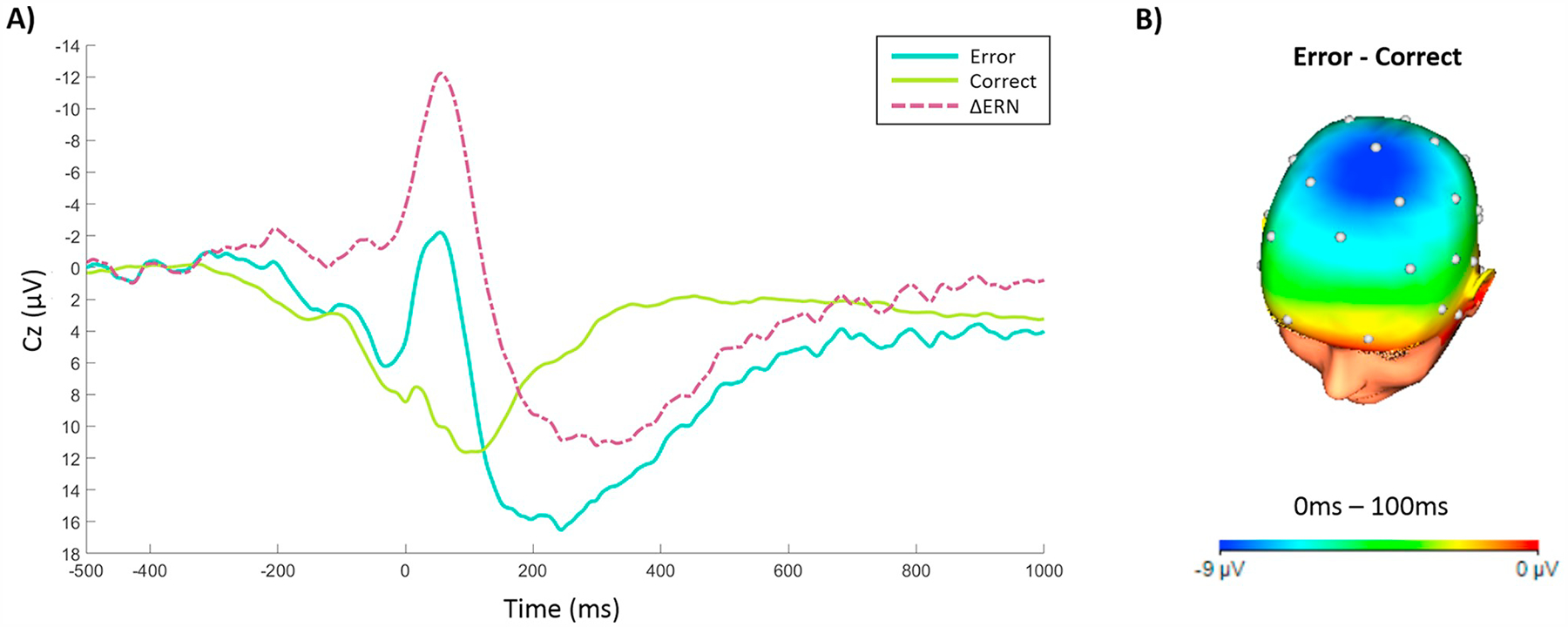
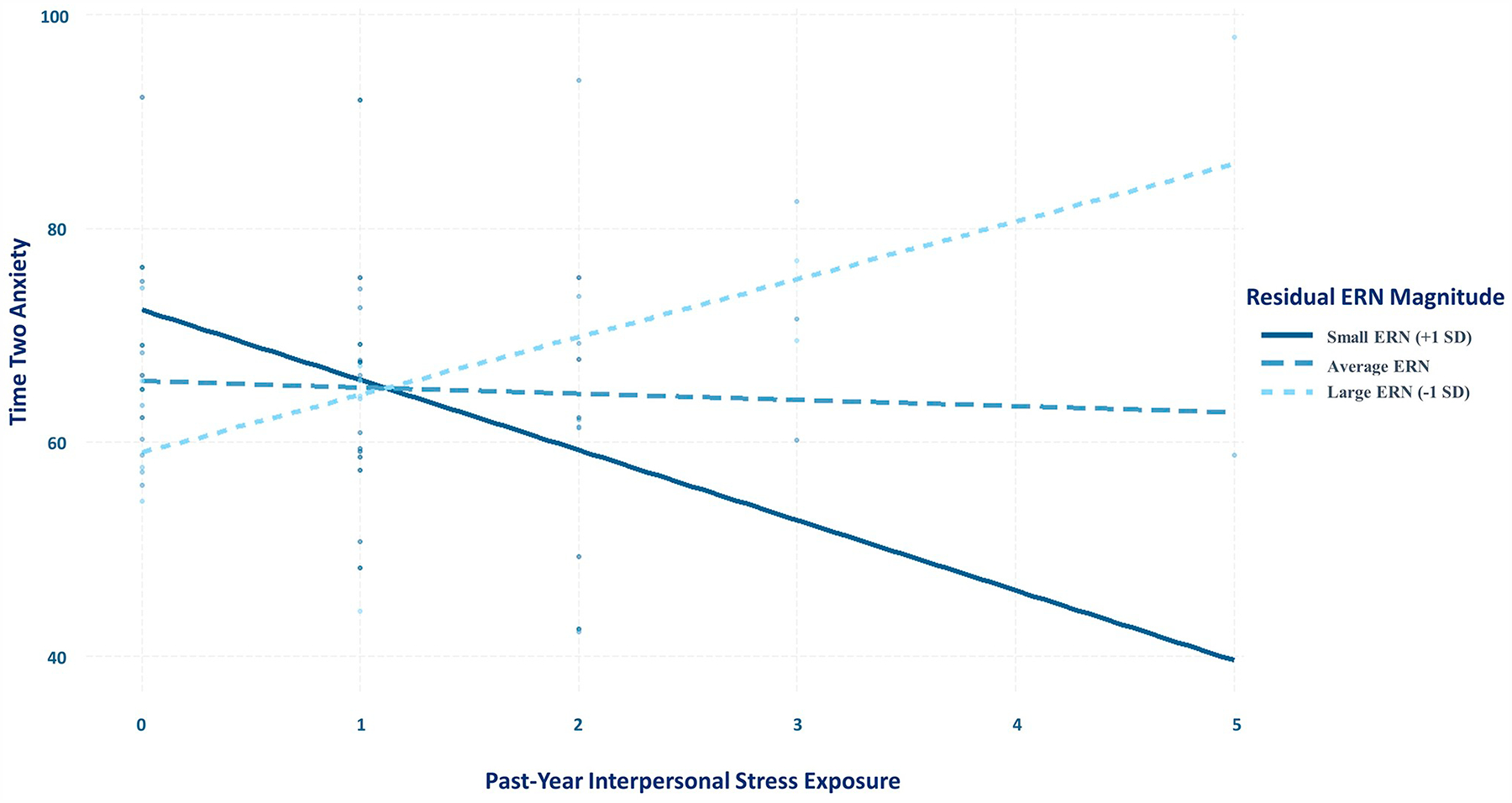
Anxiety disorders are often preceded by interpersonal stress; however, most individuals who experience stress do not develop anxiety, making it difficult to predict who is most susceptible to stress. One proposed trans-diagnostic neural risk marker for anxiety is the error-related negativity (ERN), a negative deflection in the event-related potential waveform occurring within 100 ms of error commission. The present study sought to investigate whether interpersonal stress experienced over the course of a year interacts with ERN magnitude to prospectively predict anxiety symptoms. A sample of 57 emerging adults performed an arrow flanker task to elicit the ERN at the start of the academic school year (time one). Toward the end of the academic year (time two), participants reported on past-year interpersonal stress and anxiety symptoms. Stress interacted with ERN magnitude to predict anxiety symptoms, whereby, for individuals with an enhanced ERN at time one, greater interpersonal stress over the course of a year was significantly associated with increased anxiety symptoms at time two, even controlling for anxiety symptoms at time one. These findings suggest that enhanced performance monitoring may render individuals more susceptible to the adverse effects of interpersonal stress, thereby increasing risk for heightened anxiety.
Keywords: Anxiety; Error-related negativity; Interpersonal stress.
Copyright © 2020 Elsevier B.V. All rights reserved.
Conflict of interest statement
Declaration of competing interest None.
Figures
References
-
- Antony MM, Stein MB (Eds.), 2008. Oxford Handbook of Anxiety and Related Disorders. Oxford University Press, New York.
Publication types
MeSH terms
Grants and funding
LinkOut - more resources
Full Text Sources
Medical
Miscellaneous
