


Predicting commercially available antiviral drugs that may act on the novel coronavirus (SARS-CoV-2) through a drug-target interaction deep learning model
- PMID: 32280433
- PMCID: PMC7118541
- DOI: 10.1016/j.csbj.2020.03.025
Predicting commercially available antiviral drugs that may act on the novel coronavirus (SARS-CoV-2) through a drug-target interaction deep learning model
Abstract
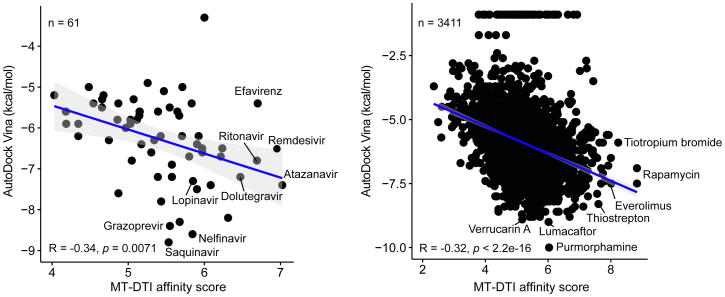
The infection of a novel coronavirus found in Wuhan of China (SARS-CoV-2) is rapidly spreading, and the incidence rate is increasing worldwide. Due to the lack of effective treatment options for SARS-CoV-2, various strategies are being tested in China, including drug repurposing. In this study, we used our pre-trained deep learning-based drug-target interaction model called Molecule Transformer-Drug Target Interaction (MT-DTI) to identify commercially available drugs that could act on viral proteins of SARS-CoV-2. The result showed that atazanavir, an antiretroviral medication used to treat and prevent the human immunodeficiency virus (HIV), is the best chemical compound, showing an inhibitory potency with Kd of 94.94 nM against the SARS-CoV-2 3C-like proteinase, followed by remdesivir (113.13 nM), efavirenz (199.17 nM), ritonavir (204.05 nM), and dolutegravir (336.91 nM). Interestingly, lopinavir, ritonavir, and darunavir are all designed to target viral proteinases. However, in our prediction, they may also bind to the replication complex components of SARS-CoV-2 with an inhibitory potency with Kd < 1000 nM. In addition, we also found that several antiviral agents, such as Kaletra (lopinavir/ritonavir), could be used for the treatment of SARS-CoV-2. Overall, we suggest that the list of antiviral drugs identified by the MT-DTI model should be considered, when establishing effective treatment strategies for SARS-CoV-2.
Keywords: Atazanavir; COVID-19; Coronavirus; Deep learning; Drug repurposing; MT-DTI; SARS-CoV-2.
© 2020 The Authors.
Conflict of interest statement
Beck B.R., Choi Y., and Park S. are employed by company Deargen Inc. Shin B. is employed by Deargen Inc as a part-time advisor. Kang K. is one of the co-founders of, and a shareholder in, Deargen Inc.
Figures
References
-
- Cavanagh D. Coronavirus avian infectious bronchitis virus. Vet Res. 2007;38:281–297. - PubMed
LinkOut - more resources
Full Text Sources
Other Literature Sources
Miscellaneous