


Features and outcome of AIH patients without elevation of IgG
- PMID: 32280942
- PMCID: PMC7139106
- DOI: 10.1016/j.jhepr.2020.100094
Features and outcome of AIH patients without elevation of IgG
Abstract
Background & aims: High IgG levels are considered a hallmark of autoimmune hepatitis (AIH). A subgroup of patients with AIH has IgG within the normal range despite evidence of clinical disease activity. The clinical significance of this biomarker has not been explored.
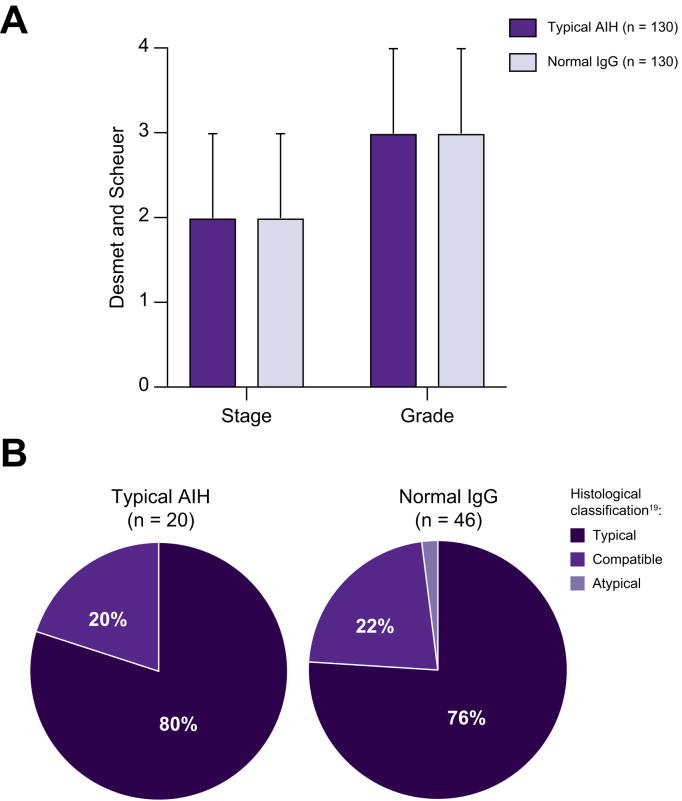
Methods: In a European multicentre study we compared biochemical, clinical and histological features from patients with AIH and normal IgG-values at diagnosis to an age- and sex-matched control group of patients with typical AIH presenting with elevated IgG. Data were assessed at diagnosis, after 12 months of therapy and at last follow-up.
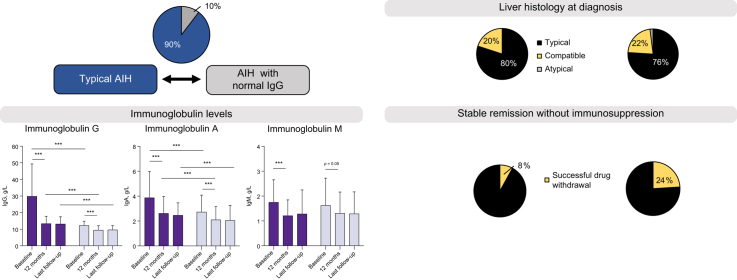
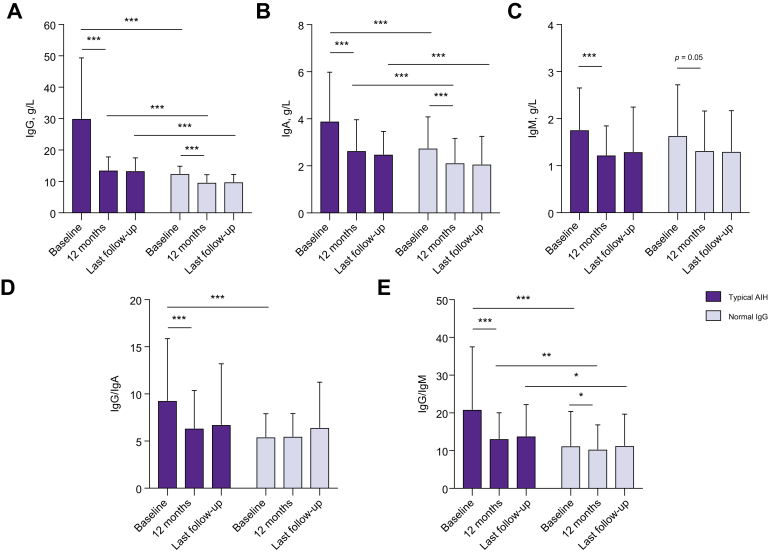
Results: Out of 1,318 patients with AIH, 130 (10%) had normal IgG at presentation. Histological and biochemical parameters at diagnosis, as well as treatment response, showed no difference between groups. Stable remission off treatment was achieved more commonly in the normal IgG group than in the typical AIH group (24 vs. 8%; p = 0.0012). Patients of the control group not only had higher IgG levels (29.5 ± 5.8 vs. 12.5 ± 3.2 g/L; p <0.0001), but also a higher IgG/IgA ratio (9.3 ± 6.9 vs. 5.4 ± 2.4; p <0.0001) at diagnosis. The IgG/IgA ratio only declined in patients with typical AIH and was no longer different between groups after 12 months (6.3 ± 4.3 vs. 5.5 ± 2.2; p = 0.1), indicating a selective increase of IgG in typical AIH and its suppression by immunosuppression. Autoantibody titres were higher in the typical AIH group, but not when controlled for IgG levels.
Conclusions: Compared to AIH with typical biochemical features, patients with normal IgG levels at diagnosis (i) show similar biochemical, serological and histological features and comparable treatment response, (ii) appear to lack the selective elevation of serum IgG levels observed in typical active AIH disease, (iii) may represent a subgroup with a higher chance of successful drug withdrawal.
Lay summary: A characteristic feature of autoimmune hepatitis (AIH) is an elevation of immunoglobulin G (IgG), which is therefore used as a major diagnostic criterion, as well as to monitor treatment response. Nevertheless, normal IgG does not preclude the diagnosis of AIH. Therefore, we herein assessed the features of patients with AIH and normal IgG in a large multicentre study. This study demonstrates that about 10% of all patients with AIH have normal IgG; these patients are indistinguishable from other patients with AIH with respect to biochemical markers, liver histology, disease severity and treatment response, but might represent a subgroup with a higher chance of remission after drug withdrawal.
Keywords: AIH, autoimmune hepatitis; ALP, alkaline phosphatase; ALT, alanine aminotransferase; AMA, anti-mitochondrial antibody; ANA, anti-nuclear antibody; AST, aspartate aminotransferase; Anti-SLA/LP, anti-soluble liver antigen and anti-liver-pancreas antibodies; INR, international normalized ratio; LKM, liver kidney microsomal antigen; SMA, smooth muscle antibody; autoimmune hepatitis; drug withdrawal; hypergammaglobulinemia; immunoglobulin G; immunoglobulins.
© 2020 Published by Elsevier B.V. on behalf of European Association for the Study of the Liver (EASL).
Conflict of interest statement
The authors declare no conflicts of interest that pertain to this work. Please refer to the accompanying ICMJE disclosure forms for further details.
Figures
References
-
- Krawitt E.L. Autoimmune hepatitis. N Engl J Med. 2006;354:54–66. - PubMed
-
- EASL clinical practice guidelines: autoimmune hepatitis. J Hepatol. 2015;63:971–1000. - PubMed
-
- Ngu J.H., Bechly K., Chapman B.A., Burt M.J., Barclay M.L., Gearry R.B. Population-based epidemiology study of autoimmune hepatitis: a disease of older women? J Gastroenterol Hepatol. 2010;25:1681–1686. - PubMed
-
- Van Gerven N.M.F., Verwer B.J., Witte B.I., van Erpecum K.J., van Buuren H.R., Maijers I. Epidemiology and clinical characteristics of autoimmune hepatitis in The Netherlands. Scand J Gastroenterol. 2014;49:1245–1254. - PubMed
-
- Cook G.C., Mulligan R., Sherlock S. Controlled prospective trial of corticosteroid therapy in active chronic hepatitis. Q J Med. 1971;40:159–185. - PubMed
LinkOut - more resources
Full Text Sources
Miscellaneous
