


doi: 10.1371/journal.pntd.0008184.
eCollection 2020 Apr.
The Strongyloides stercoralis-hookworms association as a path to the estimation of the global burden of strongyloidiasis: A systematic review
Affiliations
- PMID: 32282827
- PMCID: PMC7188296
- DOI: 10.1371/journal.pntd.0008184
Item in Clipboard
The Strongyloides stercoralis-hookworms association as a path to the estimation of the global burden of strongyloidiasis: A systematic review
PLoS Negl Trop Dis.
.
Abstract
PROSPERO (registration code CRD42019131127).
Conflict of interest statement
The authors have declared that no competing interests exist.
Figures
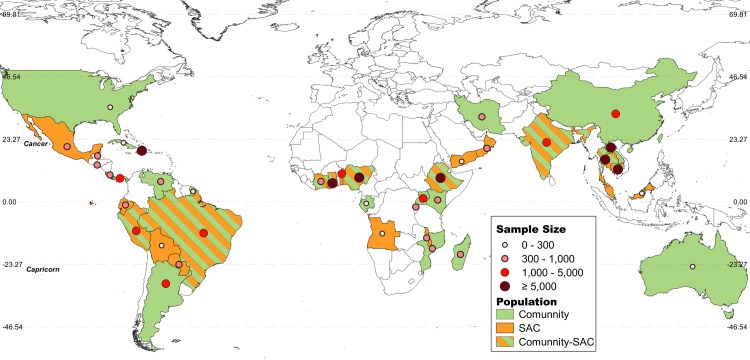
The size of each circle is proportional to the total number of surveyed individuals in each country. Countries are represented in green (community based surveys) or orange (school-aged children). Countries with both type of surveys are represented in green and orange bars.
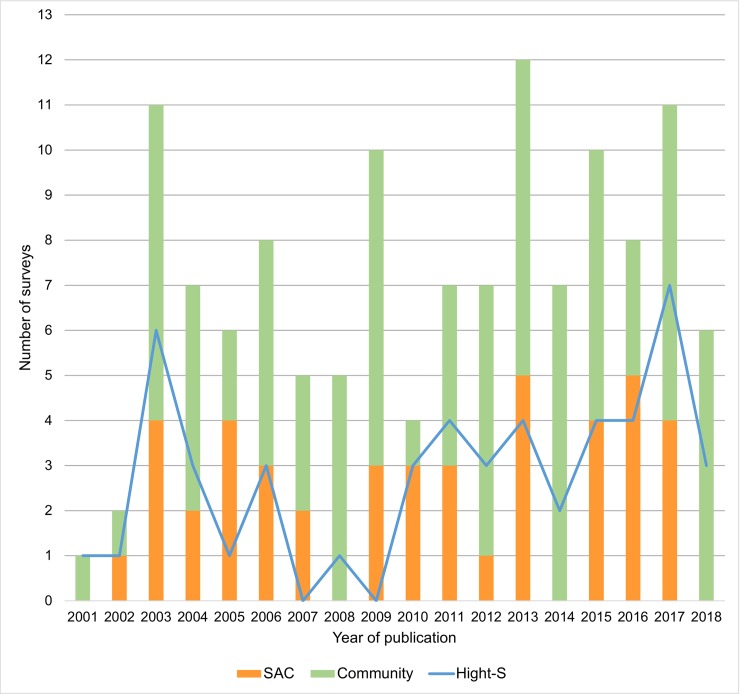
Orange bars represent the number of surveys in school-aged children (SAC) population. Green bars represent the number of surveys of the Community population. The blue line represents the total number of surveys with highly sensitive diagnostic methods (High-S).
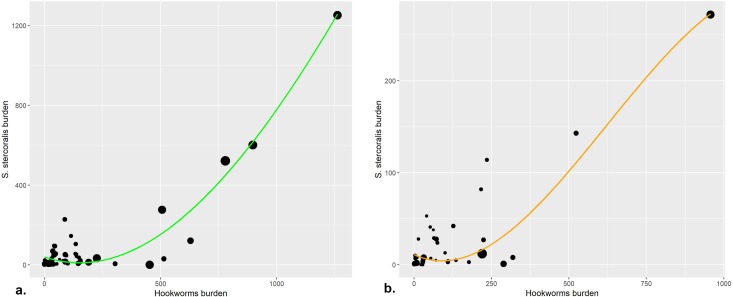
a. In black dots and green line all Community based surveys. b. In black dots and orange line: school-aged children (SAC) based surveys. The size of all dots is proportional to the sample size.
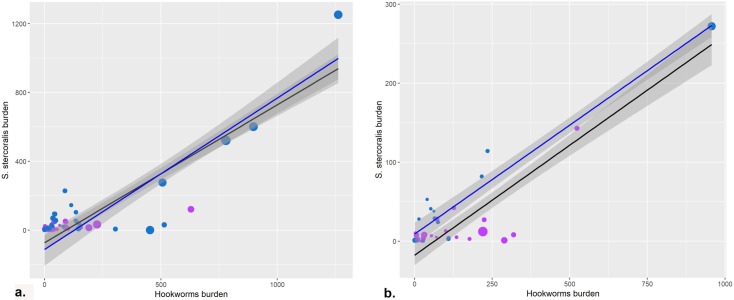
Blue dots represent surveys with high sensitivity diagnostic methods (Hight-S) and purple dots represent surveys with low sensitivity diagnostic methods (Low-S). a. Community surveys. The black line represents the curve of equation 1 (Table 1), for the linear regression of all surveys (Hight-S and Low-S) of the Community population. The blue line represents the curve of equation 2 (Table 1), for the linear regression of all surveys of the Community population with Hight-S. b. School-aged children (SAC) surveys. The black line represents the curve of equation 3 (Table 1), for the linear regression of all surveys (Hight-S and Low-S) of the SAC population. The blue line represents the curve of equation 4 (Table 1), for the linear regression of all surveys of the SAC population with Hight-S. Gray shading represents the 95% confidence interval.
References
-
- World Health Assembly, 54. (2001). Schistosomiasis and soil-transmitted helminth infections. World Health Organization; Available from: https://apps.who.int/iris/handle/10665/78794.
-
- WHO. Schistosomiasis and soil-transmittes helminthiases: numbers of people treated in 2017. Wkly Epidemiol Rec. 2018;50:681–92. Available from: https://www.who.int/neglected_diseases/resources/who_wer9350/en/ - PubMed
-
- WHO. 2030 targets for soil-transmitted helminthiases control programmes. World Health Organization. WHO; 2020. Available from: https://apps.who.int/iris/handle/10665/330611.
