Review
. 2020 Apr;10(2):102-108.
doi: 10.1016/j.jpha.2020.03.001. Epub 2020 Mar 5.

Molecular immune pathogenesis and diagnosis of COVID-19

Affiliations
Review

Molecular immune pathogenesis and diagnosis of COVID-19

Xiaowei Li et al. J Pharm Anal. 2020 Apr.

Abstract

Coronavirus disease 2019 (COVID-19) is a kind of viral pneumonia which is caused by severe acute respiratory syndrome coronavirus 2 (SARS-CoV-2). The emergence of SARS-CoV-2 has been marked as the third introduction of a highly pathogenic coronavirus into the human population after the severe acute respiratory syndrome coronavirus (SARS-CoV) and the Middle East respiratory syndrome coronavirus (MERS-CoV) in the twenty-first century. In this minireview, we provide a brief introduction of the general features of SARS-CoV-2 and discuss current knowledge of molecular immune pathogenesis, diagnosis and treatment of COVID-19 on the base of the present understanding of SARS-CoV and MERS-CoV infections, which may be helpful in offering novel insights and potential therapeutic targets for combating the SARS-CoV-2 infection.

Keywords: Coronavirus; MERS-CoV; Pathogenesis; SARS-CoV; SARS-CoV-2.


Conflict of interest statement

The authors declare that there are no conflicts of interest.

Figures
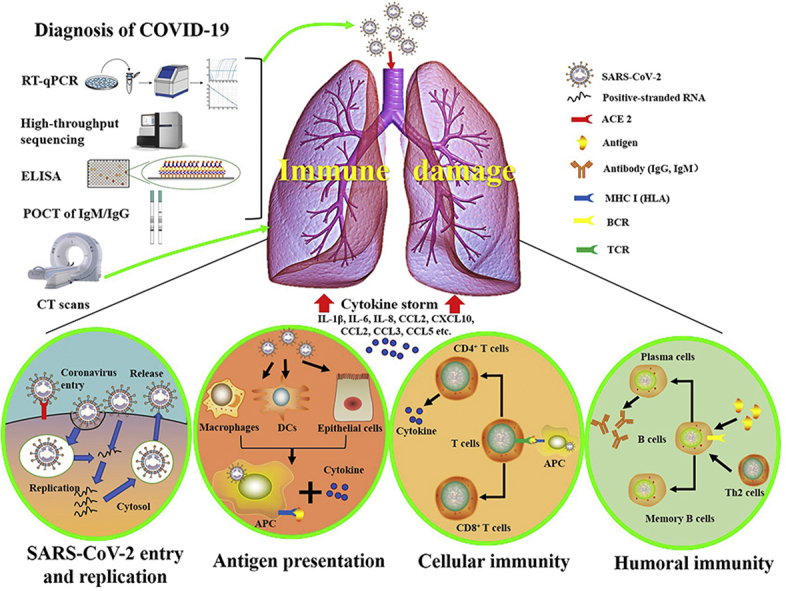
Image 1
Graphical abstract
Fig. 1
Fig. 1
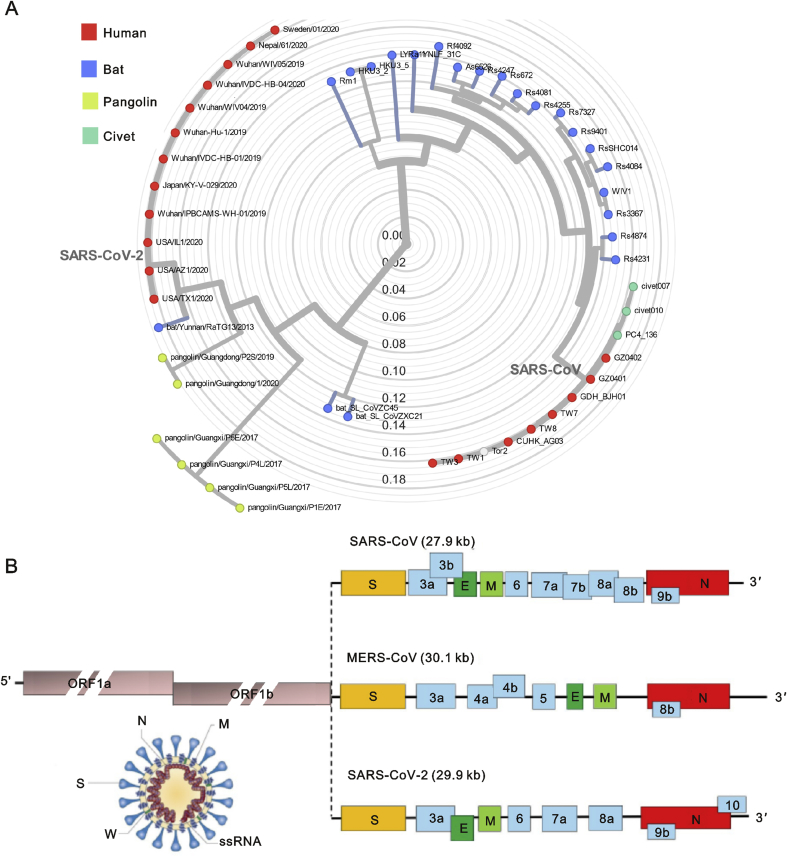
The phylogenetic tree of SARS-like coronaviruses complete genome sequences and genome of SARS-CoV, MERS-CoV and SARSCoV- 2. (A) This phylogeny shows evolution of SARS-like β-coronaviruses including samples from human (n = 20), bat (n = 22), civet (n = 3) and pangolin (n = 6). The phylogenetic tree of complete genome sequences of coronaviruses was obtained and analyzed with Nextstrain (https://github.com/blab/sars-like-cov). (B) Coronaviruses form enveloped and spherical particles of 100–160 nm in diameter. They contain a positivesense single stranded RNA (ssRNA) genome of 26–32 kb in size. In SARS-CoV, MERS-CoV and SARS-CoV-2, the 5′-terminal two-thirds of the genome ORF1a/b encodes polyproteins, which form the viral replicase transcriptase complex. The other ORFs on the one-third of the genome encode four main structural proteins: spike (S), envelope (E), nucleocapsid (N) and membrane (M) proteins, as well as several accessory proteins.

References

    1. Zhou P., Yang X.L., Wang X.G. A pneumonia outbreak associated with a new coronavirus of probable bat origin. Nature. 2020 doi: 10.1038/s41586-020-2012-7. - DOI - PMC - PubMed
    1. de Wit E., van Doremalen N., Falzarano D. SARS and MERS: recent insights into emerging coronaviruses. Nat. Rev. Microbiol. 2016;14:523–534. doi: 10.1038/nrmicro.2016.81. - DOI - PMC - PubMed
    1. Wu J.T., Leung K., Leung G.M. Nowcasting and forecasting the potential domestic and international spread of the 2019-nCoV outbreak originating in Wuhan, China: a modelling study. Lancet. 2020 doi: 10.1016/S0140-6736(20)30260-9. - DOI - PMC - PubMed
    1. Su S., Wong G., Shi W. Epidemiology, Genetic recombination, and pathogenesis of coronaviruses. Trends Microbiol. 2016;24:490–502. doi: 10.1016/j.tim.2016.03.003. - DOI - PMC - PubMed
    1. Perlman S. J. Netland Coronaviruses post-SARS: update on replication and pathogenesis. Nat. Rev. Microbiol. 2009;7:439–450. doi: 10.1038/nrmicro2147. - DOI - PMC - PubMed