


Molecular subtype, biological sex and age shape melanoma tumour evolution
- PMID: 32282938
- PMCID: PMC7613609
- DOI: 10.1111/bjd.19128
Molecular subtype, biological sex and age shape melanoma tumour evolution
Abstract
Background: Many cancer types display sex and age disparity in incidence and outcome. The mutational load of tumours, including melanoma, varies according to sex and age. However, there are no tools to explore systematically whether clinical variables such as age and sex determine the genomic landscape of cancer.
Objectives: To establish a mathematical approach using melanoma mutational data to analyse how sex and age shape the tumour genome.
Methods: We model how age-related (clock-like) somatic mutations that arise during cell division, and extrinsic (environmental ultraviolet radiation) mutations accumulate in cancer genomes.
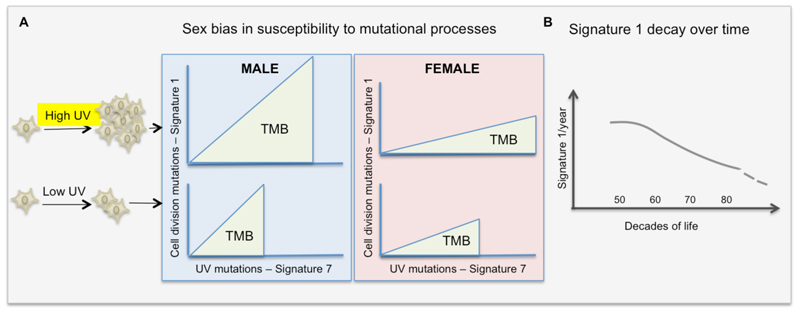
Results: Melanoma is driven primarily by cell-intrinsic age-related mutations and extrinsic ultraviolet radiation-induced mutations, and we show that these mutation types differ in magnitude and chronology and by sex in the distinct molecular melanoma subtypes. Our model confirms that age and sex are determinants of cellular mutation rate, shaping the final mutation composition. We show mathematically for the first time how, similarly to noncancer tissues, melanoma genomes reflect a decline in cell division during ageing. We find that clock-like mutations strongly correlate with the acquisition of ultraviolet-induced mutations, but critically, men present a higher number and rate of cell-division-linked mutations.
Conclusions: These data indicate that the contribution of environmental damage to melanoma likely extends beyond genetic damage to affect cell division. Sex and age determine the final mutational composition of melanoma.
© 2020 The Authors. British Journal of Dermatology published by John Wiley & Sons Ltd on behalf of British Association of Dermatologists.
Conflict of interest statement
The authors declare that they have no competing interests
Figures


Comment in
-
The influence of sex, age and sunlight exposure on mutational processes in melanoma.Br J Dermatol. 2021 Feb;184(2):197-198. doi: 10.1111/bjd.19336. Epub 2020 Dec 28. Br J Dermatol. 2021. PMID: 33372289 No abstract available.
References
-
- Cavanaugh-Hussey MW, Mu EW, Kang S, Balch CM, Wang T. Older Age is Associated with a Higher Incidence of Melanoma Death but a Lower Incidence of Sentinel Lymph Node Metastasis in the SEER Databases (2003–2011) [cited 2018 Nov 14];Ann Surg Oncol. 2015 Jul 5;22(7):2120–6. - PubMed
-
- Li CH, Haider S, Shiah YJ, Thai K, Boutros PC. Sex differences in cancer driver genes and biomarkers. Cancer Res. 2018;78(19):5527–37. - PubMed
Publication types
MeSH terms
Grants and funding
LinkOut - more resources
Full Text Sources
Medical
