. 2020 Dec;20(12):3558-3566.
doi: 10.1111/ajt.15912. Epub 2020 May 3.

Introducing a novel experimental model of bladder transplantation in mice

Affiliations

Introducing a novel experimental model of bladder transplantation in mice

Jun Wang et al. Am J Transplant. 2020 Dec.

Abstract

Bladder dysfunction is a common clinical problem attributed to various conditions such as posterior urethral valves, neurogenic bladder, ureteral ectopy, or bladder exstrophy. Currently, the main therapeutic option for these dysfunctions is neobladder reconstruction with gastrointestinal tract segments. However, the latter was associated with significant long-term complications. To provide a new candidate of possible surgical solution for bladder dysfunction, we propose a novel orthotropic mouse bladder transplantation model. The donor bladder with abdominal aorta and inferior vena cava was isolated and orthotopically sutured to the recipient, whose bladder above the ureteral opening level was removed. The recipient mice showed more than 80% 6-month survival rate and comparable body weight to control mice. At both 1 month and 6 months posttransplant, the urine voiding behavior of recipient mice and control mice was monitored by cystometry. We found that the recipient mice displayed similar bladder pressure and urine secretion ability compared to control mice especially at 6 months posttransplant. Similarity of bladder structure between recipient and control mice was confirmed by histology. As a proof of principle, we tested our model in an allogeneic setting. Early acute rejection was noted after day 5 that was histologically more profound by day 10 posttransplant. These results indicate that the mouse bladder transplant is able to provide normal bladder function.

Keywords: animal models; basic (laboratory) research/science; organ transplantation in general; surgical technique; tissue/organ engineering; tolerance; urology; vascularized composite and reconstructive transplantation.


Figures

FIGURE 1
FIGURE 1
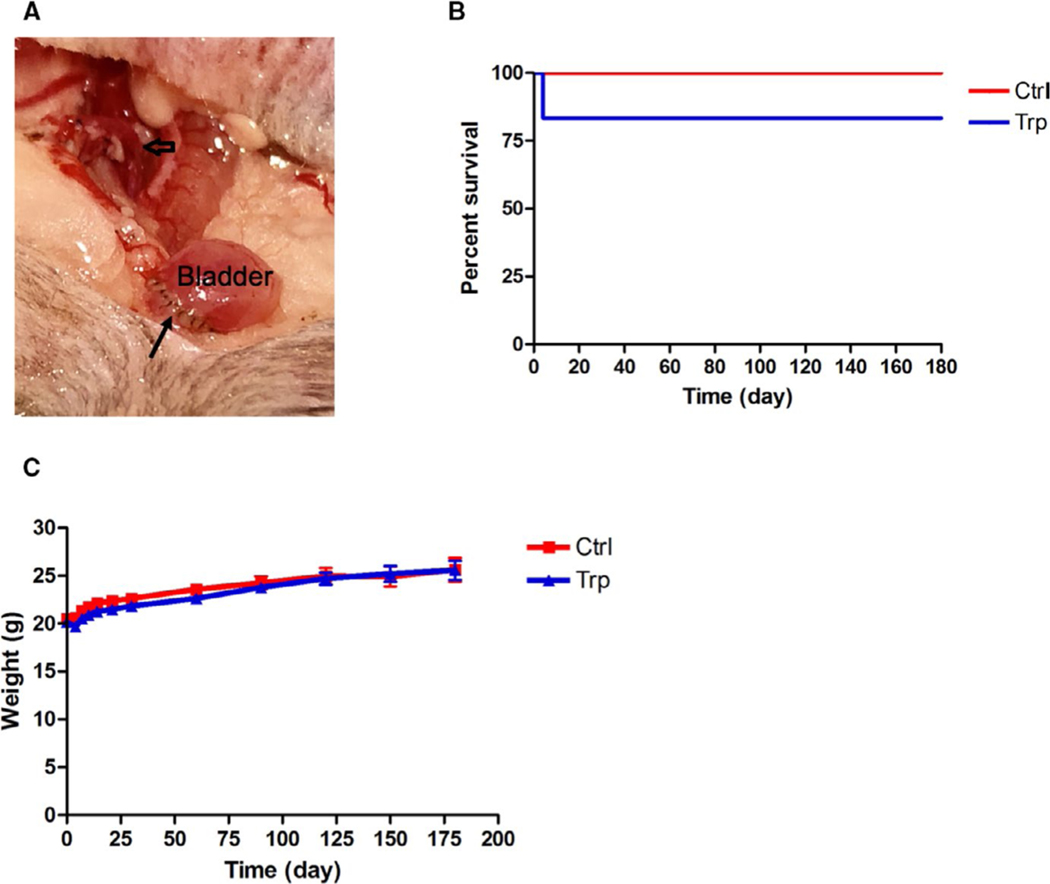
Mice with bladder transplantation survive with normal body weight. A, The donor bladder with aorta and inferior vena cava (IVC) was isolated, and the bladder above the ureteral opening level of recipient was removed without damage of the recipient’s urethra and ureters. Then the donor aorta and IVC were anastomosed to the recipient abdominal aorta and IVC. After that, donor bladder was sutured to the recipient with 11–0 running suture. The suture site is indicated by the black arrow. Black arrowhead shows the end-to-side vascular anastomoses. B, The 6-mo survival curve of Ctrl mice and Trp mice. C, The body weight of Ctrl mice and Trp mice before and after transplantation. Crtl, control; Trp, bladder transplantation
FIGURE 2
FIGURE 2
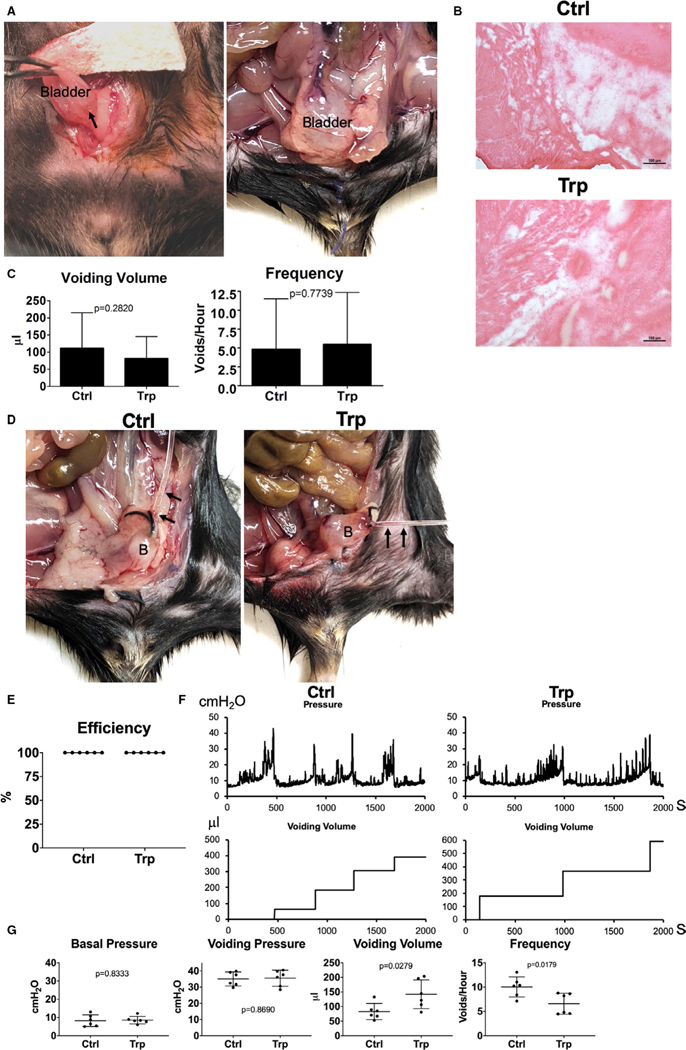
Trp mice showed comparable bladder functions as Ctrl mice at 1 mo posttransplant. A, At 1 mo post bladder transplantation, the bladders of two different recipient mice were exposed and shown. The suture site is indicated by the black arrow. B, One Ctrl mouse and one Trp mouse were euthanized at 1 mo post bladder transplantation, and the bladders were collected for 15 μm frozen section. The sections underwent hematoxylin and eosin (H&E) staining. The black bar marks 100 μm. C, At 1 mo posttransplant, the Ctrl mouse or Trp mouse were put into a metabolic cage and supplied with water and food. The urine voided was automatically collected and recorded for overnight. The voiding volume and voiding frequency of each group were summarized based on 20 voiding cycles from 2 different mice. Error bars indicate SD. D, A catheter was inserted into the bladder of either Ctrl mouse or Trp mouse and fixed with suture at 1 mo posttransplant. The “B” labels bladder and the black arrows point to the inserted catheter. E, Saline was infused into the bladders of either Ctrl mice or Trp mice through the catheter inserted in the cystometry machine. After final urine voiding, the infusion of saline was immediately stopped and residual saline was sucked out from the catheter. The bladder voiding efficiency was calculated as voiding volume/(voiding volume + residual saline). F, Saline was infused into the bladders of either Ctrl mice or Trp mice through the catheter inserted in the cystometry machine. The voiding volume and bladder pressure was automatically recorded by the machine and the representative data plots within 2000s are shown here. G, was the quantified results from (F) based on 5 voiding cycles from each mice. The basal pressure is the lowest bladder pressure between two voids, the voiding pressure is the highest pressure near voiding event. Error bars indicate SD. Each data point represents one mouse, and data were analyzed by an unpaired two-tailed t test. Crtl, control; Trp, bladder transplantation
FIGURE 3
FIGURE 3
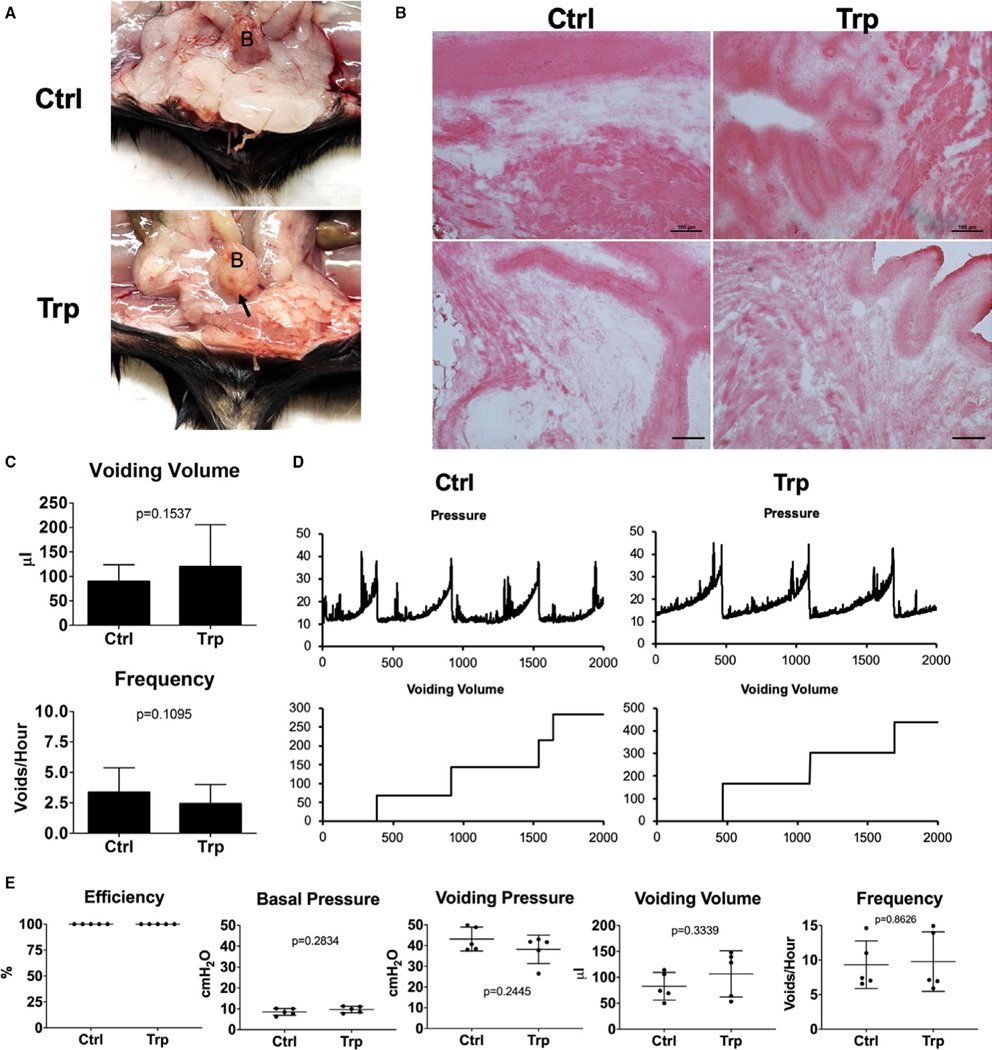
Trp mice showed the same bladder functions as Ctrl mice at 6 mo posttransplant. A, At 6 mo post bladder transplantation, the bladder of the Ctrl or Trp mouse were exposed and shown. The suture site is indicated by the black arrow. B, Two Ctrl mice and two Trp mice were euthanized at 6 mo post bladder transplantation, and the bladders were collected for 15 μm frozen section. The sections underwent hematoxylin and eosin (H&E) staining. The black bar marked 100 μm. C, At 6 mo posttransplant, the Ctrl mouse or Trp mouse were put into a metabolic cage and supplied with water and food. The urine voided was automatically collected and recorded for overnight. The voiding volume and voiding frequency of each group were summarized based on 20 voiding cycles from 3 different mice. Error bars indicate SD. D, A catheter was inserted into the bladder of either Ctrl mouse or Trp mouse and fixed with suture at 6 mo posttransplant. Two weeks after the catheter insertion, was infused into the bladders of either Ctrl mice or Trp mice through the catheter in the cystometry machine. The voiding volume and bladder pressure was automatically recorded by the machine and the representative data plots within 2000s are shown here. E, showed the bladder voiding efficiency and the quantified results from (D) based on 5 voiding cycles from each mice. Error bars indicate SD. Each data point represents one mouse, and data were analyzed by an unpaired two-tailed t test. Crtl, control; Trp, bladder transplantation
FIGURE 4
FIGURE 4
B6 mice receiving bladders from BALB/cJ mice had little changes in body weight but severe bladder tissue damage. A, Immediately after bladder transplantation (D0) or 7 days after transplantation (D7), the bladder was exposed and shown. The suture site is indicated by the black arrow. B, Body weight of each recipient mice was tracked every day from about 15 h after transplantation (day 1) till euthanasia. One data series represents one mouse. C, Body weight of each recipient mice as a percentage of the weight at day 1 was shown. One data series represents one mouse. D, After euthanasia, the bladders of each mice were collected for 15 μm frozen section. The sections underwent hematoxylin and eosin (H&E) staining. Representative pictures from day 5 and day 10 were shown

Comment in

References

    1. Roth JD, Cain MP. Neuropathic bladder and augmentation cystoplasty. Urol Clin North Am. 2018;45(4):571–585. - PubMed
    1. Cetinel B, Kocjancic E, Demirdag C. Augmentation cystoplasty in neurogenic bladder. Investig Clin Urol. 2016;57(5): 316–323. - PMC - PubMed
    1. Wu J, Miao Y, Abraham SN. The multiple antibacterial activities of the bladder epithelium. Ann Transl Med. 2017;5(2):35. - PMC - PubMed
    1. Krajewski W, Piszczek R, Krajewska M, Dembowski J, Zdrojowy R. Urinary diversion metabolic complications - underestimated problem. Adv Clin Exp Med. 2014;23(4):633–638. - PubMed
    1. Gerharz EW, Turner WH, Kalble T, Woodhouse CR. Metabolic and functional consequences of urinary reconstruction with bowel. BJU Int. 2003;91(2):143–149. - PubMed

Publication types