Review
. 2020 Jun;145(6):1535-1544.
doi: 10.1016/j.jaci.2020.02.038. Epub 2020 Apr 10.

The role of neutrophils in host defense and disease

Affiliations
Review

The role of neutrophils in host defense and disease

Heather K Lehman et al. J Allergy Clin Immunol. 2020 Jun.

Abstract

Neutrophils, the most abundant circulating leukocyte, are critical for host defense. Granulopoiesis is under the control of transcriptional factors and culminates in mature neutrophils with a broad armamentarium of antimicrobial pathways. These pathways include nicotinamide adenine dinucleotide phosphate oxidase, which generates microbicidal reactive oxidants, and nonoxidant pathways that target microbes through several mechanisms. Activated neutrophils can cause or worsen tissue injury, underscoring the need for calibration of activation and resolution of inflammation when infection has been cleared. Acquired neutrophil disorders are typically caused by cytotoxic chemotherapy or immunosuppressive agents. Primary neutrophil disorders typically result from disabling mutations of individual genes that result in impaired neutrophil number or function, and provide insight into basic mechanisms of neutrophil biology. Neutrophils can also be activated by noninfectious causes, including trauma and cellular injury, and can have off-target effects in which pathways that typically defend against infection exacerbate injury and disease. These off-target effects include acute organ injury, autoimmunity, and variable effects on the tumor microenvironment that can limit or worsen tumor progression. A greater understanding of neutrophil plasticity in these conditions is likely to pave the way to new therapeutic approaches.

Keywords: Neutrophils; degranulation; granulopoiesis; innate immunity; neutrophil dysfunction; neutrophil extracellular traps; phagocytosis.


Conflict of interest statement

Disclosure of potential conflict of interest: H. Lehman has received research contracts from Kedrion S.p.A., Leadiant Biosciences, and Takeda Ltd. B.H. Segal has served on a Data Review Committee for a Merck-sponsored clinical trial.

Figures
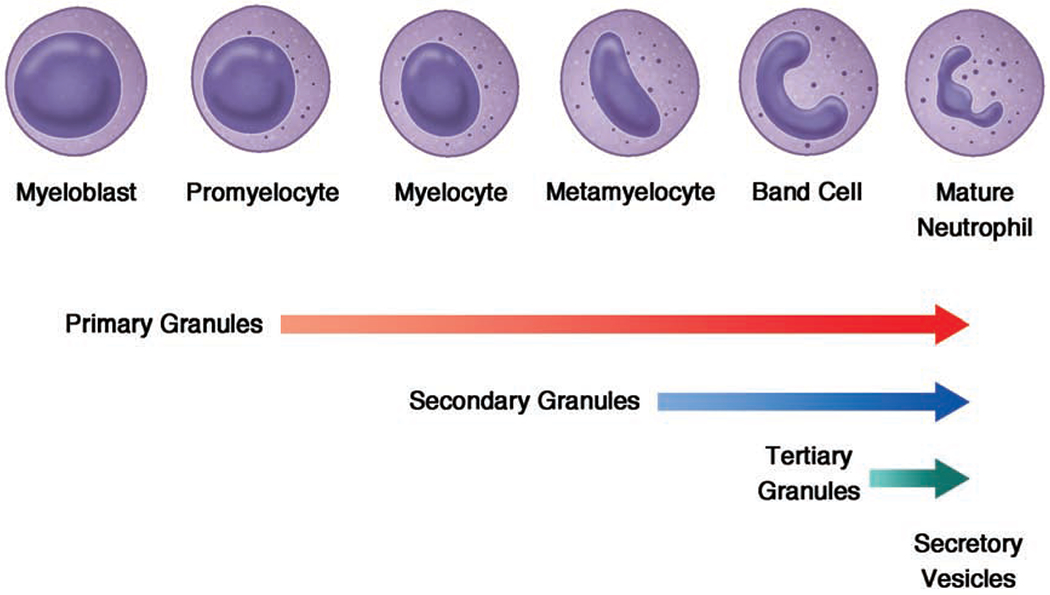
Figure 1:
Figure 1:
Neutrophil development and granule formation. Myeloblasts are the first committed precursor cells of the neutrophil lineage. These differentiate into promyelocytes followed by myelocytes. These cells then proceed through maturation steps of metamyelocytes, band cells, and mature segmented neutrophils. As neutrophils mature, they develop granules which play a key role in neutrophil microbicidal activity. Primary (azurophilic) granules develop as neutrophils are differentiating from myeloblasts to promyelocytes. Secondary (specific) granules form in myelocytes and metamyelocytes. Tertiary (gelatinase) granules first appear in band cells. Secretory vesicles are small, easily exocytosed organelles, which are present only in mature, segmented neutrophils.
Figure 2:
Figure 2:
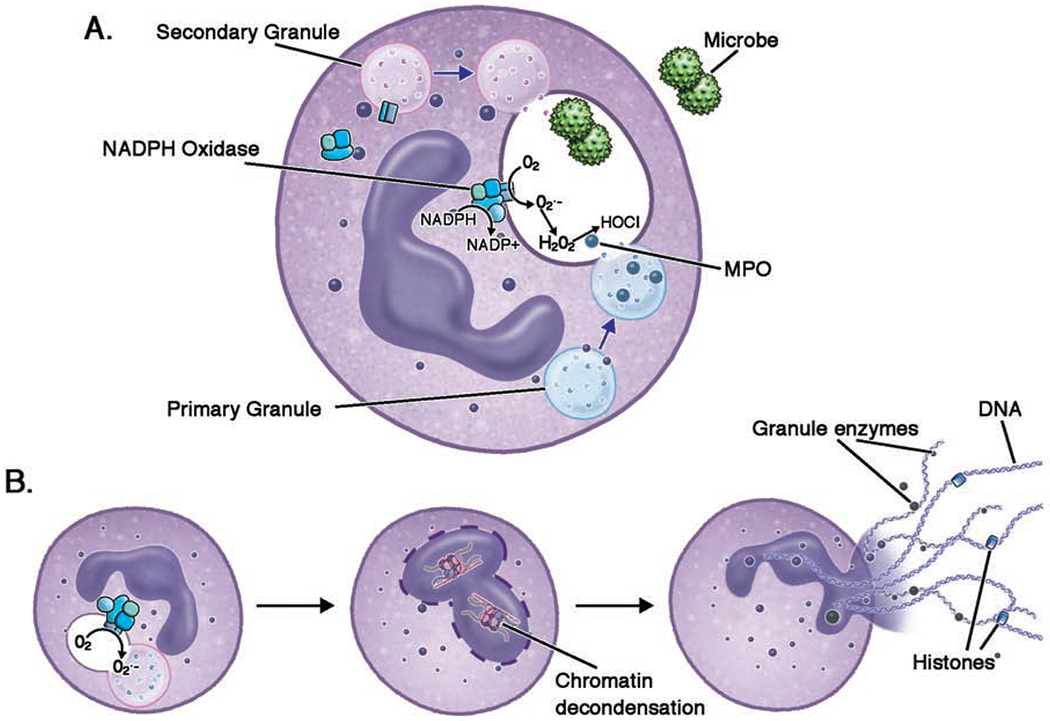
Neutrophil microbicidal activities; a.) Following phagocytosis of microbes, fusion of neutrophil granules with the phagosome introduces antimicrobial granule contents into the phagosome. Non-azurophilic granules transport the membrane bound components of the NADPH oxidase into the phagosome, where they assemble with cytoplasmic components. The assembled NADPH oxidase transfers an electron from cytosolic NADPH to oxygen, forming O2. O2 is converted into H2O2, and MPO combines H2O2 with Cl to form HOCl. b.) NETs are large, extracellular webs of microbicidal cytosolic and granule proteins assembled on a scaffold of decondensed chromatin or mitochondrial DNA (not shown). NET formation may be initiated by a variety of pathogenic triggers. In classic NADPH oxidase-dependent NETotic cell death, ROS trigger MPO to activate and translocate of NE from azurophilic granules to the nucleus, where NE disrupts chromatin packaging. MPO also works synergistically with NE in decondensing chromatin. Two nuclear enzymes are important in chromatin decondensation; DEK, a DNA-binding protein, and PAD4, which citrullinates histone arginine residues. (H2O2: hydrogen peroxide; HOCl: hypochlorous acid; MPO: myeloperoxidase; NADPH: nicotinamide adenine dinucleotide phosphate; NE: neutrophil elastase; NET: neutrophil extracellular trap; O2•−: superoxide; PAD4: protein-arginine deiminase type 4; ROS: reactive oxygen species)

References

    1. Bainton DF, Ullyot JL, Farquhar MG. The development of neutrophilic polymorphonuclear leukocytes in human bone marrow. J Exp Med 1971; 134(4): 907–34. - PMC - PubMed
    1. Mora-Jensen H, Jendholm J, Fossum A, Porse B, Borregaard N, Theilgaard-Monch K. Technical advance: immunophenotypical characterization of human neutrophil differentiation. J Leukoc Biol 2011; 90(3): 629–34. - PubMed
    1. Wengner AM, Pitchford SC, Furze RC, Rankin SM. The coordinated action of G-CSF and ELR + CXC chemokines in neutrophil mobilization during acute inflammation. Blood 2008; 111(1): 42–9. - PMC - PubMed
    1. Dancey JT, Deubelbeiss KA, Harker LA, Finch CA. Neutrophil kinetics in man. J Clin Invest 1976; 58(3): 705–15. - PMC - PubMed
    1. Summers C, Rankin SM, Condliffe AM, Singh N, Peters AM, Chilvers ER. Neutrophil kinetics in health and disease. Trends Immunol 2010; 31(8): 318–24. - PMC - PubMed

Publication types