Review
. 2020 Apr 9;21(7):2605.
doi: 10.3390/ijms21072605.

Anti-Inflammatory Drugs as Anticancer Agents

Affiliations
Review

Anti-Inflammatory Drugs as Anticancer Agents

Silvia Zappavigna et al. Int J Mol Sci. .

Abstract

Inflammation is strictly associated with cancer and plays a key role in tumor development and progression. Several epidemiological studies have demonstrated that inflammation can predispose to tumors, therefore targeting inflammation and the molecules involved in the inflammatory process could represent a good strategy for cancer prevention and therapy. In the past, several clinical studies have demonstrated that many anti-inflammatory agents, including non-steroidal anti-inflammatory drugs (NSAIDs), are able to interfere with the tumor microenvironment by reducing cell migration and increasing apoptosis and chemo-sensitivity. This review focuses on the link between inflammation and cancer by describing the anti-inflammatory agents used in cancer therapy, and their mechanisms of action, emphasizing the use of novel anti-inflammatory agents with significant anticancer activity.

Keywords: 5-LOX inhibitors; COX-2 inhibitors; NSAIDs; cancer; embelin; inflammation-associated cancer.


Conflict of interest statement

The authors declare no conflict of interest.

Figures
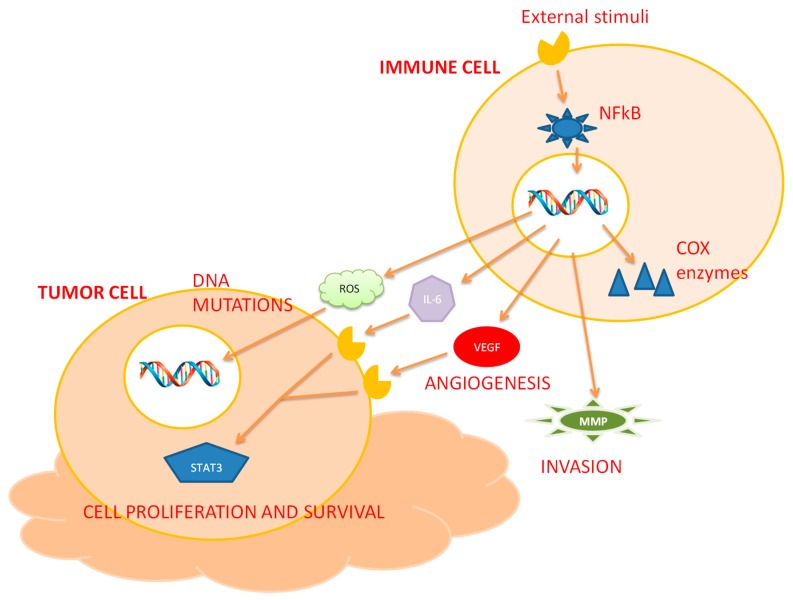
Figure 1
Figure 1
Inflammation and cancer. Various inflammatory and carcinogenic agents can activate the transcription factor NFkB. Once activated, it binds to specific DNA sequences in the nucleus and induces the production of pro-inflammatory cytokines and COX enzymes. Activated immune cells produce specific cytokines (IL-6, VEGF, etc.) and metalloproteinases (MMP-2 and MMP-9). IL-6 and growth factors can induce STAT3 activation by leading to cell proliferation and survival while metalloproteases degrade the membrane basement, promoting cell invasion. Moreover, macrophages secrete a great amount of reactive oxygen species (ROS) and mutagenic agents against microbial agents that induce a persistent tissue damage and cause DNA alterations by contributing to tumorigenesis.
Figure 2
Figure 2
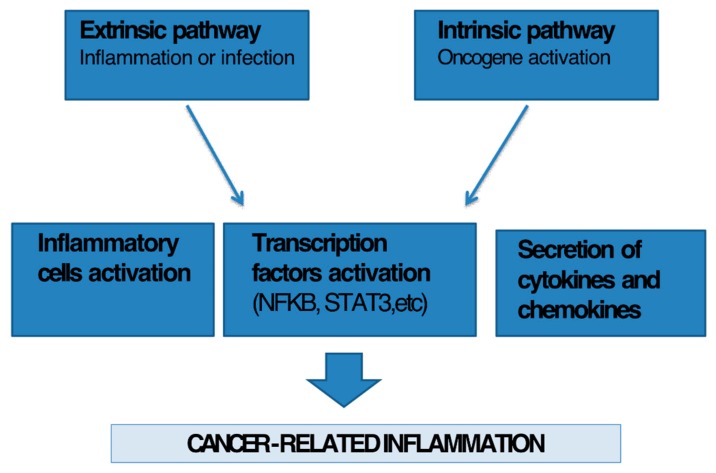
Link between inflammation and cancer. There are two pathways that link inflammation and cancer: extrinsic and intrinsic. The first is activated by inflammatory stimuli, the second by genetic alterations. These pathways are interconnected by the secretion of inflammatory cytokines that activate specific transcription factors (NFKB, STAT3, etc.) and lead to the secretion of inflammatory mediators including growth factors, metalloproteases that contribute to the development of inflammatory tumor microenvironment.
Figure 3
Figure 3
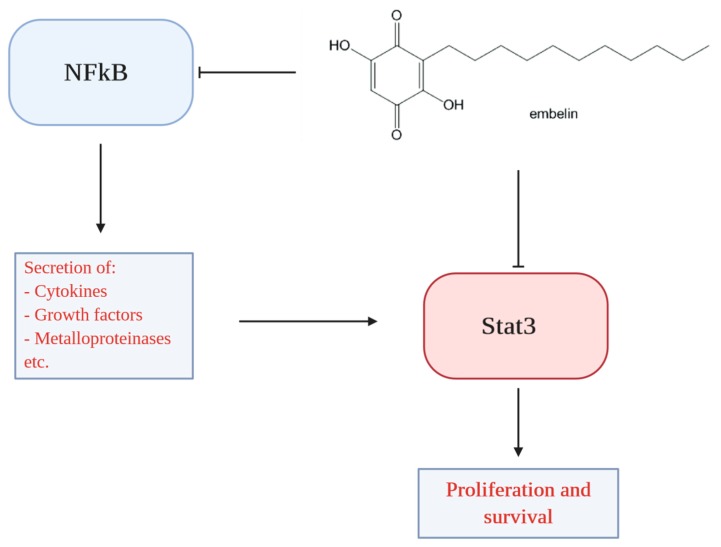
Anticancer effects of embelin. The potent antitumor activity of embelin is linked to various mechanisms, including inhibition of NF-κB and inhibition of STAT3.

References

    1. Balkwill F., Mantovani A. Inflammation and cancer: Back to Virchow? Lancet. 2001;357:539–545. doi: 10.1016/S0140-6736(00)04046-0. - DOI - PubMed
    1. Philip M., Rowley D.A., Schreiber H. Inflammation as a tumor promoter in cancer induction. Semin. Cancer Biol. 2004;14:433–439. doi: 10.1016/j.semcancer.2004.06.006. - DOI - PubMed
    1. Rayburn E.R., Ezell S.J., Zhang R. Anti-inflammatory agents for cancer therapy. Mol. Cell Pharm. 2009;1:29–43. doi: 10.4255/mcpharmacol.09.05. - DOI - PMC - PubMed
    1. Hoepelman A. In: Inflammation. Basic Principles and Clinical Correlates. 3rd ed. Gallin J.I., Snyderman R., editors. Volume 58. Lippincott Williams & Wilkins Publishers; Philadelphia, PA, USA: 2001. p. 1335. - DOI
    1. Hanahan D., Weinberg R.A. The hallmarks of cancer. Cell. 2000;100:57–70. doi: 10.1016/S0092-8674(00)81683-9. - DOI - PubMed

MeSH terms