. 2020 Dec;9(1):813-816.
doi: 10.1080/22221751.2020.1754136.

Trends in prevalence and incidence of scabies from 1990 to 2017: findings from the global Burden of disease study 2017

Affiliations

Trends in prevalence and incidence of scabies from 1990 to 2017: findings from the global Burden of disease study 2017

Wei Zhang et al. Emerg Microbes Infect. 2020 Dec.

Abstract

Scabies remains a significant public health concern globally, affecting people of all ages, races, and socioeconomic groups. The epidemic characteristics of scabies are yet unravelled, especially in high-income countries and elderly population. In this study, we sought to investigate incidence and prevalence and their trends of scabies worldwide from 1990 to 2017 via the Global Burden of Disease (GBD) Study 2017. The prevalence and incidence of scabies tend to a moderate increase after age 70. The annual percentage change in ASR of scabies prevalence and incidence increased in high SDI countries and High-income North America. Current prevention strategies should be reoriented, and much more targeted strategies should be established in some populations to forestall the increase in scabies.

Keywords: Scabies; global burden of disease; incidence; prevalence; trend analysis.


Conflict of interest statement

No potential conflict of interest was reported by the author(s).

Figures
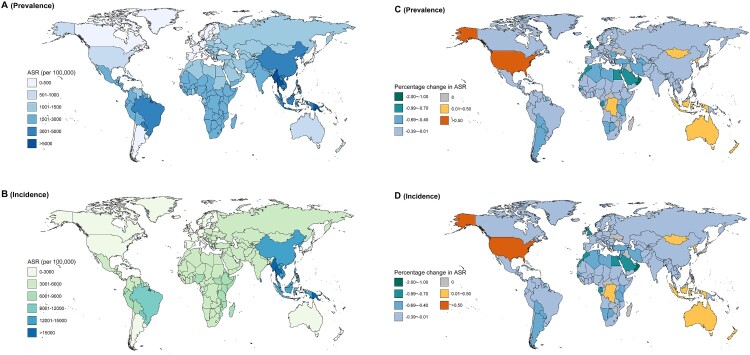
Figure 1.
Figure 1.
The global distribution of age standardized rate (ASR) and the corresponding annual percentage change (APC) of scabies prevalence and incidence for both sexes. (A) The ASR of scabies prevalence in 2017; (B) The ASR of scabies incidence in 2017; (C) The APC in ASR of scabies prevalence from 1990 to 2017; (D) The APC in ASR of scabies incidence from 1990 to 2017.
Figure 2.
Figure 2.
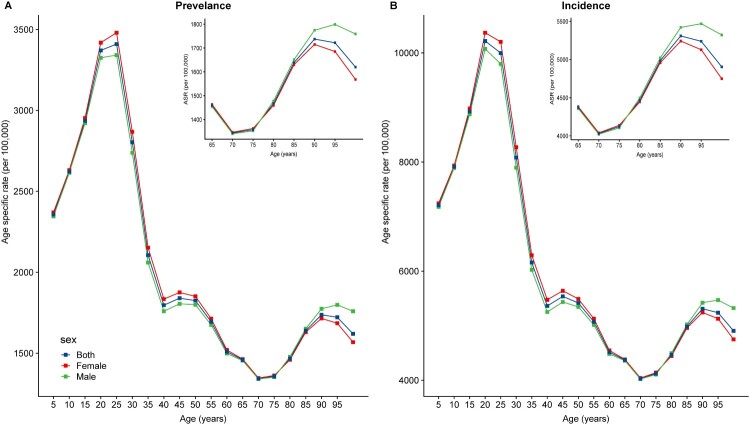
The global age specific rate of scabies prevalence (A) and incidence (B) for both sexes in 2017.

References

    1. Chang AY, Fuller LC.. Scabies-an ancient disease with unanswered questions in Modern Times. JAMA Dermatol. 2018;154(9):999–1000. doi: 10.1001/jamadermatol.2018.1891 - DOI - PubMed
    1. Engelman D, Cantey PT, Marks M, et al. The public health control of scabies: priorities for research and action. Lancet. 2019;394(10192):81–92. doi: 10.1016/S0140-6736(19)31136-5 - DOI - PMC - PubMed
    1. Romani L, Steer AC, Whitfeld MJ, et al. Prevalence of scabies and impetigo worldwide: a systematic review. Lancet Infect Dis. 2015;15(8):960–967. doi: 10.1016/S1473-3099(15)00132-2 - DOI - PubMed
    1. Karimkhani C, Colombara DV, Drucker AM, et al. The global burden of scabies: a cross-sectional analysis from the global Burden of disease study 2015. Lancet Infect Dis. 2017;17(12):1247–1254. doi: 10.1016/S1473-3099(17)30483-8 - DOI - PMC - PubMed
    1. Cassell JA, Middleton J, Nalabanda A, et al. Scabies outbreaks in ten care homes for elderly people: a prospectivè study of clinical features, epidemiology, and treatment outcomes. Lancet Infect Dis. 2018;18(8):894–902. doi: 10.1016/S1473-3099(18)30347-5 - DOI - PMC - PubMed

MeSH terms