. 2020 Jan 10;11(1):48.
doi: 10.3390/insects11010048.

Feeding Behavior of Asian Citrus Psyllid [ Diaphorina citri (Hemiptera: Liviidae)] Nymphs and Adults on Common Weeds Occurring in Cultivated Citrus Described Using Electrical Penetration Graph Recordings

Affiliations

Feeding Behavior of Asian Citrus Psyllid [ Diaphorina citri (Hemiptera: Liviidae)] Nymphs and Adults on Common Weeds Occurring in Cultivated Citrus Described Using Electrical Penetration Graph Recordings

Justin George et al. Insects. .

Abstract

Asian citrus psyllid, Diaphorina citri, transmits Candidatus Liberibacter asiaticus (CLas), the putative causal agent of Huanglongbing disease. Although they primarily feed on the phloem of Citrus and related plants, when grove or host conditions are unfavorable, D. citri may be able to use weed species as alternate food sources for survival. To explore this possibility, electrical penetration graph (EPG) recordings (18 h) were performed to investigate the feeding behavior of psyllid adults and nymphs on three common south Florida weeds (Bidens alba, Eupatorium capillifolium, and Ludwigia octovalvis). EPG recordings revealed that the proportion of time spent by D. citri feeding on xylem was similar on all tested weed species (19%-22%) and on the positive control (20%), the preferred host, Citrus macrophylla. Very little to no phloem feeding was observed on weed species by either nymphs or adults. Histological studies using epifluorescence microscopy showed that salivary sheaths were branched and extended into xylem of weed species, whereas they ended in phloem on citrus plants. No choice behavioral assays showed that adults can obtain some nutrition by feeding on weed species (xylem feeding) and they may be able to survive on them for short intervals, when host conditions are unfavorable.

Keywords: Asian citrus psyllid; Huanglongbing; electrical penetration graph; weed species; xylem feeding.


Conflict of interest statement

The authors declare no competing interests.

Figures
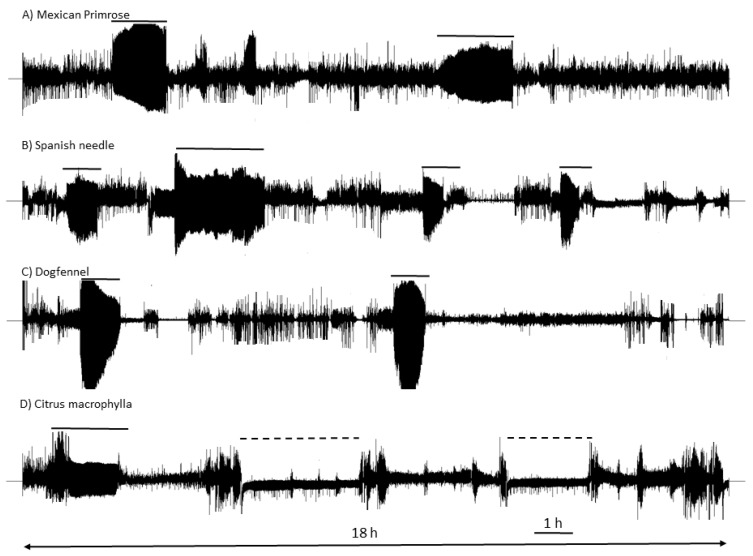
Figure 1
Figure 1
Example electrical penetration graph recordings illustrating feeding activities of Diaphorina citri adults on the weed species during 18 h recordings: (A) Mexican primrose, (B) Spanish needle, (C) Dogfennel, and a preferred host (D) Citrus macrophylla. Horizontal black lines indicate xylem feeding (G) and dashed black lines indicate phloem feeding (E2). Black horizontal scale bar shows 1 h.
Figure 2
Figure 2
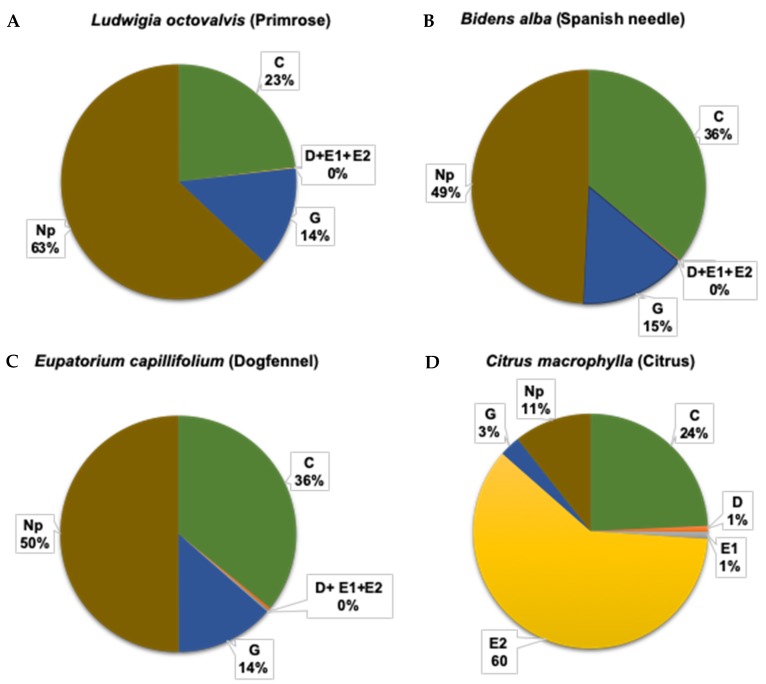
Percent duration of each feeding activity (C, D, E1, E2, G, and Np) performed by Diaphorina citri nymphs on various weed species and citrus during 18 h EPG recordings. (A) Primrose, n = 18; (B) Spanish needle, n = 22; (C) Dogfennel, n = 18; and, (D) Citrus macrophylla, n = 22.
Figure 3
Figure 3
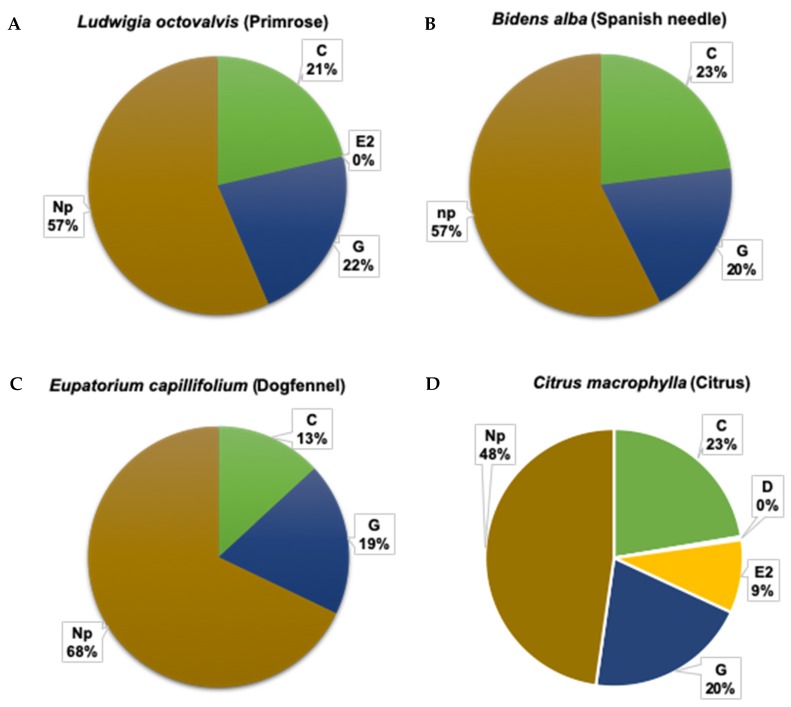
Percent duration of each feeding activity (C, D, E1, E2, G, and Np) performed by Diaphorina citri adults on various weed species and citrus during 18 h EPG recordings. (A) Primrose, n = 18; (B) Spanish needle, n = 22; (C) Dogfennel, n = 18; and, (D) Citrus macrophylla, n = 22.
Figure 4
Figure 4
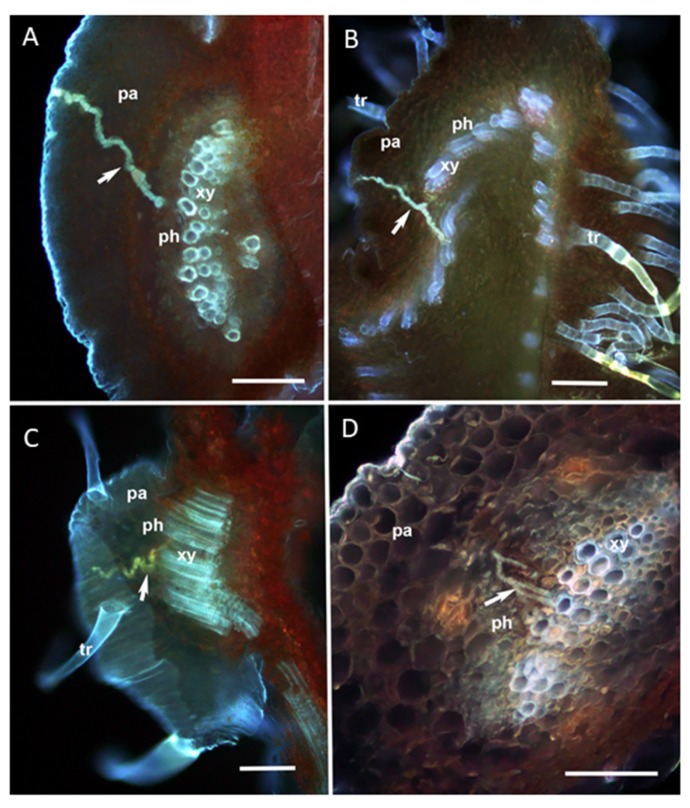
Fluorescence micrographs of cross section in the midribs of (A) Citrus macrophylla, (B) Dogfennel, (C) Primrose, and (D) Spanish needle leaves on which Diaphorina citri adults were caged for 4 days (n = 3). D. citri stylet tracks (salivary sheaths, arrows) terminated in the phloem (ph) in C. macrophylla (A), but terminated in xylem vessels (xy) in the three tested weeds (BD). Abbreviations: pa: parenchyma; ph: phloem; tr: trichomes; xy: xylem. Scale bars = 50 µm.
Figure 5
Figure 5
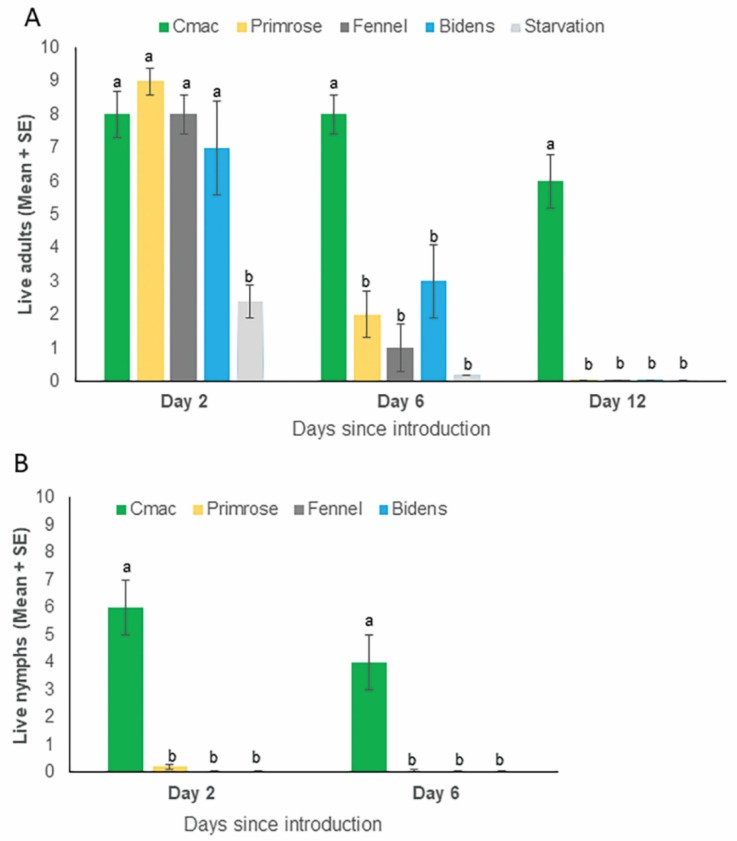
Bar graph showing the survival of Diaphrina citri adults (A) and nymphal (B) instars (means ± SEM) on individual plants of four different plant species (Primrose, Dogfennel, Spanish needle, and Citrus macrophylla) and starved control 2, 6, and 12 days after introduction onto plants in clip cages. (A) Live adult psyllids on plants and starved control after 2, 6, and 12 days. (B) Live fourth instar nymphs on plants after 2 and 6 days. Means analyzed by one-way ANOVA followed by Tukey’s HSD. Treatments having no letters in common are significantly different (α = 0.05) (n = 5).

References

    1. Bove J.M. Huanglongbing: A destructive, newly emerging, century-old disease of citrus. J. Plant. Pathol. 2006;88:7–37.
    1. Gottwald T.R. Current epidemiological understanding of citrus huanglongbing. Ann. Rev. Phytopathol. 2010;48:119–139. doi: 10.1146/annurev-phyto-073009-114418. - DOI - PubMed
    1. Hall D.G., Richardson M.L., Ammar E.-D., Halbert S.E. Asian citrus psyllid, Diaphorina citri (Hemiptera: Psyllidae), vector of citrus huanglongbing disease. Entomol. Exp. Appl. 2013;146:207–223. doi: 10.1111/eea.12025. - DOI
    1. Stansly P.A., Arevalo H.A., Qureshi J.A., Jones M.M., Hendricks K., Roberts P.D., Roka F.M. Vector control and foliar nutrition to maintain economic sustainability of bearing citrus in Florida groves affected by huanglongbing. Pest. Manag. Sci. 2014;70:415–425. doi: 10.1002/ps.3577. - DOI - PubMed
    1. Qureshi J.A., Kostyk B.C., Stansly P.A. Insecticidal suppression of Asian citrus psyllid Diaphorina citri (Hemiptera: Liviidae) vector of Huanglongbing pathogens. PLoS ONE. 2014;9:e112331. doi: 10.1371/journal.pone.0112331. - DOI - PMC - PubMed

LinkOut - more resources