. 2020 Jun;42(3):951-961.
doi: 10.1007/s11357-020-00185-1. Epub 2020 Apr 13.

Heterochronic parabiosis regulates the extent of cellular senescence in multiple tissues

Affiliations

Heterochronic parabiosis regulates the extent of cellular senescence in multiple tissues

Matthew J Yousefzadeh et al. Geroscience. 2020 Jun.

Abstract

An increase in the burden of senescent cells in tissues with age contributes to driving aging and the onset of age-related diseases. Genetic and pharmacologic elimination of senescent cells extends both health span and life span in mouse models. Heterochronic parabiosis in mice has been used to identify bloodborne, circulating pro- and anti-geronic factors able to drive or slow aging, respectively. However, whether factors in the circulation also regulate senescence is unknown. Here, we measured the expression of senescence and senescence-associated secretory phenotype (SASP) markers in multiple tissues from 4- to 18-month-old male mice that were either isochronically or heterochronically paired for 2 months. In heterochronic parabionts, the age-dependent increase in senescence and SASP marker expression was reduced in old mice exposed to a young environment, while senescence markers were concurrently increased in young heterochronic parabionts. These findings were supported by geropathology analysis using the Geropathology Grading Platform that showed a trend toward reduced hepatic lesions in old heterochronic parabionts. In summary, these results demonstrate that senescence is regulated in part by circulating geronic factors and suggest that one of the possible mediators of the rejuvenating effects with heterochronic parabiosis is through the reduction of the senescent cell burden.

Keywords: Aging; Cellular senescence; Geropathology; Parabiosis; SASP.


Conflict of interest statement

The authors declare that they have no conflict of interest.

Figures
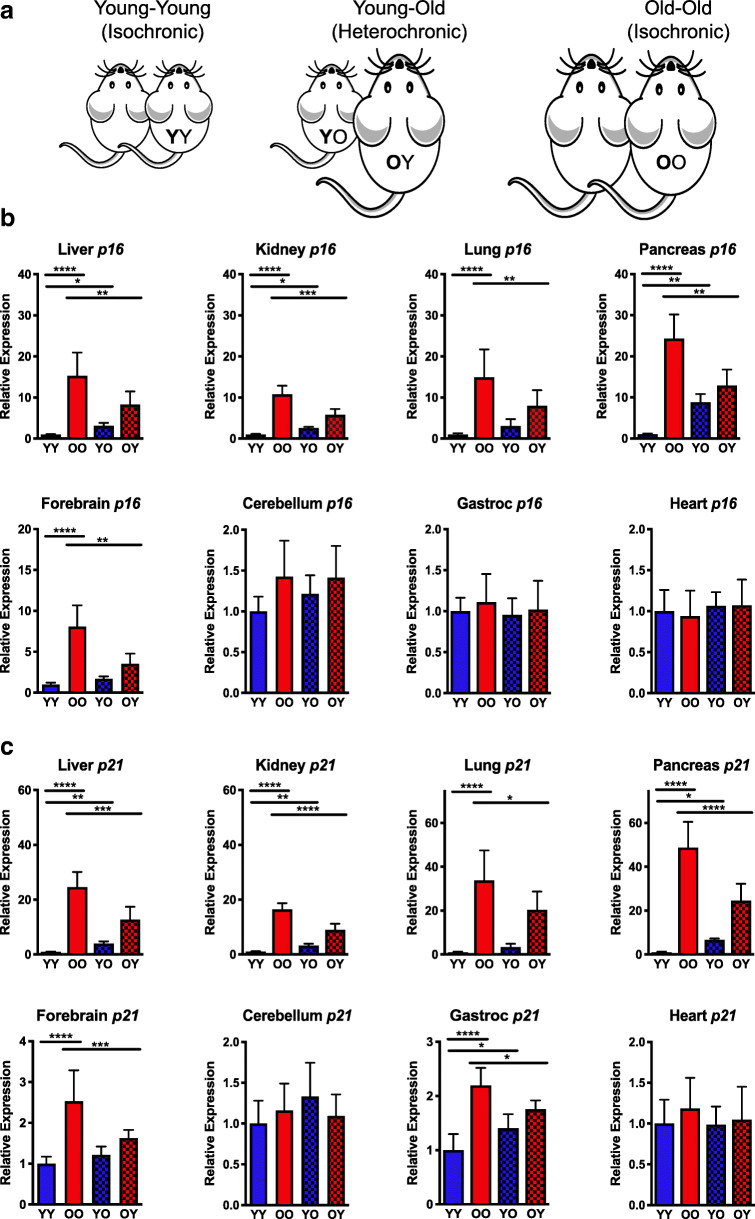
Fig. 1
Fig. 1
Expression of p16Ink4a and p21Cip1 in various tissues of parabiotic mice. A Schematic of isochronic and heterochronic parabiotic pairings of 4- and 18-month-old mice. B Total RNA was isolated from snap-frozen tissues collected from parabiotic mice (n = 5–8 mice per group). Expression of senescence markers Bp16Ink4a and Cp21Cip1 was measured by qPCR using the ∆∆Ct method and normalized to Gapdh expression. Values represent the mean ± SD and one-way ANOVA with Tukey’s test. *p < 0.05, **p < 0.01, ***p < 0.001, ****p < 0.0001
Fig. 2
Fig. 2
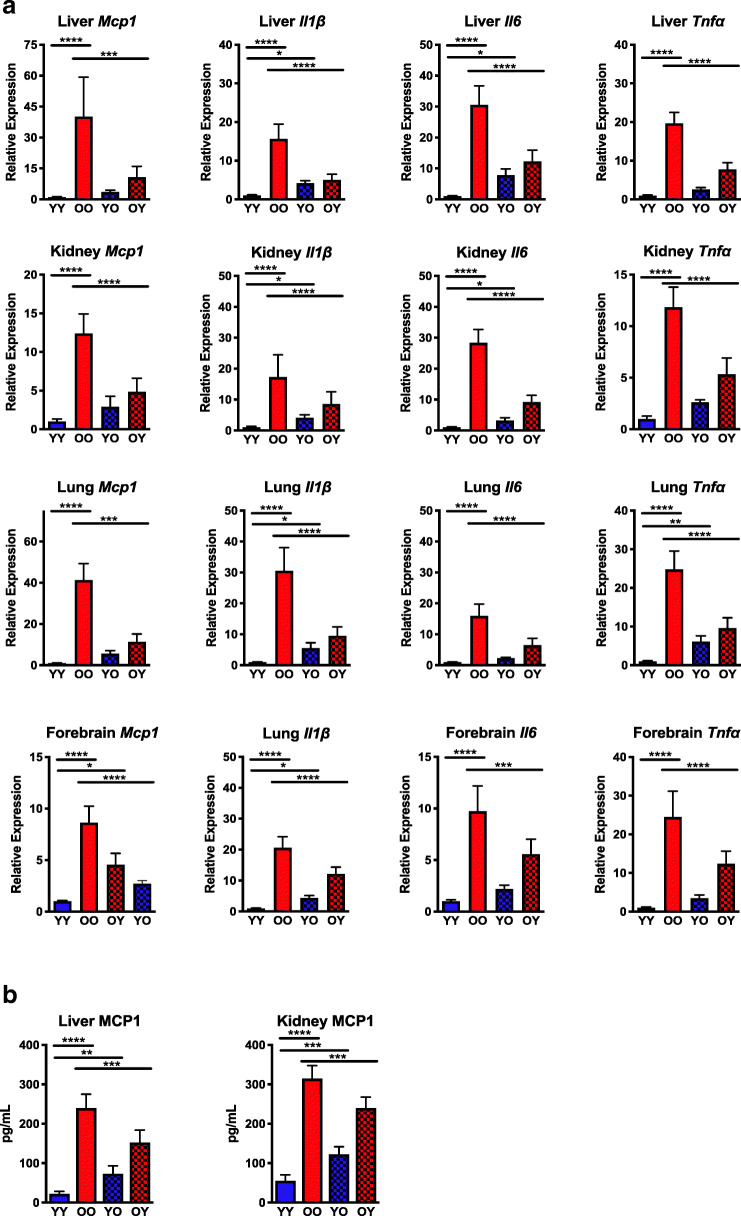
Analysis of the senescence-associated secretory phenotype in parabiotic mice. A Total RNA was isolated from snap-frozen tissues collected from parabiotic mice (n = 5–8 mice per group). Expression of senescence-associated secretory phenotype (SASP) genes Il1β, Il6, Mcp1, and Tnfα was measured by qPCR using the ∆∆Ct method and normalized to Gapdh expression. B Hepatic and renal levels of the SASP factor MCP-1 were quantified by ELISA (n = 7 mice per group). Values represent the mean ± SD and one-way ANOVA with Tukey’s test. *p < 0.05, **p < 0.01, ***p < 0.001, ****p < 0.0001
Fig. 3
Fig. 3
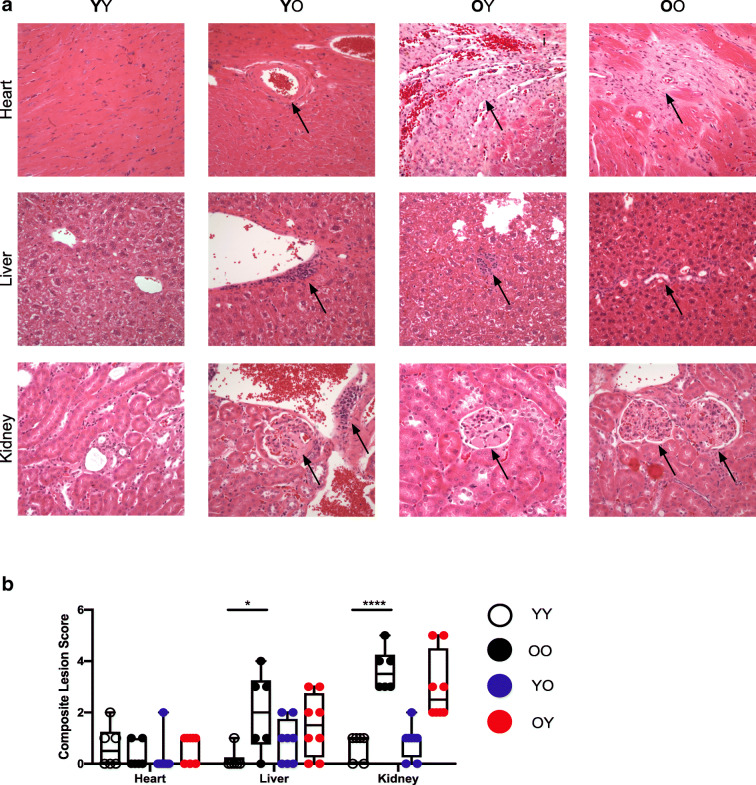
Geropathological scoring of parabiotic mice. A Representative images of heart, liver, and kidney histologic sections from parabiotic mice. All images were taken at × 40. Heart (arteriosclerosis, YO; cardiomyopathy, OY, OO), liver (lymphoid aggregate, YO, OY; bile duct hyperplasia/cysts, OO), and kidney (nephropathy, YO, OY, OO; lymphoid aggregate, YO) pathologies are indicated by arrow. B Histopathologic composite lesion scores (CLS) for age-related pathology in tissues determined using the Geropathology Grading Platform (n = 6–8 tissues per group). Values represent the mean ± SD and one-way ANOVA with Tukey’s test. *p < 0.05, ***p < 0.001

References

    1. Baker DJ, et al. Clearance of p16Ink4a-positive senescent cells delays ageing-associated disorders. Nature. 2011;479:232–236. doi: 10.1038/nature10600. - DOI - PMC - PubMed
    1. Baker DJ, et al. Naturally occurring p16(Ink4a)-positive cells shorten healthy lifespan. Nature. 2016;530:184–189. doi: 10.1038/nature16932. - DOI - PMC - PubMed
    1. Brack AS, Conboy MJ, Roy S, Lee M, Kuo CJ, Keller C, Rando TA. Increased Wnt signaling during aging alters muscle stem cell fate and increases fibrosis. Science. 2007;317:807–810. doi: 10.1126/science.1144090. - DOI - PubMed
    1. Bussian TJ, Aziz A, Meyer CF, Swenson BL, van Deursen JM, Baker DJ. Clearance of senescent glial cells prevents tau-dependent pathology and cognitive decline. Nature. 2018;562:578–582. doi: 10.1038/s41586-018-0543-y. - DOI - PMC - PubMed
    1. Campisi J, d’Adda di Fagagna F. Cellular senescence: when bad things happen to good cells. Nat Rev Mol Cell Biol. 2007;8:729–740. doi: 10.1038/nrm2233. - DOI - PubMed

Publication types

LinkOut - more resources