. 2020 Apr 14;10(1):6374.
doi: 10.1038/s41598-020-63389-7.

Metabotropic glutamate receptor 5 in bulimia nervosa

Affiliations

Metabotropic glutamate receptor 5 in bulimia nervosa

Yoan Mihov et al. Sci Rep. .

Abstract

Bulimia nervosa (BN) shares central features with substance-related and addictive disorders. The metabotropic glutamate receptor subtype 5 (mGlu5) plays an important role in addiction. Based on similarities between binge eating and substance-related and addictive disorders, we investigated mGlu5 in vivo in 15 female subjects with BN and 15 matched controls. We measured mGlu5 distribution volume ratio (DVR) with positron emission tomography (PET) using [11 C]ABP688. In BN mGlu5 DVR was higher in the anterior cingulate cortex (ACC), subgenual prefrontal cortex, and straight gyrus (p < 0.05). In BN, higher mGlu5 DVR in various brain regions, including ACC, pallidum, putamen, and caudate, positively correlated with "maturity fears" as assessed using the Eating Disorder Inventory-2 (p < 0.05). In BN and controls, smokers had globally decreased mGlu5 DVR. We present the first evidence for increased mGlu5 DVR in BN. Our findings suggest that pharmacological agents inhibiting mGlu5 might have a therapeutic potential in BN.


Conflict of interest statement

The authors declare no competing interests.

Figures

Figure 1
Figure 1
Differences between BN and HC in mGlu5 DVR. The figure shows the distribution of t-values for the comparisons between BN and HC with respect to mGlu5 DVR. Brain regions are listed on the left side of the figure, along the y-axis. For each brain region, a horizontal grey bar shows the t-value for the comparison of BN vs HC (n = 15 per group). The x-axis shows a scale for t-values. For illustration purposes, two vertical red lines at t = −2.0484 and t = 2.0484 show significance thresholds corresponding to p = 0.05, 2-tailed, based on a t-distribution with 28 degrees of freedom. The vertical red line corresponds to t = 0. Thus, grey bars to the right of the central red line correspond to positive t-values and indicate that mGlu5 DVR of BN > HC for the corresponding brain region. Conversely, a grey bar to the left of the central red line corresponds to a negative t-value and indicates that mGlu5 DVR of BN < HC for the corresponding brain region. The lengths of the grey bars indicate the magnitude of the difference and the respective t-values, from 2-tailed Welch’s tests. The three grey bars crossing the significance threshold indicate three brain regions for which mGlu5 in BN > HC: subgenual prefrontal cortex (sgPFC) (p = 0.046, t = 2.093), straight gyrus (p = 0.046, t = 2.09), and anterior cingulate gyrus (ACC) (p = 0.027, t = 2.33) (all p-values from 2-tailed Welch’s tests, uncorrected for multiple comparisons).
Figure 2
Figure 2
mGlu5 DVR in the straight gyrus, the anterior cingulate cortex, and the subgenual prefrontal cortex. The figure shows the distribution of mGlu5 DVR in three brain regions. Data is shown for three brain regions: the straight gyrus (Straight Gyrus), the anterior cingulate cortex (ACC), and the subgenual prefrontal cortex (sgPFC). mGlu5 DVR-values are shown on the y-axis. Circles represent individual data points, blue indicates healthy controls (HC, n = 15), red indicates bulimia nervosa (BN, n = 15). For each brain region and each group, three horizontal black lines show the mean ± one standard deviation of mGlu5 DVR-values.
Figure 3
Figure 3
The effects of diagnostic group, smoking status, and their interaction on mGlu5 DVR. The figure summarizes the results of 35 ANOVAs, fitting a main effect of group (HC vs. BN, n = 15 per group), a main effect of smoking (smokers vs. non-smokers), and an interaction effect group*smoking on mGlu5 DVR for 35 brain regions. Panel a shows the results for the main effect of group, with brain regions along the x-axis and p-values on the y-axis. A broken black line connects the p-values corresponding to the main effect of group for each brain region. A straight horizontal red line indicates the significance threshold (p = 0.05, uncorrected for multiple comparisons). Dips of the black line below the significance threshold indicate higher mGlu5 DVR in BN than in HC for the corresponding brain region (p < 0.05, uncorrected for multiple comparisons). Panel b shows a summary for the main effects of smoking, notation analogous to Panel a. Significant main effect of smoking corresponds to lower mGlu5 DVR in smokers than in non-smokers (p < 0.05, uncorrected for multiple comparisons). Panel c shows a summary for the interaction effect group*smoking with notation analogous to Panel a.
Figure 4
Figure 4
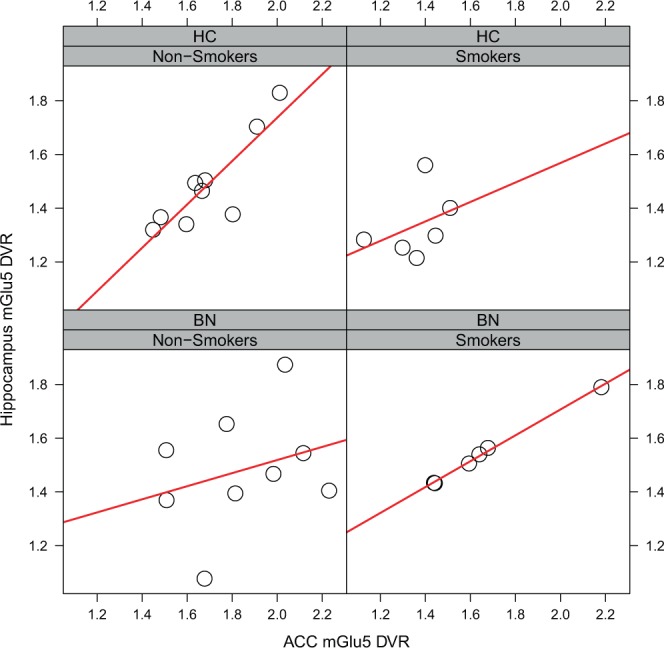
Hippocampus-ACC mGlu5 DVR-correlations in subjects with bulimia nervosa and healthy controls. The figure shows the relation between Hippocampus mGlu5 DVR (y-axis) and ACC mGlu5 DVR (x-axis) in healthy controls (upper row) and subjects with bulimia nervosa (lower row). Each diagnostic group is subdivided into non-smokers (left column, n = 9) and smokers (right column, n = 6). Pearson’s r correlation between hippocampus and ACC mGlu5 was significantly higher in smokers with bulimia than in healthy smokers (smokers with bulimia: Pearson’s r = 0.998, healthy smokers: Pearson’s r = 0.382, difference p-value < 0.001, two-tailed, uncorrected for multiple comparisons). This difference was not significant for the comparison between non-smokers with bulimia and healthy non-smokers (non-smokers with bulimia: Pearson’s r = 0.289, healthy non-smokers: Pearson’s r = 0.867, difference p-value = 0.077, two-tailed, uncorrected for multiple comparisons). Correlation comparisons were carried out using Fisher’s r-to-z transformation as reported previously.

References

    1. Stansley BJ, Conn PJ. Neuropharmacological Insight from Allosteric Modulation of mGlu Receptors. Trends. Pharmacol. Sci. 2019;40:240–252. doi: 10.1016/j.tips.2019.02.006. - DOI - PMC - PubMed
    1. Piers, T. et al. Translational Concepts of mGluR5 in Synaptic Diseases of the Brain. Front. Pharmacol. 3, 10.3389/fphar.2012.00199 (2012). - PMC - PubMed
    1. Ayala JE, et al. mGluR5 Positive Allosteric Modulators Facilitate both Hippocampal LTP and LTD and Enhance Spatial Learning. Neuropsychopharmacology. 2009;34:2057–2071. doi: 10.1038/npp.2009.30. - DOI - PMC - PubMed
    1. Joffe ME, et al. Mechanisms underlying prelimbic prefrontal cortex mGlu3/mGlu5-dependent plasticity and reversal learning deficits following acute stress. Neuropharmacology. 2019;144:19–28. doi: 10.1016/j.neuropharm.2018.10.013. - DOI - PMC - PubMed
    1. Wijetunge LS, Till SM, Gillingwater TH, Ingham CA, Kind PC. mGluR5 regulates glutamate-dependent development of the mouse somatosensory cortex. J. Neurosci. 2008;28:13028–13037. doi: 10.1523/jneurosci.2600-08.2008. - DOI - PMC - PubMed

Publication types

Substances