. 2020 Apr 28;14(4):5143-5147.
doi: 10.1021/acsnano.0c02857. Epub 2020 Apr 16.

Computational Design of ACE2-Based Peptide Inhibitors of SARS-CoV-2

Affiliations

Computational Design of ACE2-Based Peptide Inhibitors of SARS-CoV-2

Yanxiao Han et al. ACS Nano. .

Abstract

Peptide inhibitors against the SARS-CoV-2 coronavirus, currently causing a worldwide pandemic, are designed and simulated. The inhibitors are mostly formed by two sequential self-supporting α-helices (bundle) extracted from the protease domain (PD) of angiotensin-converting enzyme 2 (ACE2), which bind to the SARS-CoV-2 receptor binding domains. Molecular dynamics simulations revealed that the α-helical peptides maintain their secondary structure and provide a highly specific and stable binding (blocking) to SARS-CoV-2. To provide a multivalent binding to the SARS-CoV-2 receptors, many such peptides could be attached to the surfaces of nanoparticle carriers. The proposed peptide inhibitors could provide simple and efficient therapeutics against the COVID-19 disease.

Keywords: COVID-19; SARS-CoV-2; molecular dynamics simulations; peptide inhibitors; therapeutics.


Conflict of interest statement

The authors declare no competing financial interest.

Figures
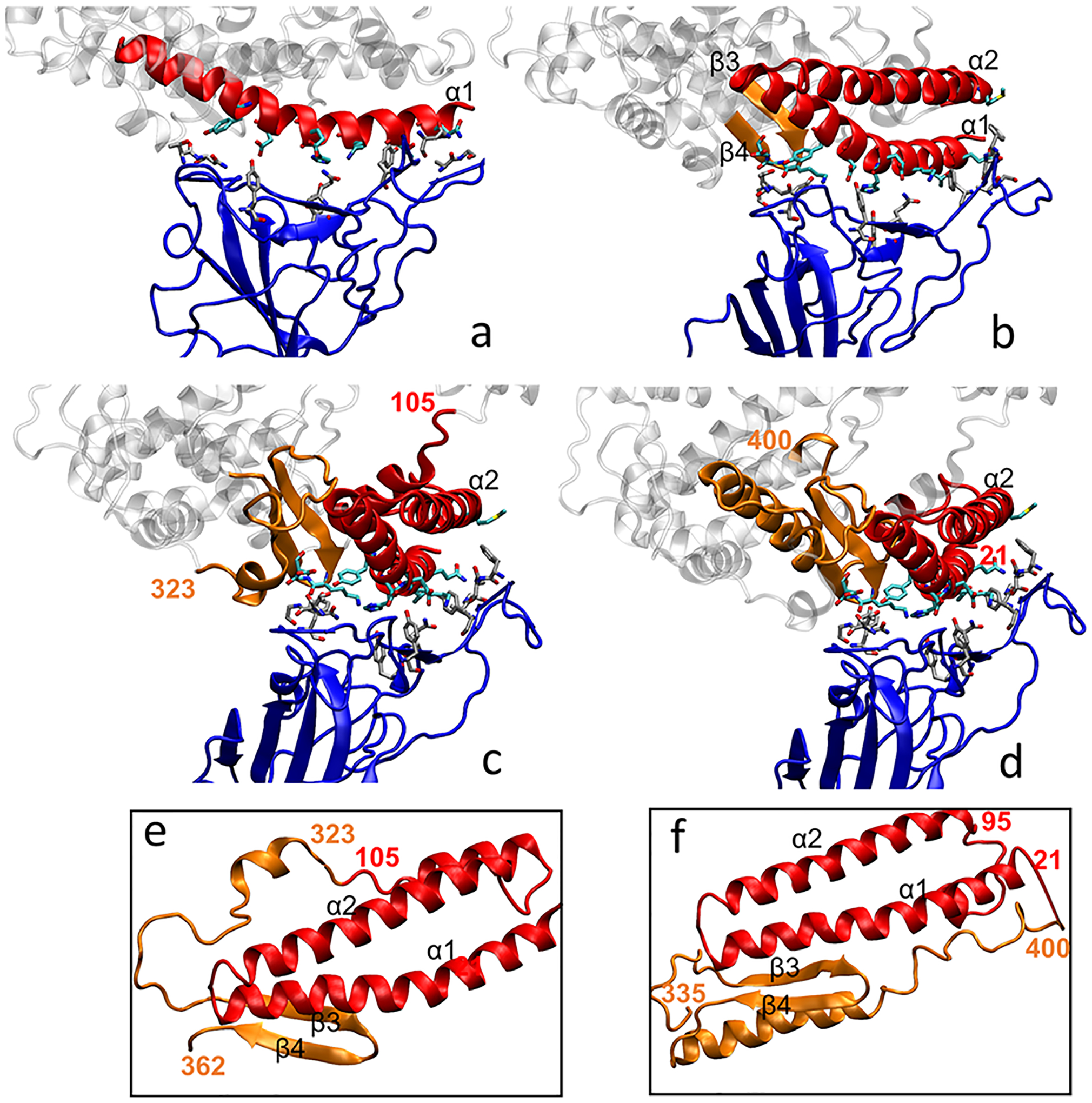
Figure 1.
Figure 1.
Structural components of the inhibitors designed: (a) inhibitor 1 is composed of α1 (residues 21 to 55); (b) inhibitor 2 is composed of α1, α2, and loose chain between β3 and β4 connected by a C–C bond between residues 45 and 351 (residues 21 to 88 and 349 to 357); (c) inhibitor 3 is composed of α1, α2, and β3, β4 (residues 21 to 105 and 323 to 362); (d) inhibitor 4 has the same composition as inhibitor 3 but different linkage (residues 21 to 95 and 335 to 400); (e) details of inhibitor 3 (c), reorganized with residue 323 connecting residue 105; (f) details of inhibitor 3 (d), reorganized with residue 21 connecting residue 400. (e-f) Conformation of the α-helices and β-sheets was maintained with the rest adapting to the connection. Coloring scheme: red, α-helices; orange, β-sheets or other linker components; blue, RBD of SARS-CoV-2; gray, other parts of ACE2; licorice, the initial contacting residues in the RBD–ACE2 interface.
Figure 2.
Figure 2.
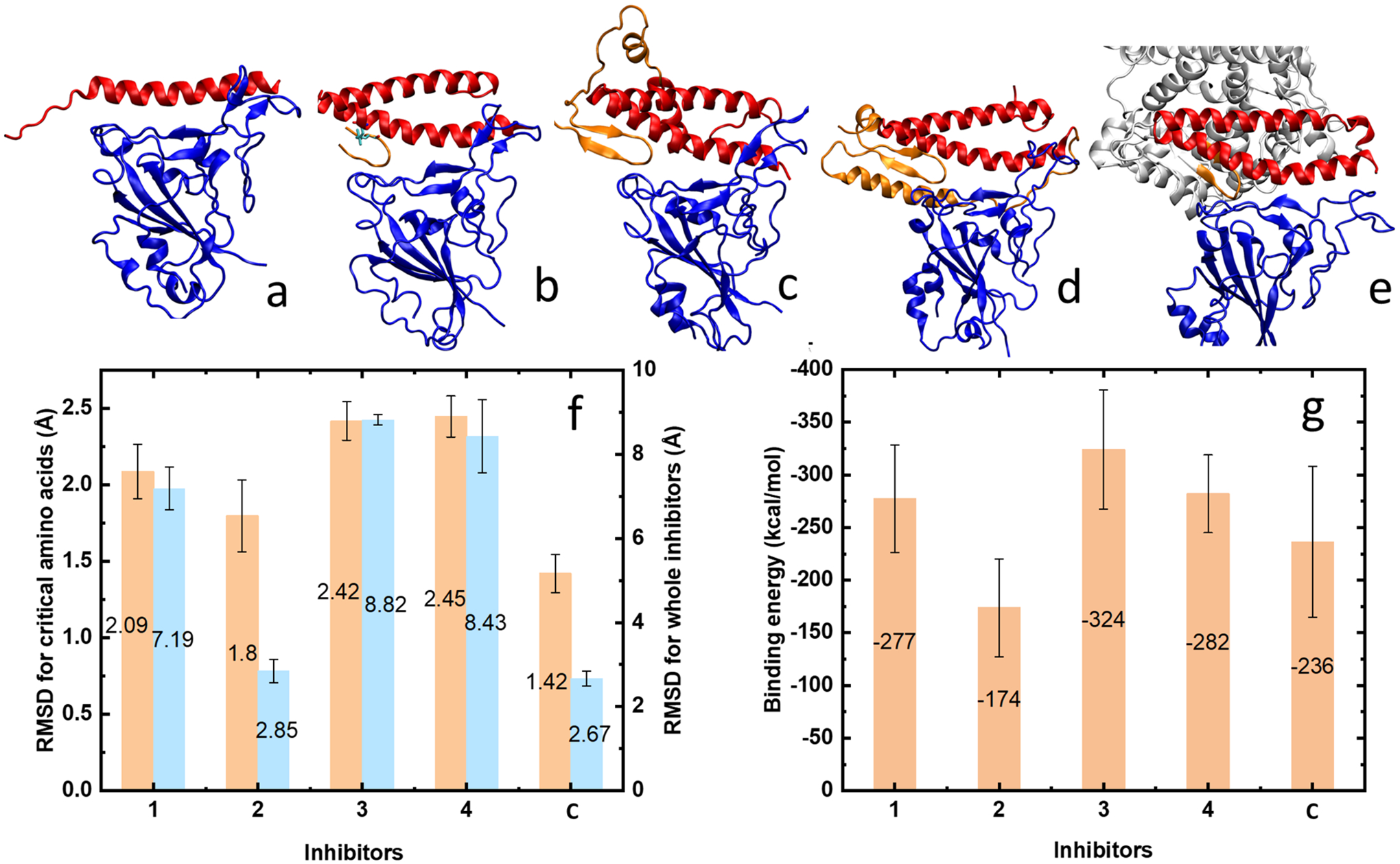
(a–e) Final conformations of inhibitors 1, 2, 3, 4, and control. (f) Averaged root-mean-square deviation for the critical amino acids in each inhibitor and for the whole inhibitors when binding with the RBD of SARS-CoV-2. Numbering scale: 1–4, inhibitors 1–4 with RBD; C, control system of PD from ACE2 and the RBD of SARS-CoV-2. (g) Average interaction energies between the contact residues of inhibitors 1–4 (or ACE2) and the RBD of SARS-CoV-2.

References

    1. Gorbalenya AE; Baker SC; Baric RS; de Groot RJ; Drosten C; Gulyaeva AA The Species Severe Acute Respiratory Syndrome-Related Coronavirus: Classifying 2019-nCoV and Naming It SARS-CoV-2. Nat. Microbiol 2020, 5, 536–544. - PMC - PubMed
    1. Chen N; Zhou M; Dong X; Qu J; Gong F; Han Y; Qiu Y; Wang J; Liu Y; Wei Y; Xia J; Yu T; Zhang X; Zhang L Epidemiological and Clinical Characteristics of 99 Cases of 2019 Novel Coronavirus Pneumonia in Wuhan, China: A Descriptive Study. Lancet 2020, 395, 507–513. - PMC - PubMed
    1. Huang C; Wang Y; Li X; Ren L; Zhao J; Hu Y; Zhang L; Fan G; Xu J; Gu X; Cheng Z; Yu T; Xia J; Wei Y; Wu W; Xie X; Yin W; Li H; Liu M; Xiao Y; Gao H; Guo L; Xie J; Wang G; Jiang R; Gao Z; Jin Q; Wang J; Cao B Clinical Features of Patients Infected with 2019 Novel Coronavirus in Wuhan, China. Lancet 2020, 395, 497–506. - PMC - PubMed
    1. Zhou P; Yang X-L; Wang X-G; Hu B; Zhang L; Zhang W; Si H-R; Zhu Y; Li B; Huang C-L; Chen H-D; Chen J; Luo Y; Guo H; Jiang R-D; Liu M-Q; Chen Y; Shen X-R; Wang X; Zheng X-S; Zhao K; Chen Q-J; Deng F; Liu L-L; Yan B; Zhan F-X; Wang Y-Y; Xiao G-F; Shi Z-L A Pneumonia Outbreak Associated with a New Coronavirus of Probable Bat Origin. Nature 2020, 579, 270–273. - PMC - PubMed
    1. Wrapp D; Wang N; Corbett KS; Goldsmith JA; Hsieh C-L; Abiona O; Graham BS; McLellan JS Cryo-EM Structure of the 2019-nCoV Spike in the Prefusion Conformation. Science 2020, 367, 1260–1263. - PMC - PubMed

Publication types