. 2020 Apr 14;15(4):e0231484.
doi: 10.1371/journal.pone.0231484. eCollection 2020.

What anticipatory coarticulation in children tells us about speech motor control maturity

Affiliations

What anticipatory coarticulation in children tells us about speech motor control maturity

Guillaume Barbier et al. PLoS One. .

Abstract

Purpose: This study aimed to evaluate the role of motor control immaturity in the speech production characteristics of 4-year-old children, compared to adults. Specifically, two indices were examined: trial-to-trial variability, which is assumed to be linked to motor control accuracy, and anticipatory extra-syllabic vowel-to-vowel coarticulation, which is assumed to be linked to the comprehensiveness, maturity and efficiency of sensorimotor representations in the central nervous system.

Method: Acoustic and articulatory (ultrasound) data were recorded for 20 children and 10 adults, all native speakers of Canadian French, during the production of isolated vowels and vowel-consonant-vowel (V1-C-V2) sequences. Trial-to-trial variability was measured in isolated vowels. Extra-syllabic anticipatory coarticulation was assessed in V1-C-V2 sequences by measuring the patterns of variability of V1 associated with variations in V2. Acoustic data were reported for all subjects and articulatory data, for a subset of 6 children and 2 adults.

Results: Trial-to-trial variability was significantly larger in children. Systematic and significant anticipation of V2 in V1 was always found in adults, but was rare in children. Significant anticipation was observed in children only when V1 was /a/, and only along the antero-posterior dimension, with a much smaller magnitude than in adults. A closer analysis of individual speakers revealed that some children showed adult-like anticipation along this dimension, whereas the majority did not.

Conclusion: The larger trial-to-trial variability and the lack of anticipatory behavior in most children-two phenomena that have been observed in several non-speech motor tasks-support the hypothesis that motor control immaturity may explain a large part of the differences observed between speech production in adults and 4-year-old children, apart from other causes that may be linked with language development.


Conflict of interest statement

The authors have declared that no competing interests exist.

Figures
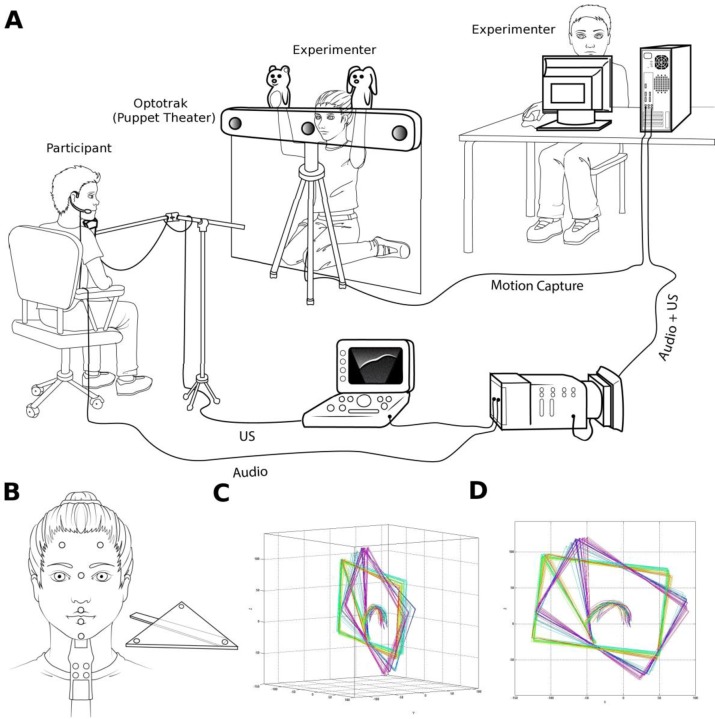
Fig 1
Fig 1
A. Experimental setup (where US = UltraSound). A participant is seated in front of the Optotrak. To keep the subject from seeing the activities of the operator who was presenting the dolls, the operator was hidden behind a sheet suspended from the Optotrack sensor bar. Synchronized ultrasound and acoustic data are recorded, as well as Optotrak motion capture data, in order to align extracted tongue contours with palatal hard structures. B. Placement of the Optotrak IREDs on the participant's head and ultrasound probe. The device used to measure the occlusal plane is also shown. (Illustrations by Sabine Burfin.) C. Ultrasound tongue contours corrected for head movements. D. The same contours projected onto the midsagittal plane. Note that between some data (green-yellow) and others (blue-purple), the child participant moved, but data were realigned within a single articulatory space, relative to the child’s hard palate.
Fig 2
Fig 2
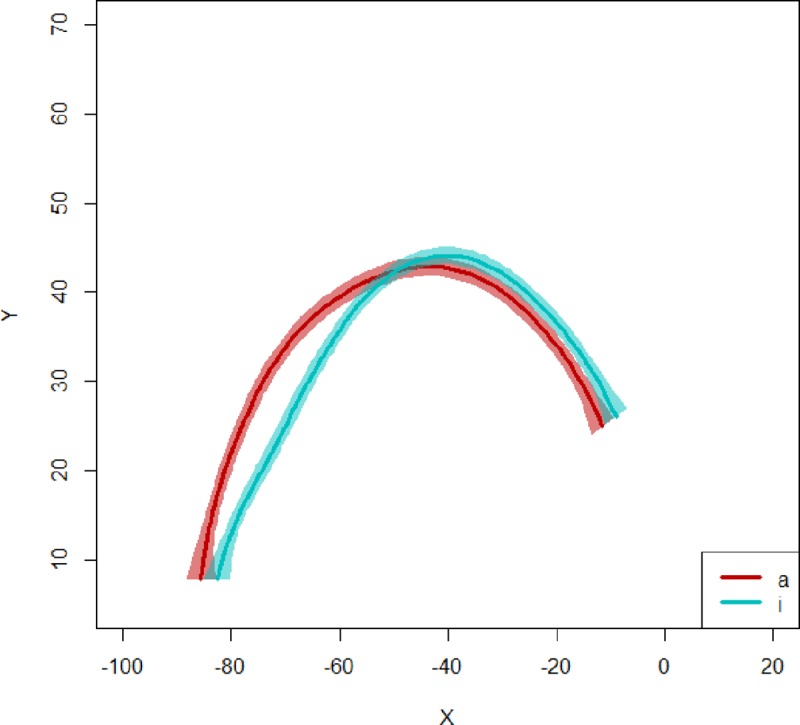
Illustration of average splines corresponding to midsagittal tongue contours with 95% confidence intervals, for a child participant, for /ε/ in /εbi/ (blue) and in /εba/ (red). X and Y are in mm.
Fig 3
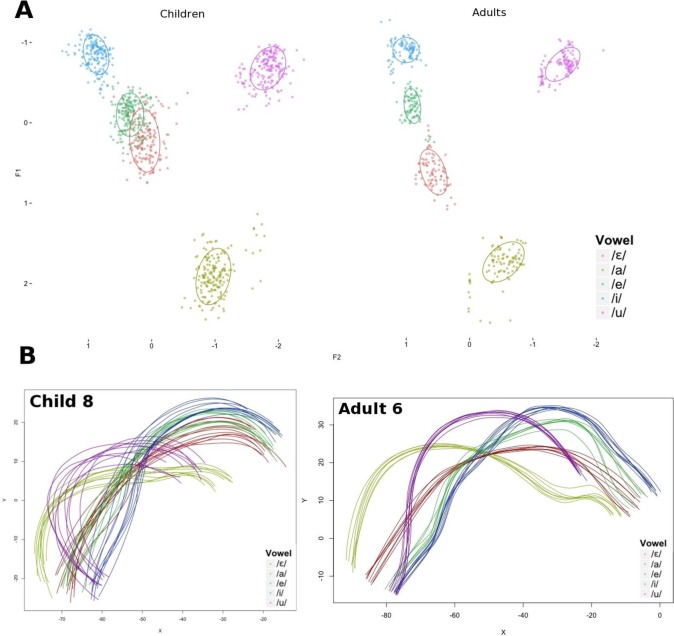
Fig 3. Illustration of the trial-to-trial variability in vowel production in the acoustic and articulatory domains, and the main differences between the group of adults and the group of children.
Top panels: Variability in the z-scored (F1, F2) planes for the group of children (left) and the group of adults (right). Bottom panels: Examples of articulatory variability in the mid-sagittal plane for a child (left) and an adult (right) participant; X and Y are in mm.
Fig 4
Fig 4
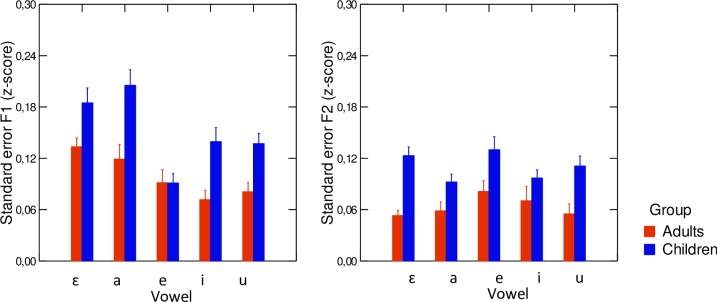
Average values of standard error of z-scored formants F1 and F2 for each vowel category, across speaker groups (left-hand panel: F1, right-hand panel: F2). Red columns correspond to adult participants and blue columns correspond to child participants. Error bars are standard errors of the mean.
Fig 5
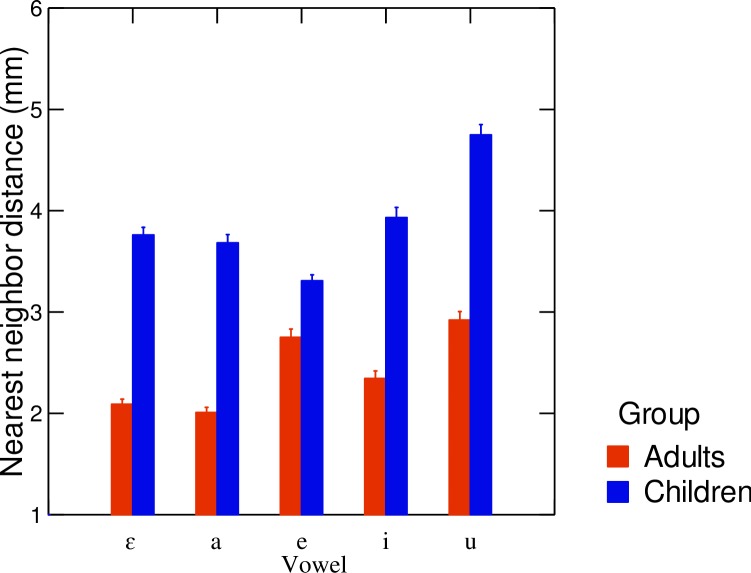
Fig 5. Average nearest neighbor distance for each vowel category, across age groups.
Error bars are standard errors of the mean.
Fig 6
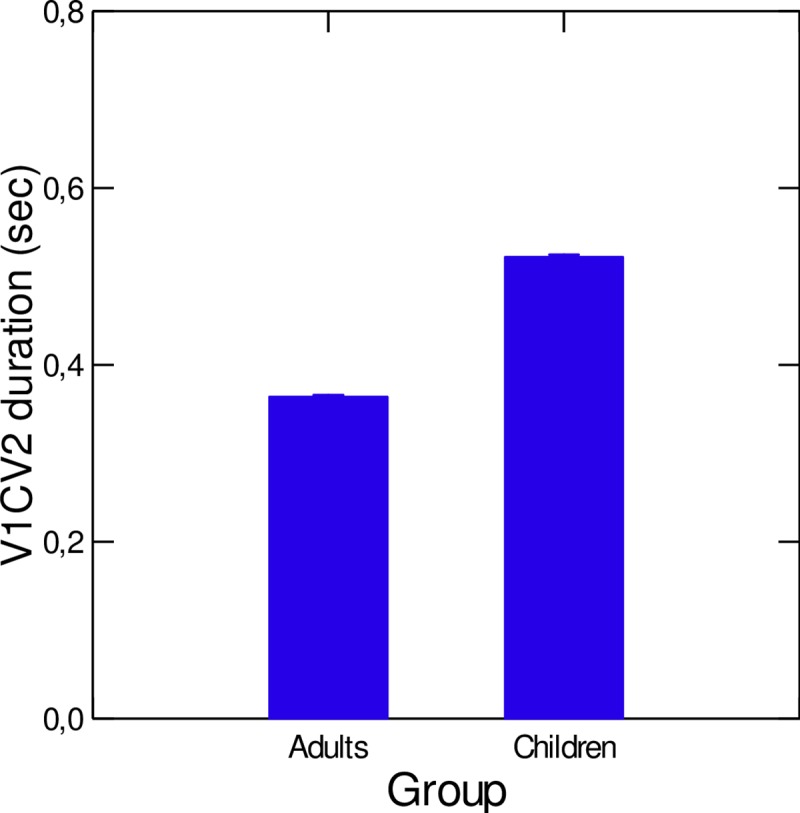
Fig 6. Average duration of V1CV2 sequences, for both speaker groups.
Error bars are standard errors of the mean.
Fig 7
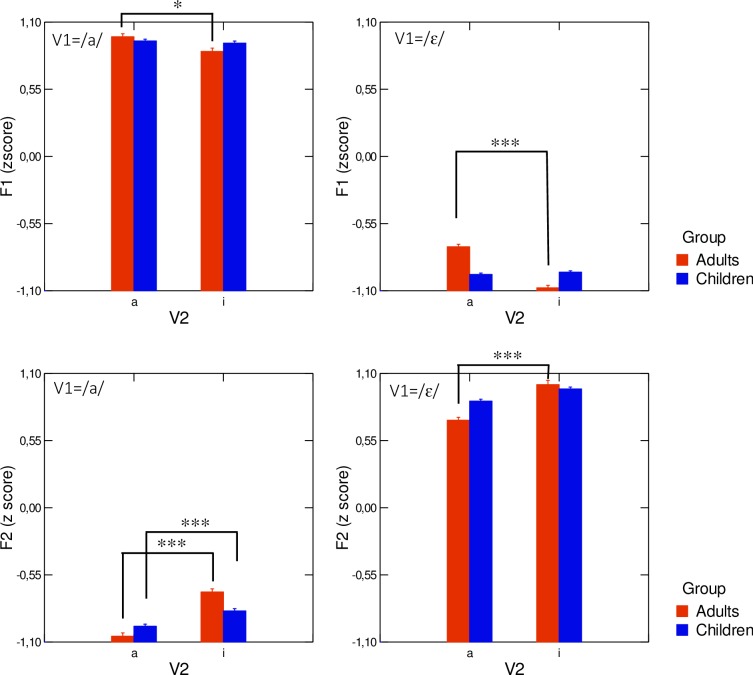
Fig 7. Average values of z-scored F1 and F2, for both speaker groups and V2 contexts, in V1CV2 sequences.
Error bars are standard errors of the mean.
Fig 8
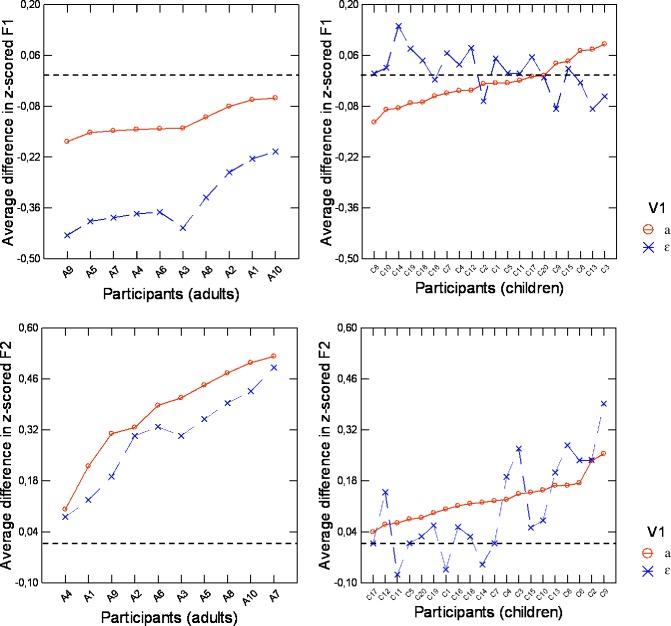
Fig 8. Average difference in z-scored F1 and z-scored F2 in V1 between V1C/i/ and V1C/a/, per participant.
The solid line corresponds to /a/CV2 sequences and the dashed line corresponds to /ɛ/CV2 sequences. In each panel the horizontal dotted line indicates zero difference. In the upper panels anticipation corresponds to negative differences. In the lower panels anticipation corresponds to positive differences.
Fig 9
Fig 9
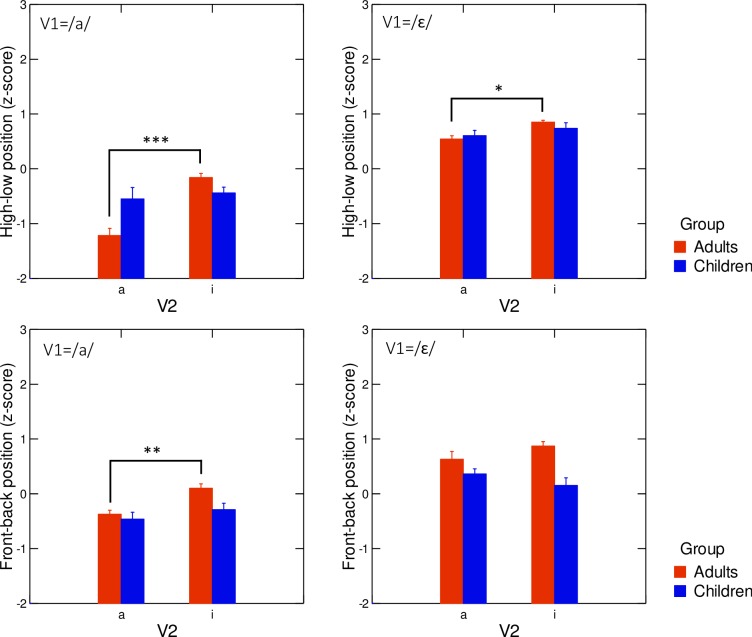
Average values of z-scored front-back (x, bottom row) and high-low (y, top row) positions of the highest point of the tongue in V1, across V2 contexts (/a/ or /i/), for both participant groups (red columns: Adults, blue columns: Children). Left-hand panels: tokens for which V1 = /a/; right-hand panels: tokens for which V1 = /ε/. Error bars are standard errors of the mean.
Fig 10
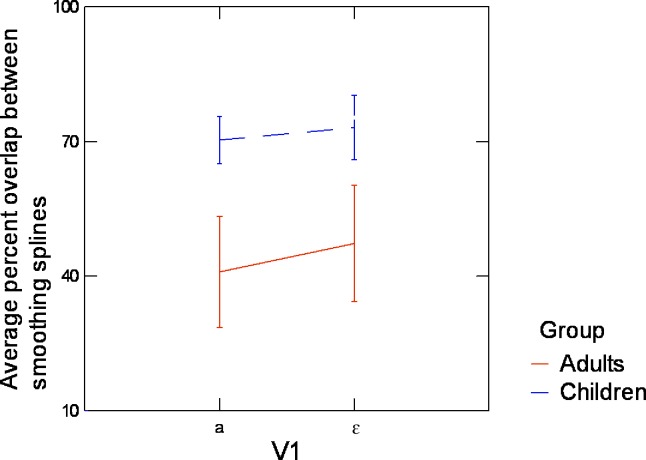
Fig 10. Average overlap across consonantal contexts between the confidence intervals of the average smoothing splines for V1 in both V2 contexts, for children and adults.
Error bars are standard errors of the mean.
Fig 11
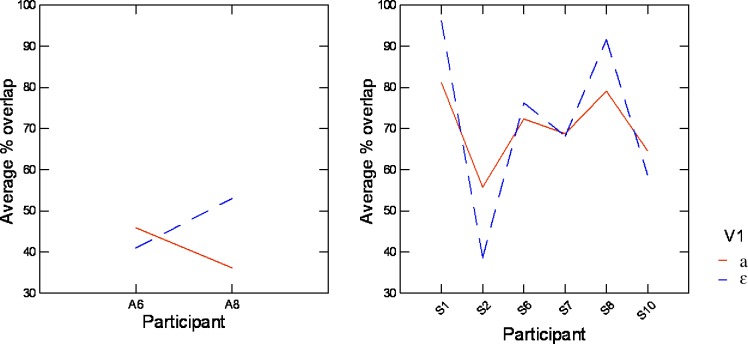
Fig 11. Average percent overlap in V1 between V1C/i/ and V1C/a,/ per participant.
The solid line corresponds to /a/CV2 sequences and the dashed line corresponds to /ɛ/CV2 sequences.

References

    1. Kent R. D., & Forner L. L. (1980). Speech segment durations in sentence recitations by children and adults. Journal of Phonetics, 8(2), 157–168.
    1. Nittrouer S. (1995). Children learn separate aspects of speech production at different rates: Evidence from spectral moments. The Journal of the Acoustical Society of America, 97(1), 520–530. 10.1121/1.412278 - DOI - PubMed
    1. Smith A. & Goffman L. (1998). Stability and patterning of speech movement sequences in children and adults, Journal of Speech, Langage and Hearing Research, 41, 18–30. - PubMed
    1. Lee S., Potamianos A., & Narayanan S. (1999). Acoustics of children’s speech: Developmental changes of temporal and spectral parameters. The Journal of the Acoustical Society of America, 105(3), 1455–1468. 10.1121/1.426686 - DOI - PubMed
    1. Walsh B. & Smith A. (2002). Articulatory movements in adolescents: evidence for protracted development of speech motor control processes. Journal of Speech, Language and Hearing Research, 45, 1119–1133. - PubMed

Publication types