Review
. 2009 Sep;28(8):925-942.
doi: 10.1016/j.trac.2009.05.005. Epub 2009 Jun 26.

Bioactive paper provides a low-cost platform for diagnostics

Affiliations
Review

Bioactive paper provides a low-cost platform for diagnostics

Robert Pelton. Trends Analyt Chem. 2009 Sep.

Abstract

Bioactive paper includes a range of potential paper-based materials that can perform analytical functions normally reserved for multi-well plates in the laboratory or for portable electronic devices. Pathogen detection is the most compelling application. Simple paper-based detection, not requiring hardware, has the potential to have impacts in society, ranging from the kitchen to disasters in the developing world. Bioactive-paper research is an emerging field with significant efforts in Canada, USA (Harvard), Finland and Australia. Following a brief introduction to the material and surface properties of paper, I review the literature. Some of the early work exploits the porosity of paper to generate paper-based microfluidics ("paperfluidics") devices. I exclude from this review printed electronic devices and plastics-supported devices.

Keywords: Antibody; Antimicrobial paper; Bacteriophage; Bioactive paper; Biosensor; DNA aptamer; Lateral flow; Paper-supported assay; Paperfluidics; Pathogen detection.


Figures

Figure 1
Figure 1
The chemical structures of polyamide-epichlorohydrin (PAE) and glyoxal-modified polyacrylamide (GPAM) wet-strength resins. PAE gives permanent wet strength whereas GPAM cross-links hydrolyze with exposure time to water.
Figure 2
Figure 2
Alkyl ketene dimer (AKD) and alkyl succinic anhydride “size” react with fibers to lower surface energy and water-penetration rates.
Figure 3
Figure 3
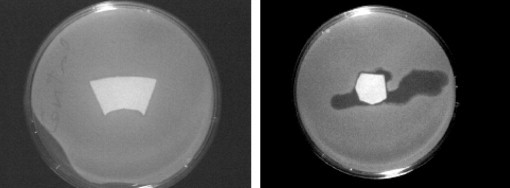
Killing bacteria with filter paper impregnated with wild T4 phage (left), and filter paper with genetically-engineered T4 phage with cellulose-binding module (CBM) (right) giving spontaneous adhesion of the phage head to cellulose. The CBM-immobilized phage infects and kills the bacteria giving transparent regions in the media .
Figure 4
Figure 4
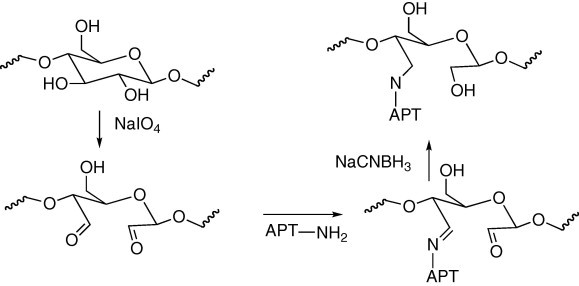
Coupling a DNA aptamer to oxidized cellulose.
Figure 5
Figure 5
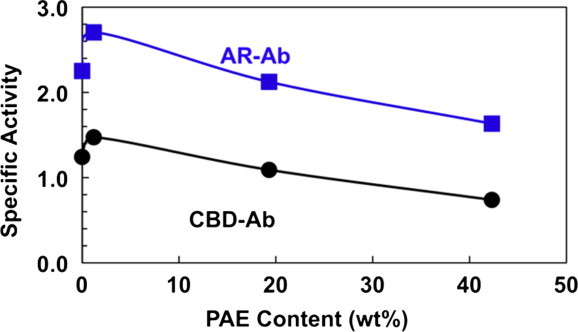
The influence of PAE wet-strength resin on paper-supported ELISA. AR-Ab is a conventional anti-mouse antibody (Ab) immobilized by non-specific adsorption. CBD-Ab is complex structure with 5 Abs fused to 5 cellulose-binding modules (CBMs) (Adapted from [77]).
Figure 6
Figure 6
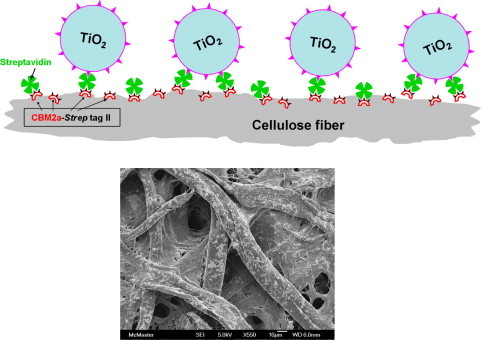
Cellulose-binding-module protein used to attach TiO2 to cellulose (Adapted from [30]).
Figure 7
Figure 7
Coupling antibodies or DNA aptamers to carboxylated microgels (Adapted from [17]).
Figure 8
Figure 8
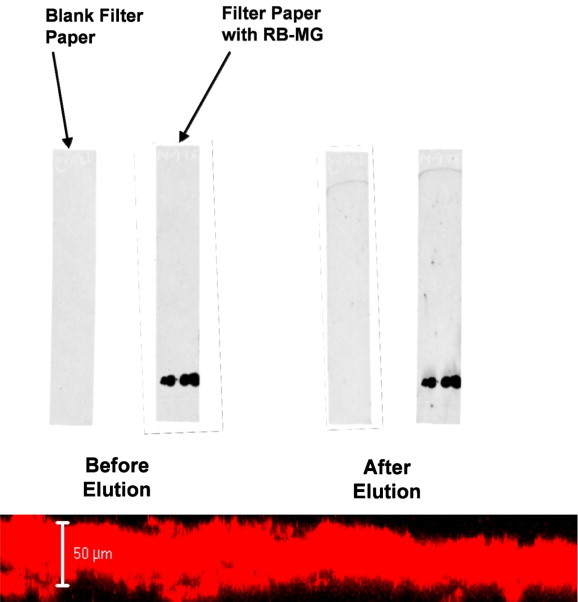
Chromatographic elution of filter paper spotted with fluorescently-labeled microgel (Adapted from [17]).
Figure 9
Figure 9
Bodenhamer’s displacement assay for pathogen detection on transparent films. Initially a dye-conjugated antibody is bound to an immobilized facsimile antigen, giving a colored √. Antigen exposure strips the antibody-dye conjugate from the surface, giving a color change , .
Figure 10
Figure 10
Enzyme-linked immunosorbent assay (ELISA) scheme for detection and reporting.
Figure 11
Figure 11
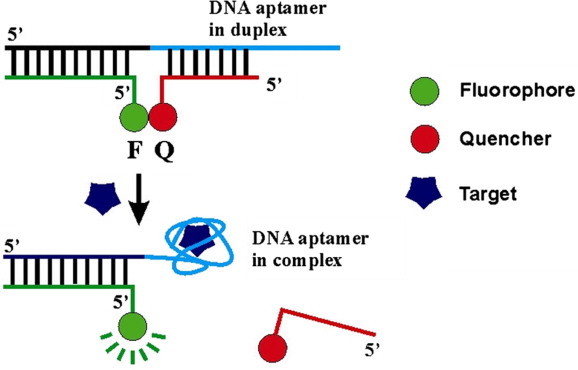
DNA aptamer with built-in fluorescent reporting. In the initial duplex, the fluorescent aptamer is quenched. Upon exposure to the target, the duplex dissociates, giving a fluorescent signal (Adapted from [101]).
Figure 12
Figure 12
Gold-nanoparticle reporting with a DNA-aptamer biosensor. Initially the aptamers prevent the nanoparticles from aggregating (Adapted from [10]). Exposure to target strips the aptamers from the particles causing aggregation and color change.
Figure 13
Figure 13
A paper-supported sensor measuring the presence of DNase. Decomposition of the stabilizing chains on the nanoparticles causes them to aggregate, giving a color change (Adapted from [23]).
Figure 14
Figure 14
Antigen displaces facsimile antibody-quencher from quantum dot, producing fluorescence .

References

    1. S. Aikio, S. Grönqvist, L. Hakola, E. Hurme, S. Jussila, O. Kaukoniemi, H. Kopola, M. Känsäkoski, M. Leinonen, S. Lippo, R. Mahlberg, S. Peltonen, P. Qvintus-Leino, T. Rajamäki, A. Ritschkoff, M. Smolander, J. Vartiainen, L. Viikari, M. Vilkman, Bioactive paper and fibre products patent and literary survey, VTT Working Paper 51, VTT Technical Research Centre of Finland, Oulu, Finland, 2006.
    1. Shen Y., Chiuman W., Brennan J.D., Li Y. Chembiochem. 2006;7:1343. - PubMed
    1. Ali M.M., Kandadai S.A., Li Y. Can. J. Chem. 2007;85:261.
    1. Ali M.M., Su S., Filipe C.D.M., Pelton R., Li Y. Chem. Commun. 2007:4459. - PubMed
    1. Di Risio S., Yan N. Macromol. Rapid Commun. 2007;28:1934.

LinkOut - more resources