


Recombinase polymerase amplification: Basics, applications and recent advances
- PMID: 32287544
- PMCID: PMC7112910
- DOI: 10.1016/j.trac.2017.10.015
Recombinase polymerase amplification: Basics, applications and recent advances
Abstract
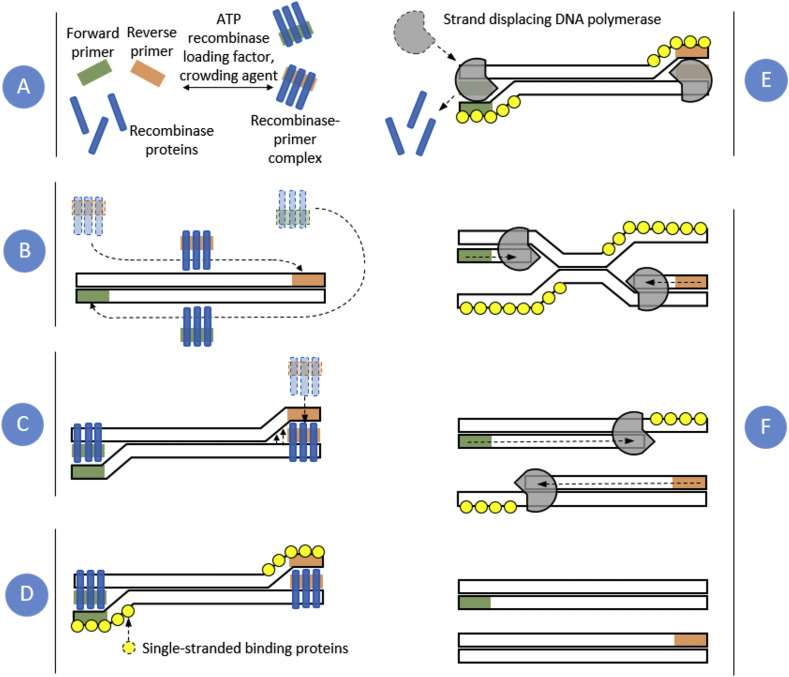
Recombinase polymerase amplification (RPA) is a highly sensitive and selective isothermal amplification technique, operating at 37-42°C, with minimal sample preparation and capable of amplifying as low as 1-10 DNA target copies in less than 20 min. It has been used to amplify diverse targets, including RNA, miRNA, ssDNA and dsDNA from a wide variety of organisms and samples. An ever increasing number of publications detailing the use of RPA are appearing and amplification has been carried out in solution phase, solid phase as well as in a bridge amplification format. Furthermore, RPA has been successfully integrated with different detection strategies, from end-point lateral flow strips to real-time fluorescent detection amongst others. This review focuses on the different methodologies and advances related to RPA technology, as well as highlighting some of the advantages and drawbacks of the technique.
Keywords: Isothermal amplification; Multiplexing; Recombinase polymerase amplification; Solid-phase amplification.
© 2017 Elsevier B.V. All rights reserved.
Figures


References
-
- Deng H., Gao Z. Bioanalytical applications of isothermal nucleic acid amplification techniques. Anal. Chim. Acta. 2015;853:30–45. - PubMed
-
- Yan L., Zhou J., Zheng Y., Gamson A.S., Roembke B.T., Nakayama S., Sintim H.O. Isothermal amplified detection of DNA and RNA. Mol. Biosyst. 2014;10:970–1003. - PubMed
-
- Craw P., Balachandran W. Isothermal nucleic acid amplification technologies for point-of-care diagnostics: a critical review. Lab. Chip. 2012;12:2469–2486. - PubMed
-
- Mayboroda O., Benito A.G., Del Rio J.S., Svobodova M., Julich S., Tomaso H., O'Sullivan C.K., Katakis I. Isothermal solid-phase amplification system for detection of Yersinia pestis. Anal. Bioanal. Chem. 2015;408:671–676. - PubMed
Publication types
LinkOut - more resources
Full Text Sources
Other Literature Sources