


Monitoring of viable airborne SARS virus in ambient air
- PMID: 32288549
- PMCID: PMC7129584
- DOI: 10.1016/j.atmosenv.2004.03.044
Monitoring of viable airborne SARS virus in ambient air
Abstract
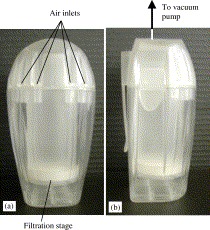
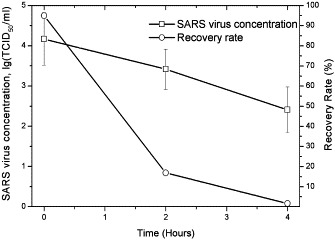
Due to recent SARS related issues (Science 300 (5624) 1394; Nature 423 (2003) 240; Science 300 (5627) 1966), the development of reliable airborne virus monitoring procedures has become galvanized by an exceptional sense of urgency and is presently in a high demand (In: Cox, C.S., Wathers, C.M. (Eds.), Bioaerosols Handbook, Lewis Publishers, Boca Raton, FL, 1995, pp. 247-267). Based on engineering control method (Aerosol Science and Technology 31 (1999) 249; 35 (2001) 852), which was previously applied to the removal of particles from gas carriers, a new personal bioaerosol sampler has been developed. Contaminated air is bubbled through porous medium submerged into liquid and subsequently split into multitude of very small bubbles. The particulates are scavenged by these bubbles, and, thus, effectively removed. The current study explores its feasibility for monitoring of viable airborne SARS virus. It was found that the natural decay of such virus in the collection fluid was around 0.75 and 1.76 lg during 2 and 4 h of continuous operation, respectively. Theoretical microbial recovery rates of higher than 55 and 19% were calculated for 1 and 2 h of operation, respectively. Thus, the new sampling method of direct non-violent collection of viable airborne SARS virus into the appropriate liquid environment was found suitable for monitoring of such stress sensitive virus.
Keywords: Bioaerosol; Collection efficiency; Personal monitoring; SARS; Viable microorganisms.
Copyright © 2004 Elsevier Ltd. All rights reserved.
Figures
References
-
- Agranovski I, Myojo T, Braddock R.D. Removal of aerosols by bubbling through porous media. Aerosol Science and Technology. 1999;31:249–257.
-
- Agranovski I, Myojo T, Braddock R.D. Comparative study of the performance of nine filters utilized in filtration of aerosols by bubbling. Aerosol Science and Technology. 2001;35:852–859.
-
- Agranovski I, Agranovski V, Grinshpun S, Reponen T, Willeke K. Collection of airborne microorganisms into liquid by bubbling through porous medium. Aerosol Science and Technology. 2002;36:502–509.
-
- Agranovski I, Agranovski V, Reponen T, Willeke K, Grinshpun S. Development and evaluation of a new personal sampler for viable airborne microorganisms. Atmospheric. Environment. 2002;36:889–898.
-
- Comtois P, Isard S. Aerobiology: coming of age in a new millennium. Aerobiologia. 1999;15:259–266.
Grants and funding
LinkOut - more resources
Full Text Sources
Miscellaneous