


Chikungunya fever - A new global threat
- PMID: 32289075
- PMCID: PMC7140256
- DOI: 10.1016/j.medcle.2014.05.013
Chikungunya fever - A new global threat
Abstract
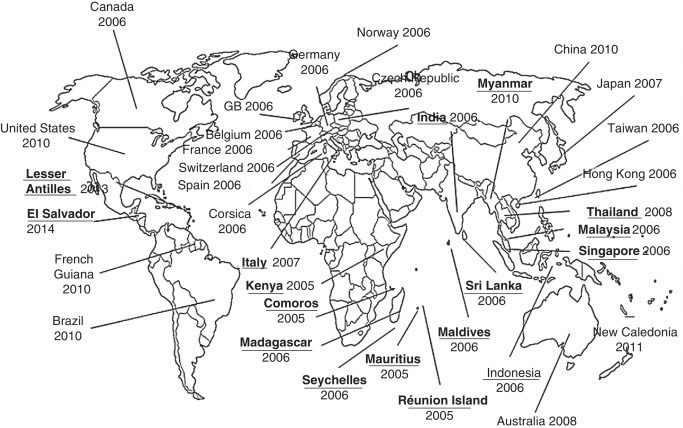
The recent onset of epidemics caused by viruses such as Ebola, Marburg, Nipah, Lassa, coronavirus, West-Nile encephalitis, Saint Louis encephalitis, human immunodeficiency virus, dengue, yellow fever and Venezuelan haemorrhagic fever alerts about the risk these agents represent for the global health. Chikungunya virus represents a new threat. Surged from remote African regions, this virus has become endemic in the Indic ocean basin, the Indian subcontinent and the southeast of Asia, causing serious epidemics in Africa, Indic Ocean Islands, Asia and Europe. Due to their epidemiological and biological features and the global presence of their vectors, chikungunya represents a serious menace and could become endemic in the Americas. Although chikungunya infection has a low mortality rate, its high attack ratio may collapse the health system during epidemics affecting a sensitive population. In this paper, we review the clinical and epidemiological features of chikungunya fever as well as the risk of its introduction into the Americas. We remark the importance of the epidemiological control and mosquitoes fighting in order to prevent this disease from being introduced into the Americas.
Las epidemias causadas, entre otros, por los virus Ébola, Marburgo, Nipah, Lassa, coronavirus, virus del Nilo Occidental, virus de Saint Louis, virus de la inmunodeficiencia humana, dengue, fiebre amarilla y fiebre hemorrágica venezolana han puesto sobre el tapete el riesgo que estos agentes representan para la salud pública global.Entre las nuevas amenazas destaca el virus chikungunya, que ha extendido rápidamente su área endémica desde regiones remotas de África hacia la cuenca del océano Índico y el Pacífico Oriental, causando importantes epidemias en África, Asia, islas del Índico y Europa Occidental, llegando a establecerse recientemente en islas del Caribe.Debido a su comportamiento dual endémico y epidémico, a sus propiedades virológicas y a la presencia global de sus vectores, este virus entraña el riesgo de causar grandes epidemias e instalarse en el territorio continental de las Américas a partir de la introducción de casos importados y a la circulación local vista en la región caribeña.Se revisan las principales características epidemiológicas y clínicas de la fiebre chikungunya y el riesgo de introducción de esta enfermedad en las Américas, enfatizando el rol de la vigilancia y la lucha contra los mosquitos en su prevención.
Keywords: Chikungunya; Emerging infections; Tropical medicine.
Copyright © 2014 Elsevier España, S.L.U. All rights reserved.
Figures


References
-
- Mason P.J., Haddow A.J. An epidemic of virus disease in Southern Province, Tanganyika Territory, in 1952–53. An additional note on Chikungunya virus isolations and serum antibodies. Trans R Soc Trop Med Hyg. 1957;51:238–240. - PubMed
-
- Robinson M.C. An epidemic of virus disease in Southern Province, Tanganyika territory, in 1952–53. Trans R Soc Trop Med Hyg. 1955;49:28–32. - PubMed
-
- Outbreak and spread of chikungunya. Wkly Epidemiol Rec. 2007;82:409–415. - PubMed
-
- Powers A.M., Logue C.H. Changing patterns of chikungunya virus: reemergence of a zoonotic arbovirus. J Gen Virol. 2007;88:2363–2377. - PubMed
-
- Renault P., Solet J.L., Sissoko D., Balleydier E., Larrieu S., Filleul L. A major epidemic of chikungunya virus infection on Reunion Island, France, 2005–2006. Am J Trop Med Hyg. 2007;77:727–731. - PubMed
Publication types
LinkOut - more resources
Full Text Sources
Other Literature Sources