Review
. 2020 Apr 10;12(4):935.
doi: 10.3390/cancers12040935.

Future Challenges in Cancer Resistance to Immunotherapy

Affiliations
Review

Future Challenges in Cancer Resistance to Immunotherapy

Marit J van Elsas et al. Cancers (Basel). .

Abstract

Cancer immunotherapies, including checkpoint inhibitors, adoptive T cell transfer and therapeutic cancer vaccines, have shown promising response rates in clinical trials. Unfortunately, there is an increasing number of patients in which initially regressing tumors start to regrow due to an immunotherapy-driven acquired resistance. Studies on the underlying mechanisms reveal that these can be similar to well-known tumor intrinsic and extrinsic primary resistance factors that precluded the majority of patients from responding to immunotherapy in the first place. Here, we discuss primary and secondary immune resistance and point at strategies to identify potential new mechanisms of immune evasion. Ultimately, this may lead to improved immunotherapy strategies with improved clinical outcomes.

Keywords: immunotherapy; primary resistance; secondary resistance.


Conflict of interest statement

The authors declare no conflict of interest.

Figures
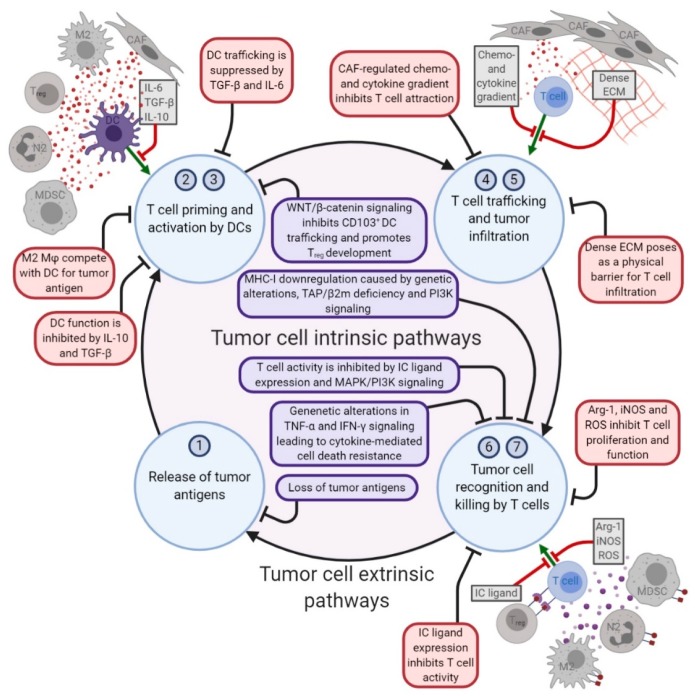
Figure 1
Figure 1
A simplified version of the cancer immunity cycle, adapted from Chen & Mellman [74] to show the tumor cell intrinsic and extrinsic pathways in T cell-based immunotherapy resistance. The numbers refer to steps in the original cancer immunity cycle. 1. The release of cancer cell antigens (cancer cell death); 2. Cancer antigen presentation (dendritic cells/APCs); 3. Priming and activation (Antigen Presenting Cells (APCs) & T cells); 4. The trafficking of T cells to tumors (Cytotoxic T Lymphocytes (CTLs)); 5. The infiltration of T cells into tumors (CTLs, endothelial cells); 6. The recognition of cancer cells by T cells (CTLs, cancer cells); 7. The killing of cancer cells (immune and cancer cells). Created with BioRender.com.
Figure 2
Figure 2
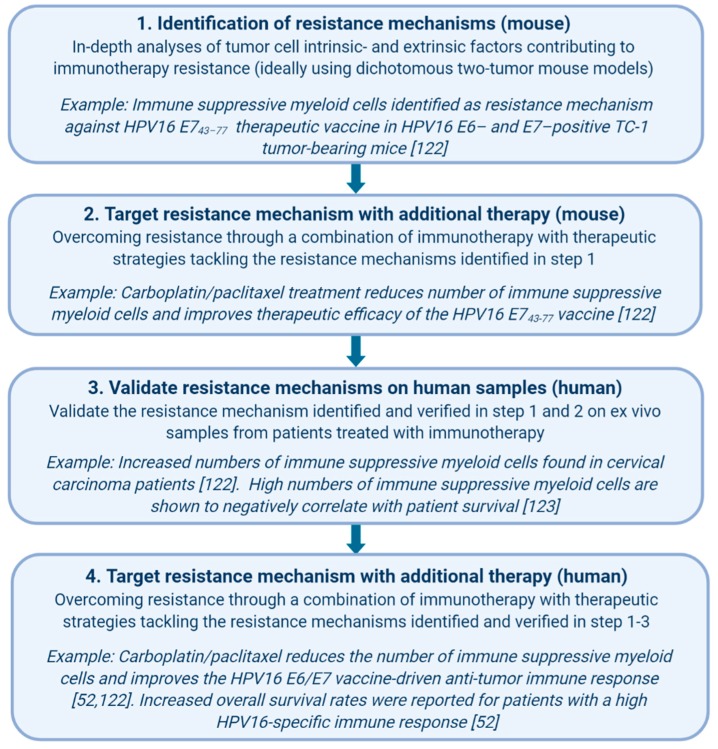
A workflow for the identification and validation of immunotherapy resistance mechanisms. Created with BioRender.com.

References

    1. Bray F., Ferlay J., Soerjomataram I., Siegel L R., Torre A.L., Jemal A. Global cancer statistics 2018: GLOBOCAN estimates of incidence and mortality worldwide for 36 cancers in 185 countries. CA Cancer J. Clin. 2018;68:394–424. doi: 10.3322/caac.21492. - DOI - PubMed
    1. Van der Burg S.H. Correlates of immune and clinical activity of novel cancer vaccines. Semin. Immunol. 2018;39:119–136. doi: 10.1016/j.smim.2018.04.001. - DOI - PubMed
    1. Helissey C., Vicier C., Champiat S. The development of immunotherapy in older adults: New treatments, new toxicities? J. Geriatr. Oncol. 2016;7:325–333. doi: 10.1016/j.jgo.2016.05.007. - DOI - PubMed
    1. Linsley P.S., Greene J.L., Brady W., Bajorath J., Ledbetter J.A., Peach R. Human B7-1 (CD80) and B7-2 (CD86) bind with similar avidities but distinct kinetics to CD28 and CTLA-4 receptors. Immunity. 1994;1:793–801. doi: 10.1016/S1074-7613(94)80021-9. - DOI - PubMed
    1. Riley J.L., Mao M., Kobayashi S., Biery M., Burchard J., Cavet G., Gregson B.P., June C.H., Linsley P.S. Modulation of TCR-induced transcriptional profiles by ligation of CD28, ICOS, and CTLA-4 receptors. Proc. Natl. Acad. Sci. USA. 2002;99:11790–11795. doi: 10.1073/pnas.162359999. - DOI - PMC - PubMed

LinkOut - more resources