


Azaphilones from the Red Sea Fungus Aspergillus falconensis
- PMID: 32290208
- PMCID: PMC7231052
- DOI: 10.3390/md18040204
Azaphilones from the Red Sea Fungus Aspergillus falconensis
Abstract
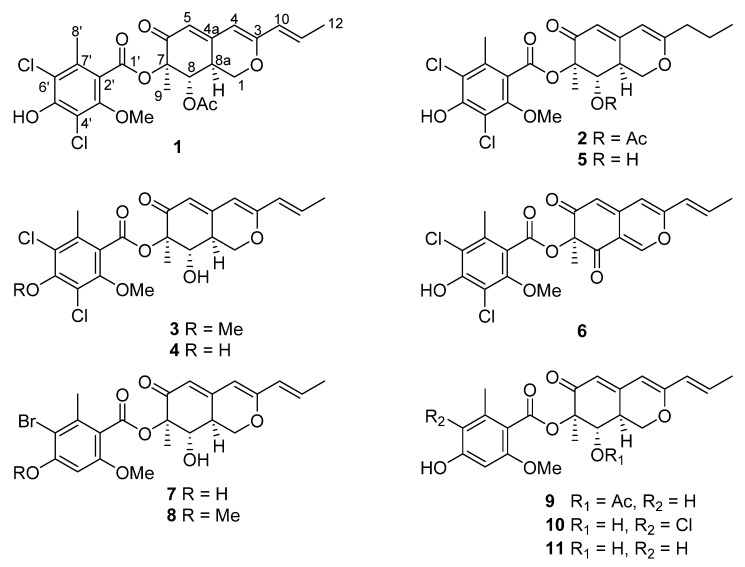
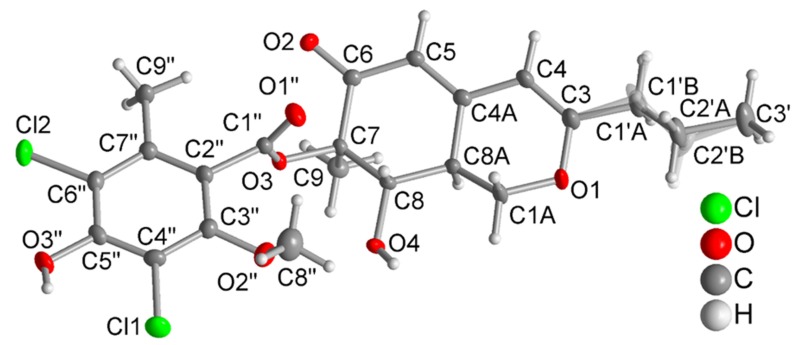
The marine-derived fungus Aspergillus falconensis, isolated from sediment collected from the Canyon at Dahab, Red Sea, yielded two new chlorinated azaphilones, falconensins O and P (1 and 2) in addition to four known azaphilone derivatives (3-6) following fermentation of the fungus on solid rice medium containing 3.5% NaCl. Replacing NaCl with 3.5% NaBr induced accumulation of three additional new azaphilones, falconensins Q-S (7-9) including two brominated derivatives (7 and 8) together with three known analogues (10-12). The structures of the new compounds were elucidated by 1D and 2D NMR spectroscopy and HRESIMS data as well as by comparison with the literature. The absolute configuration of the azaphilone derivatives was established based on single-crystal X-ray diffraction analysis of 5, comparison of NMR data and optical rotations as well as on biogenetic considerations. Compounds 1, 3-9, and 11 showed NF-κB inhibitory activity against the triple negative breast cancer cell line MDA-MB-231 with IC50 values ranging from 11.9 to 72.0 µM.
Keywords: Aspergillus falconensis; NF-κB inhibition; OSMAC; X-ray diffraction; azaphilones.
Conflict of interest statement
The authors declare no conflict of interest.
Figures
References
-
- Fenical W., Jensen P.R., Cheng X.C. Halimide, A Cytotoxic Marine Natural Product, and Derivatives Thereof. No. 6,069,146. U.S. Patent. 2000 May 30;
-
- Petersen L.E., Kellermann M.Y., Schupp P.J. Secondary metabolites of marine microbes: From natural products chemistry to chemical ecology. In: Jungblut S., Liebich V., Bode-Dalby M., editors. YOUMARES 9-The oceans: Our Research, our Future. Springer International Publishing; Cham, Switzerland: 2020. pp. 159–180.
MeSH terms
Substances
Grants and funding
LinkOut - more resources
Full Text Sources
Miscellaneous
