Review
. 2020 Apr 10;11(4):239.
doi: 10.3390/insects11040239.

Diversity and Global Distribution of Viruses of the Western Honey Bee, Apis mellifera

Affiliations
Review

Diversity and Global Distribution of Viruses of the Western Honey Bee, Apis mellifera

Alexis Beaurepaire et al. Insects. .

Abstract

In the past centuries, viruses have benefited from globalization to spread across the globe, infecting new host species and populations. A growing number of viruses have been documented in the western honey bee, Apis mellifera. Several of these contribute significantly to honey bee colony losses. This review synthetizes the knowledge of the diversity and distribution of honey-bee-infecting viruses, including recent data from high-throughput sequencing (HTS). After presenting the diversity of viruses and their corresponding symptoms, we surveyed the scientific literature for the prevalence of these pathogens across the globe. The geographical distribution shows that the most prevalent viruses (deformed wing virus, sacbrood virus, black queen cell virus and acute paralysis complex) are also the most widely distributed. We discuss the ecological drivers that influence the distribution of these pathogens in worldwide honey bee populations. Besides the natural transmission routes and the resulting temporal dynamics, global trade contributes to their dissemination. As recent evidence shows that these viruses are often multihost pathogens, their spread is a risk for both the beekeeping industry and the pollination services provided by managed and wild pollinators.

Keywords: emerging infectious diseases; epidemiology; honey bee health; invasive species; pathogens; social insects; viruses.


Conflict of interest statement

The authors declare no conflict of interest.

Figures
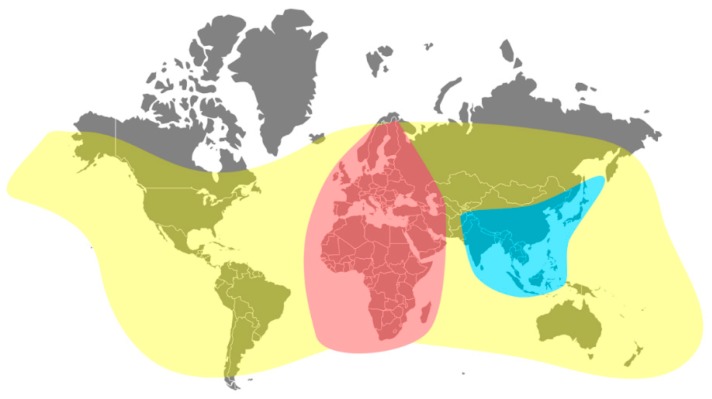
Figure 1
Figure 1
Distribution of domesticated honey bees (A. mellifera and A. cerana). Native and current distribution of the Western (A. mellifera) and Eastern (A. cerana) honey bees. Red: native range of A. mellifera. Yellow: current distribution of A. mellifera. Blue: native range of A. cerana. Current distribution was derived from ‘research grade’ observations on iNaturalist (www.inaturalist.org). Native range of A. mellifera and A. cerana from [116,117].
Figure 2
Figure 2
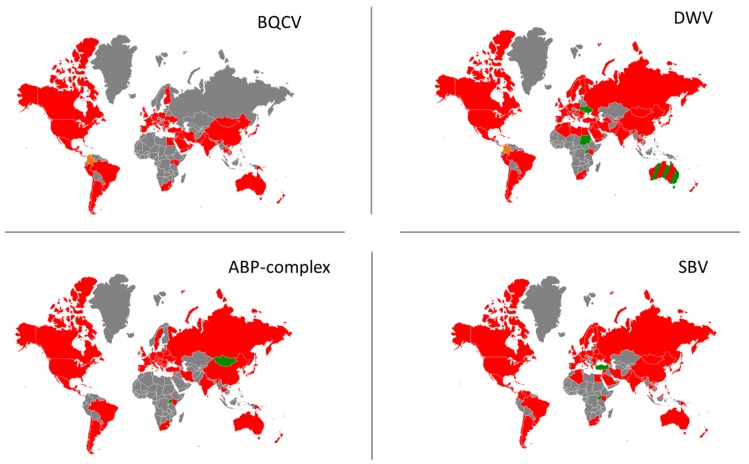
World maps depicting the viral distribution of DWV, BQCV, SBV and the acute bee paralysis complex in A. mellifera. Top left: global distribution of BQCV. Top right: global distribution of DWV. Bottom left: global distribution of the acute bee paralysis complex. Bottom right: global distribution of SBV. Red indicates that at least one study in the respective country has reported the presence of this virus. Green indicates that no study has detected the virus in their screening in the respective country. Orange indicates that the virus has been detected but only in bumblebees. Grey indicates absence of data.
Figure 3
Figure 3
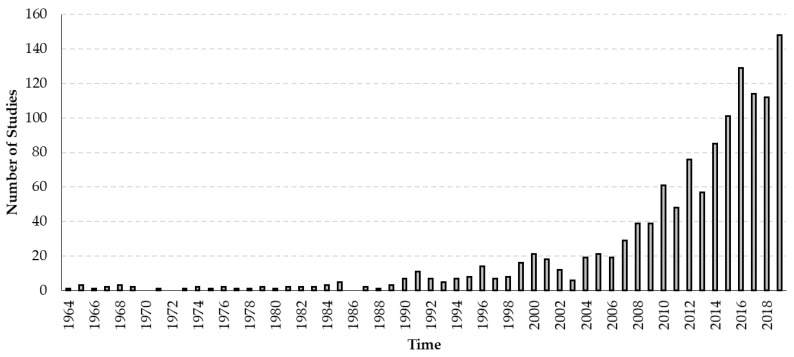
Increase of the number of studies on viruses of honey bees. Graph representing the temporal evolution of the number of studies published in scientific peer-reviewed journals.

References

    1. Kolar C.S., Lodge D.M. Progress in invasion biology: Predicting invaders. Trends Ecol. Evol. 2001;16:199–204. doi: 10.1016/S0169-5347(01)02101-2. - DOI - PubMed
    1. Tatem A.J., Rogers D.J., Hay S.I. Global transport networks and infectious disease spread. Adv. Parasitol. 2006;62:293–343. - PMC - PubMed
    1. Essl F., Dullinger S., Rabitsch W., Hulme P.E., Hülber K., Jarošík V., Kleinbauer I., Krausmann F., Kühn I., Nentwig W., et al. Socioeconomic legacy yields an invasion debt. Proc. Natl. Acad. Sci. USA. 2011;108:203–207. doi: 10.1073/pnas.1011728108. - DOI - PMC - PubMed
    1. Daszak P., Cunningham A.A., Hyatt A.D. Emerging infectious diseases of wildlife—Threats to biodiversity and human health. Science. 2000;287:443–449. doi: 10.1126/science.287.5452.443. - DOI - PubMed
    1. Jones K.E., Patel N.G., Levy M.A., Storeygard A., Balk D., Gittleman J.L., Daszak P. Global trends in emerging infectious diseases. Nature. 2008;451:990–993. doi: 10.1038/nature06536. - DOI - PMC - PubMed