Review
. 2020 Apr 12;12(4):434.
doi: 10.3390/v12040434.

HCV Interplay with Lipoproteins: Inside or Outside the Cells?

Affiliations
Review

HCV Interplay with Lipoproteins: Inside or Outside the Cells?

François-Loïc Cosset et al. Viruses. .

Abstract

Hepatitis C virus (HCV) infection is a major public health issue leading to chronic liver diseases. HCV particles are unique owing to their particular lipid composition, namely the incorporation of neutral lipids and apolipoproteins. The mechanism of association between HCV virion components and these lipoproteins factors remains poorly understood as well as its impact in subsequent steps of the viral life cycle, such as entry into cells. It was proposed that the lipoprotein biogenesis pathway is involved in HCV morphogenesis; yet, recent evidence indicated that HCV particles can mature and evolve biochemically in the extracellular medium after egress. In addition, several viral, cellular and blood components have been shown to influence and regulate this specific association. Finally, this specific structure and composition of HCV particles was found to influence entry into cells as well as their stability and sensitivity to neutralizing antibodies. Due to its specific particle composition, studying the association of HCV particles with lipoproteins remains an important goal towards the rational design of a protective vaccine.

Keywords: cell entry; hepatitis C virus; immune escape; lipidation; lipoproteins.


Conflict of interest statement

The authors declare no conflict of interest.

Figures
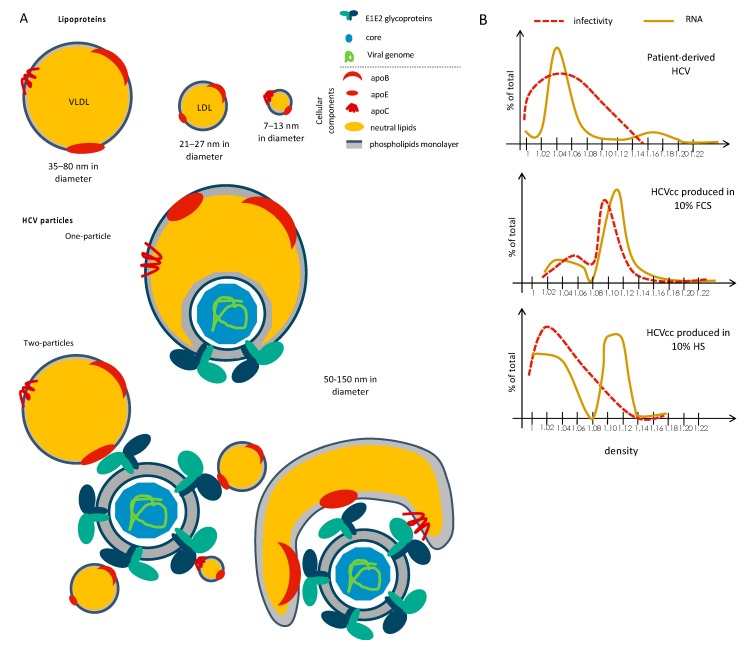
Figure 1
Figure 1
Unique composition and structure of Hepatitis C virus (HCV) particles. (A) Schematic representation of lipoproteins and two proposed models of HCV particles, depicted as “one-particle” or “two-particles” models. Viral particles are composed of both cellular (lipids and proteins) components and viral components (proteins and nucleic acids). (B) Schematic representation of buoyant density profiles of the infectivity and viral RNA of HCV particles produced in vivo from HCV-infected patients vs. ex vivo assays in the presence of 10% fetal calf serum (FCS) or human serum (HS).
Figure 2
Figure 2
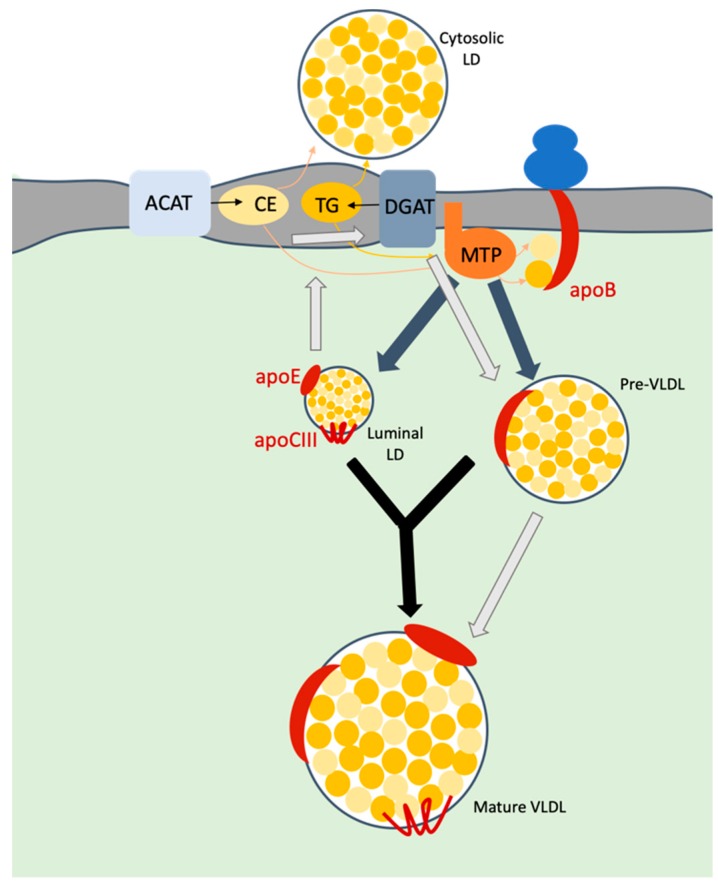
Model of VLDL biosynthesis. Upon translocation of apoB into ER lumen, microsomal transfer protein (MTP) transfers triglycerides (TG) and cholesterol esters (CE) to this apolipoprotein. TG mainly originate through the action of the diacylglycerol acyltransferase-1 (DGAT1) protein whereas CE are derived from the action of acyl-CoA cholesterol acyltransferase (ACAT). Both neutral lipids accumulate within the membrane bilayer and are recruited to form either cytosolic or luminal lipid droplets (LDs). MTP is responsible for the formation of a pre-VLDL as well as of luminal LDs (grey arrows). The maturation of VLDLs is thought to occur either via the fusion of the pre-VLDLs with luminal LDs (black arrows) or through a cascade of hydrolysis/re-esterification of TG from LDs (light grey arrows). Mature VLDL are then secreted in the extracellular medium.
Figure 3
Figure 3
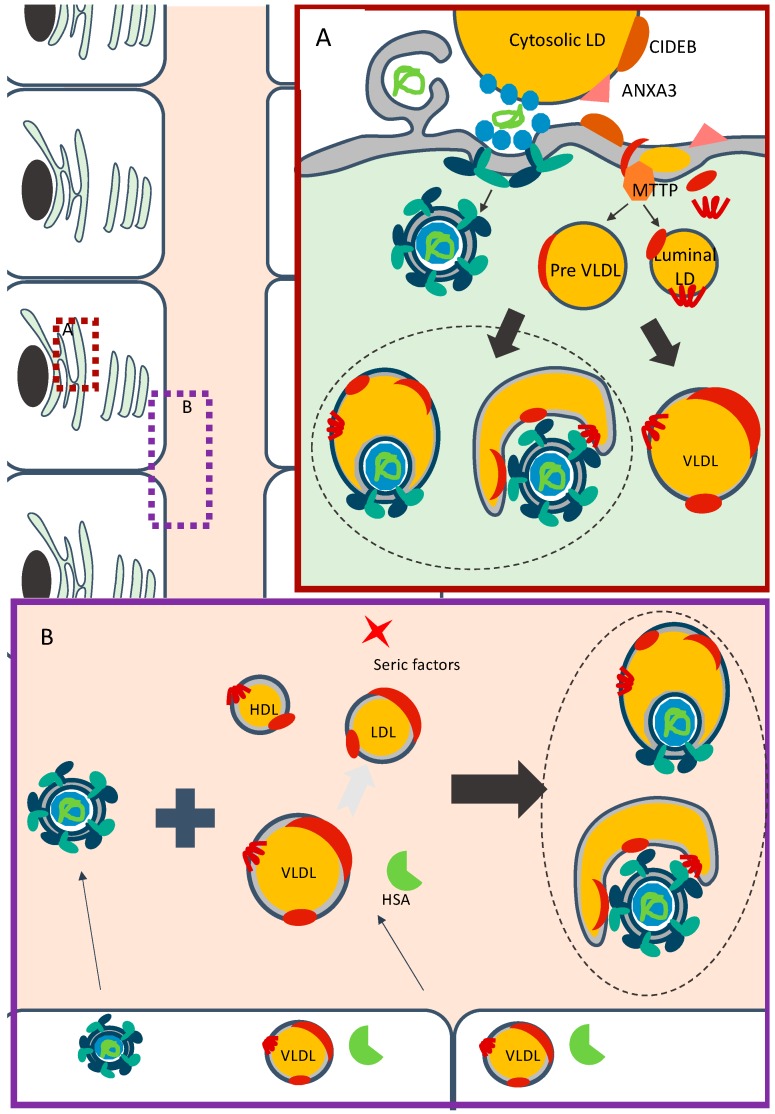
Models for association of HCV with lipoproteins components. (A) Model for association of HCV particles within infected cells. HCV replication takes place in double-membrane vesicles (for simplicity, the non-structural proteins are not depicted). The early stages of assembly occur in close proximity between replication organelles and cytosolic LDs. Following or during their budding, HCV particles may associate with preVLDLs or with mature lipoproteins, and are secreted through a specific route. (B) Model for HCV particles maturation in the extracellular milieu. HCV particles, already associated or not with lipoproteins components, are secreted by infected hepatocytes. In the extracellular milieu, these particles could interact with lipoproteins and serum factors, which are secreted or not by the hepatocytes. With the help of human serum albumin (HSA) or alternative unidentified serum factors, HCV particles associate with the three classes of lipoproteins to generate mature infectious particles.

References

    1. Moradpour D., Penin F. Hepatitis c virus proteins: From structure to function. Curr. Top. Microbiol. Immunol. 2013;369:113–142. - PubMed
    1. Alazard-Dany N., Denolly S., Boson B., Cosset F.L. Overview of hcv life cycle with a special focus on current and possible future antiviral targets. Viruses. 2019;11:30. doi: 10.3390/v11010030. - DOI - PMC - PubMed
    1. Bartenschlager R., Baumert T.F., Bukh J., Houghton M., Lemon S.M., Lindenbach B.D., Lohmann V., Moradpour D., Pietschmann T., Rice C.M., et al. Critical challenges and emerging opportunities in hepatitis c virus research in an era of potent antiviral therapy: Considerations for scientists and funding agencies. Virus Res. 2018;248:53–62. doi: 10.1016/j.virusres.2018.02.016. - DOI - PubMed
    1. Scott N., Wilson D.P., Thompson A.J., Barnes E., El-Sayed M., Benzaken A.S., Drummer H.E., Hellard M.E. The case for a universal hepatitis c vaccine to achieve hepatitis c elimination. BMC Med. 2019;17:175. doi: 10.1186/s12916-019-1411-9. - DOI - PMC - PubMed
    1. Scott N., McBryde E., Vickerman P., Martin N.K., Stone J., Drummer H., Hellard M. The role of a hepatitis c virus vaccine: Modelling the benefits alongside direct-acting antiviral treatments. BMC Med. 2015;13:198. doi: 10.1186/s12916-015-0440-2. - DOI - PMC - PubMed

Publication types