Review
. 2020 Apr 12;9(4):1096.
doi: 10.3390/jcm9041096.

Inositol 1,4,5-Trisphosphate Receptors in Human Disease: A Comprehensive Update

Affiliations
Review

Inositol 1,4,5-Trisphosphate Receptors in Human Disease: A Comprehensive Update

Jessica Gambardella et al. J Clin Med. .

Abstract

Inositol 1,4,5-trisphosphate receptors (ITPRs) are intracellular calcium release channels located on the endoplasmic reticulum of virtually every cell. Herein, we are reporting an updated systematic summary of the current knowledge on the functional role of ITPRs in human disorders. Specifically, we are describing the involvement of its loss-of-function and gain-of-function mutations in the pathogenesis of neurological, immunological, cardiovascular, and neoplastic human disease. Recent results from genome-wide association studies are also discussed.

Keywords: Alzheimer; GWAS; IP3 Receptors; ITPRs; ataxia; autoimmune disease; cancer; cardiovascular disease; diabetes; mutations.


Conflict of interest statement

The authors declare no conflict of interest.

Figures
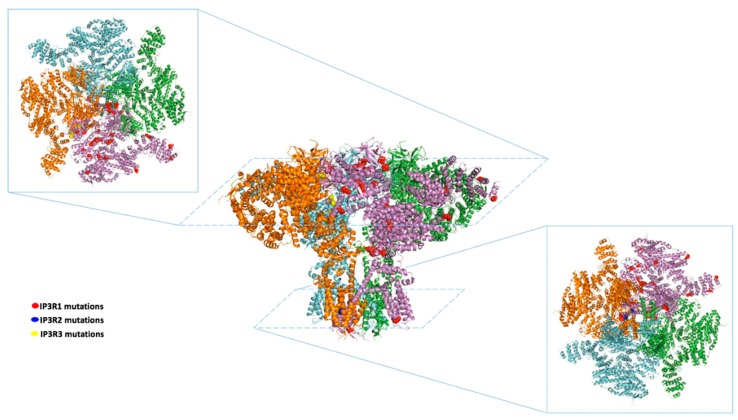
Figure 1
Figure 1
Representative structure of inositol 1,4,5-trisphosphate receptors (ITPRs) (1-3) showing disease-related mutations. In the middle, representative “mushroom-like structure” of ITPRs. For clarity, only the crystal of human isoform 3 is shown. Top left corner: View from the top; bottom right corner: View from the bottom. The residues in red, blue, and yellow indicate the mutations in ITPR1, 2, and 3, respectively, that have been hitherto reported in humans.

References

    1. Mikoshiba K., Changeux J.P. Morphological and biochemical studies on isolated molecular and granular layers from bovine cerebellum. Brain Res. 1978;142:487–504. doi: 10.1016/0006-8993(78)90911-3. - DOI - PubMed
    1. Mikoshiba K., Huchet M., Changeux J.P. Biochemical and immunological studies on the P400 protein, a protein characteristic of the Purkinje cell from mouse and rat cerebellum. Dev. Neurosci. 1979;2:254–275. doi: 10.1159/000112489. - DOI - PubMed
    1. Crepel F., Dupont J.L., Gardette R. Selective absence of calcium spikes in Purkinje cells of staggerer mutant mice in cerebellar slices maintained in vitro. J. Physiol. 1984;346:111–125. doi: 10.1113/jphysiol.1984.sp015010. - DOI - PMC - PubMed
    1. Maeda N., Niinobe M., Nakahira K., Mikoshiba K. Purification and characterization of P400 protein, a glycoprotein characteristic of Purkinje cell, from mouse cerebellum. J. Neurochem. 1988;51:1724–1730. doi: 10.1111/j.1471-4159.1988.tb01151.x. - DOI - PubMed
    1. Furuichi T., Yoshikawa S., Miyawaki A., Wada K., Maeda N., Mikoshiba K. Primary structure and functional expression of the inositol 1,4,5-trisphosphate-binding protein P400. Nature. 1989;342:32–38. doi: 10.1038/342032a0. - DOI - PubMed

LinkOut - more resources
