


Body Composition in Young Adults Living With a Fontan Circulation: The Myopenic Profile
- PMID: 32290749
- PMCID: PMC7428525
- DOI: 10.1161/JAHA.119.015639
Body Composition in Young Adults Living With a Fontan Circulation: The Myopenic Profile
Abstract
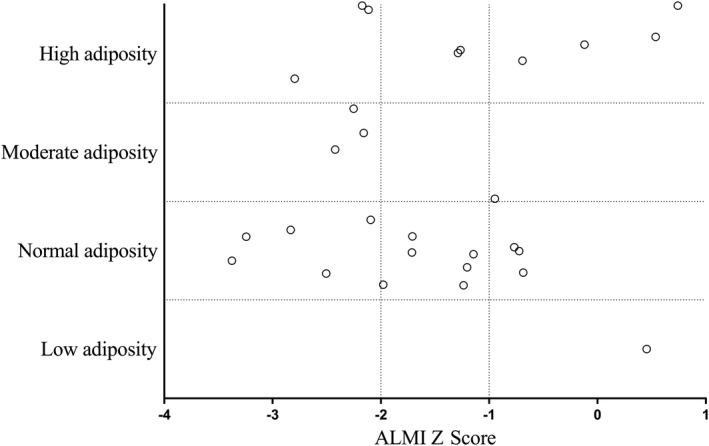
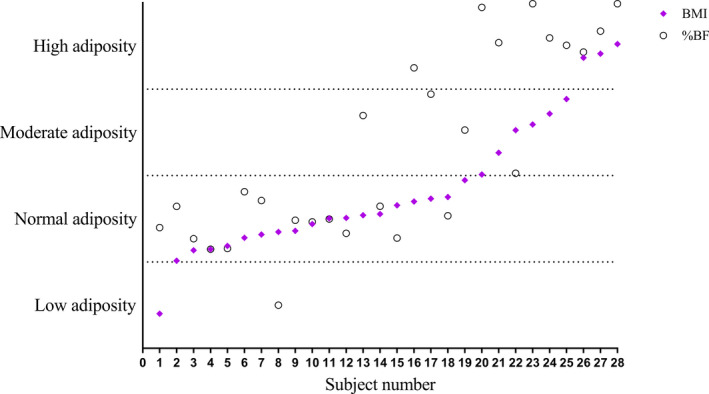
Background We sought to characterize body composition abnormalities in young patients living with a Fontan circulation and explore potential pathophysiologic associations. Methods and Results Twenty-eight patients with a Fontan circulation were prospectively recruited in this cross-sectional study. Participants underwent cardiopulmonary exercise testing, dual-energy X-ray absorptiometry, echocardiography, and biochemical assessment. Mean age was 26±7 years. Skeletal muscle mass, estimated by appendicular lean mass index Z score, was reduced compared with reference data (-1.49±1.10, P<0.001). Percentage body fat Z score overall was within normal range (0.23±1.26, P=0.35), although 46% had elevated adiposity. Those with reduced skeletal muscle mass (appendicular lean mass index Z score of -1 or lower) had lower percent predicted oxygen pulse (55±15 versus 76±16%, P=0.002). Overall agreement between body mass index and dual-energy X-ray absorptiometry to assess adiposity was fair only (weighted [linear] κ coefficient: 0.53; 95% CI, 0.34-0.73) and slight in the setting of muscle mass deficiency (weighted κ coefficient: 0.32; 95% CI, 0.13-0.50). Appendicular lean mass was independently associated with absolute peak VO2 (β=70.6 mL/min, P=0.001). Appendicular lean mass index Z score was inversely associated with hemoglobin (r=-0.4, P=0.04), and the degree of muscle deficit was associated with ventricular systolic impairment. Conclusions Young patients with a Fontan circulation have a body composition characterized by reduced skeletal muscle mass, which is associated with peak exercise capacity. Increased adiposity is common despite a normal body mass index. Low skeletal muscle mass is associated with systolic dysfunction and compensatory erythrocytosis.
Keywords: congenital heart disease; exercise capacity; muscle wasting; obesity; single ventricle.
Figures
References
-
- d'Udekem Y, Iyengar AJ, Galati JC, Forsdick V, Weintraub RG, Wheaton GR, Bullock A, Justo RN, Grigg LE, Sholler GF, et al. Redefining expectations of long‐term survival after the fontan procedure: twenty‐five years of follow‐up from the entire population of Australia and New Zealand. Circulation. 2014;130:S32–S38. - PubMed
-
- Cordina R, O'Meagher S, Gould H, Rae C, Kemp G, Pasco JA, Celermajer DS, Singh N. Skeletal muscle abnormalities and exercise capacity in adults with a fontan circulation. Heart. 2013;99:1530–1534. - PubMed
-
- Sandberg C, Johansson K, Christersson C, Hlebowicz J, Thilen U, Johansson B. Sarcopenia is common in adults with complex congenital heart disease. Int J Cardiol. 2019;296:57–62. - PubMed
Publication types
MeSH terms
LinkOut - more resources
Full Text Sources
Medical
