


Patterns of chromosome 18 loss of heterozygosity in multifocal ileal neuroendocrine tumors
- PMID: 32291827
- PMCID: PMC7384092
- DOI: 10.1002/gcc.22850
Patterns of chromosome 18 loss of heterozygosity in multifocal ileal neuroendocrine tumors
Erratum in
-
ERRATUM.Genes Chromosomes Cancer. 2022 Sep;61(9):579. doi: 10.1002/gcc.23078. Genes Chromosomes Cancer. 2022. PMID: 35809044 Free PMC article. No abstract available.
Abstract
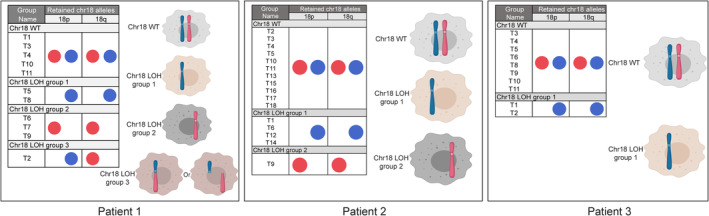
Ileal neuroendocrine tumors (NETs) represent the most common neoplasm of the small intestine. Although up to 50% of patients with ileal NETs are diagnosed with multifocal disease, the mechanisms by which multifocal ileal NETs arise are not yet understood. In this study, we analyzed genome-wide sequencing data to examine patterns of copy number variation in 40 synchronous primary ileal NETs derived from three patients. Chromosome (chr) 18 loss of heterozygosity (LOH) was the most frequent copy number alteration identified; however, not all primary tumors from the same patient had evidence of this LOH. Our data revealed three distinct patterns of chr18 allelic loss, indicating that primary tumors from the same patient can present different LOH patterns including retention of either parental allele. In conclusion, our results are consistent with the model that multifocal ileal NETs originate independently. In addition, they suggest that there is no specific germline allele on chr18 that is the target of somatic LOH.
Keywords: chromosome 18; copy number variation; high-throughput sequencing; ileal neuroendocrine tumor; loss of heterozygosity.
© 2020 The Authors. Genes, Chromosomes & Cancer published by Wiley Periodicals, Inc.
Conflict of interest statement
The authors declare that they have no conflicts of interest with the contents of this article. However, Dr Meyerson declares the following general conflicts of interest: research support from Bayer, Ono, Novo, and Janssen; patent licensing royalties from LabCorp; and serving as scientific advisory board chair and consultant for OrigiMed.
Figures
References
-
- Bilimoria KY, Bentrem DJ, Wayne JD, Ko CY, Bennett CL, Talamonti MS. Small bowel cancer in the United States: changes in epidemiology, treatment, and survival over the last 20 years. Ann Surg. 2009;249(1):63‐71. - PubMed
-
- Yao JC, Hassan M, Phan A, et al. One hundred years after “carcinoid”: epidemiology of and prognostic factors for neuroendocrine tumors in 35,825 cases in the United States. J Clin Oncol. 2008;26(18):3063‐3072. - PubMed
-
- Norlén O, Stålberg P, Öberg K, et al. Long‐term results of surgery for small intestinal neuroendocrine tumors at a tertiary referral center. World J Surg. 2012;36(6):1419‐1431. - PubMed
