


Ki-67 index, progesterone receptor expression, histologic grade and tumor size in predicting breast cancer recurrence risk: A consecutive cohort study
- PMID: 32291973
- PMCID: PMC7170660
- DOI: 10.1002/cac2.12024
Ki-67 index, progesterone receptor expression, histologic grade and tumor size in predicting breast cancer recurrence risk: A consecutive cohort study
Abstract
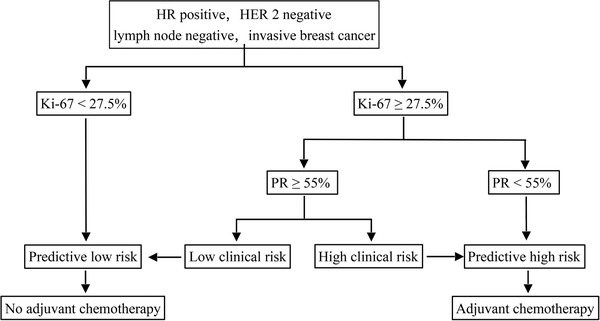
Background: The 21-gene recurrence score (RS) assay has been recommended by major guidelines for treatment decision in hormone receptor (HR)-positive early breast cancer (EBC). However, the genomic assay is not accessible and affordable worldwide. Alternatively, an increasing number of studies have shown that traditional immunohistochemistry (IHC) can partially or even completely replace the role of the 21-gene genomic assay. Here, we developed and validated a predictive model (IHC3 model) combining the Ki-67 index, progesterone receptor (PR) expression, histologic grade, and tumor size to predict the recurrence risk of HR-positive EBC.
Methods: The data from 389 patients (development set) with HR-positive, human epidermal growth factor receptor 2-negative, lymph node non-metastasized invasive breast cancer were used to construct the IHC3 model based on the Surexam® 21-gene RS and the TAILORx clinical trial criteria. An additional 146 patients with the same characteristics constituted the validation set. The predictive accuracy of the IHC3 model was compared with that of Orucevic et al.'s nomogram. Invasive disease-free survival (IDFS) was analyzed in the IHC3 predictive low-recurrence risk (pLR) group and the predictive high-recurrence risk (pHR) group. The Pearson chi-square test, Fisher exact test, and log-rank test were used for analysis.
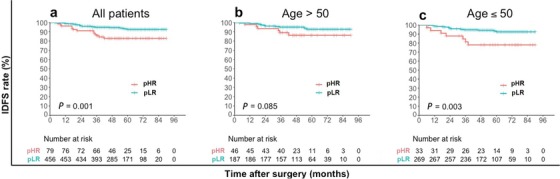
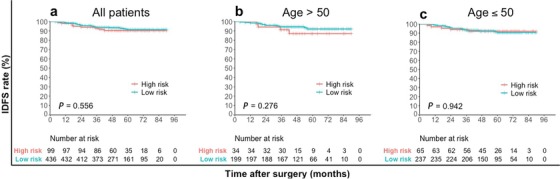
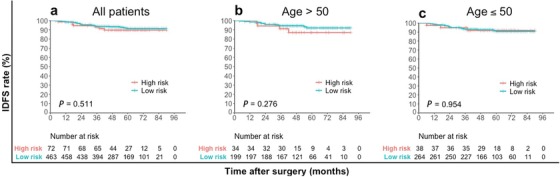
Results: The pLR and pHR group could be easily stratified using the decision tree model without network dependence. The accuracies of the IHC3 model were 86.1% in the development set and 87.7% in the validation set. The predictive accuracy of the IHC3 model and Orucevic et al.'s nomogram for the whole cohort was 86.5% and 86.9%, respectively. After a 52-month of median follow-up, a significant difference was found in IDFS between of the IHC3 pLR and the pHR groups (P = 0.001) but not in the IDFS between the low- and high-recurrence risk groups according to the Surexam® 21-gene RS and the TAILORx clinical trial criteria (P = 0.556) or 21-gene binary RS group (P = 0.511).
Conclusions: The proposed IHC3 model could reliably predict low and high recurrence risks in most HR-positive EBC patients. This easy-to-use predictive model may be a reliable replacement for the 21-gene genomic assay in patients with EBC who have no access to or cannot afford the 21-gene genomic assay.
Keywords: 21-gene genomic assay; Ki-67; breast cancer; histologic grade; progesterone receptor; recurrence score.
© 2020 The Authors. Cancer Communications published by John Wiley & Sons Australia, Ltd. on behalf of Sun Yat-sen University Cancer Center.
Conflict of interest statement
All authors declare that they have no competing interests.
Figures
References
-
- Harbeck N, Gnant M. Breast cancer. Lancet. 2017;389(10074):1134‐50. - PubMed
-
- Bray F, Ferlay J, Soerjomataram I, Siegel RL, Torre LA, Jemal A. Global cancer statistics 2018: GLOBOCAN estimates of incidence and mortality worldwide for 36 cancers in 185 countries. CA Cancer J Clin. 2018;68(6):394‐424. - PubMed
-
- Siegel RL, Miller KD, Jemal A. Cancer statistics, 2018. CA Cancer J Clin. 2018;68(1):7‐30. - PubMed
-
- Goetz MP, Gradishar WJ, Anderson BO, Abraham J, Aft R, Allison KH, et al. NCCN Guidelines Insights: Breast Cancer, Version 3.2018. J Natl Compr Canc Netw. 2019;17(2):118‐26. - PubMed
Publication types
MeSH terms
Substances
LinkOut - more resources
Full Text Sources
Medical
Research Materials
Miscellaneous
