


Pharmacokinetics and Metabolism of Naringin and Active Metabolite Naringenin in Rats, Dogs, Humans, and the Differences Between Species
- PMID: 32292344
- PMCID: PMC7118210
- DOI: 10.3389/fphar.2020.00364
Pharmacokinetics and Metabolism of Naringin and Active Metabolite Naringenin in Rats, Dogs, Humans, and the Differences Between Species
Abstract
Background: Pharmacokinetics provides a scientific basis for drug product design, dosage regimen planning, understanding the body's action on the drug, and relating the time course of the drug in the body to its pharmacodynamics and/or toxic effects. Recently, naringin, a natural flavonoid, was approved for clinical trials as a first-class new drug product by the China Food and Drug Administration, owing to its nonclinical efficacy in relieving cough, reducing sputum, and low toxicity. Previous reports focused on the pharmacokinetic studies of naringin or its active metabolite naringenin in rats, which were scattered and insufficient because naringin was coadministered with mixtures such as herbs, fruits, and other traditional medicines. The purpose of this study was to evaluate the pharmacokinetics and metabolism of naringin and naringenin, following oral and intravenous administration of naringin in rats, dogs, and humans, which can be beneficial for new drug development.
Methods: Separate bioanalytical methods were developed and validated to determine the concentrations of naringin and its active metabolite naringenin in biological samples obtained from rats, dogs, and humans. Comprehensive nonclinical and clinical data were used to estimate the pharmacokinetic parameters of naringin and naringenin. Experiments included single-dose studies (oral and intravenous administration), multiple-dose studies, and an assessment of food-effects. Furthermore, the metabolism of naringin and naringenin was studied in rat and human liver and kidney microsomes. All biological samples were analyzed using liquid chromatography-tandem mass spectrometry.
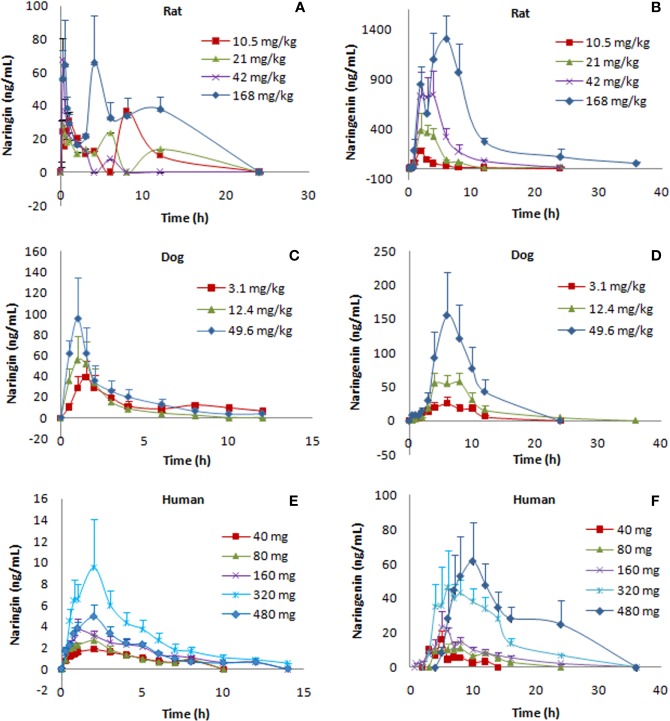
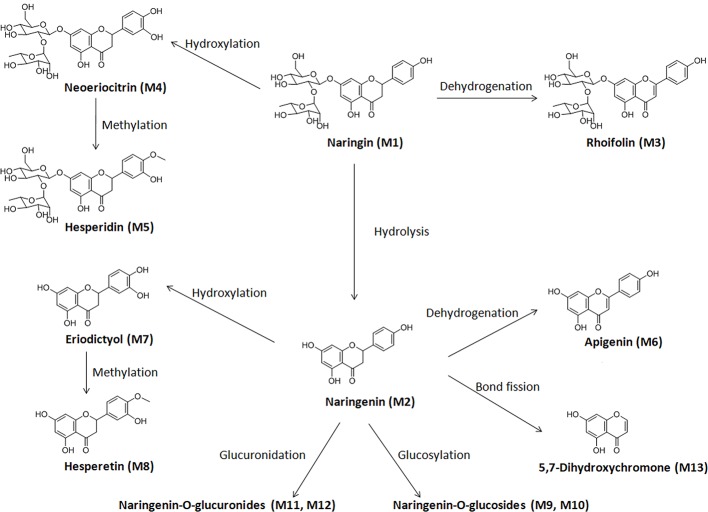
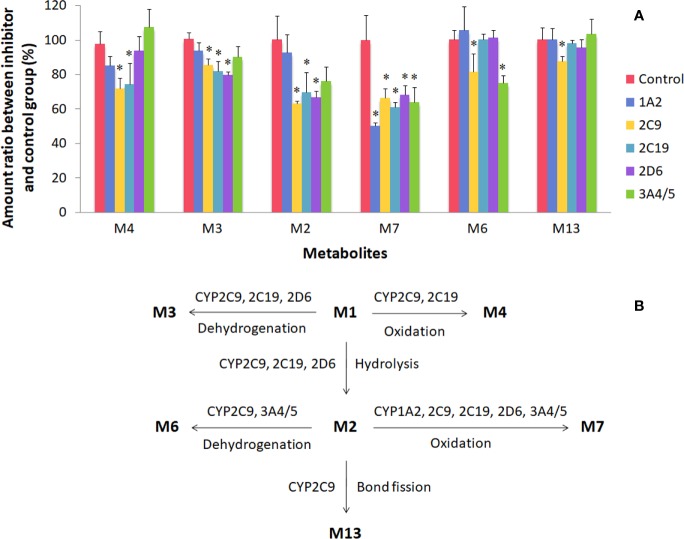
Results: The pharmacokinetic parameters of naringin and naringenin were calculated and the results show an insignificant influence of high-fat diet and insignificant accumulation of the drugs after multiple dosing. Twelve metabolites were detected in the liver and kidney microsomes of rats and humans; naringin metabolism was a complex process simultaneously catalyzed by multiple human enzymes. All evaluated species demonstrated differences in the pharmacokinetics and metabolism of naringin and naringenin.
Conclusion: The results can be used to design a dosage regimen, deepen understanding of mechanisms, and accelerate new drug development.
Clinical trial registration: http://www.chinadrugtrials.org.cn/eap/main, identifiers CTR20130704 and CTR20190127.
Keywords: dog; human; metabolism; naringenin; naringin; pharmacokinetics; rat; species differences.
Copyright © 2020 Bai, Peng, Yang, Zou, Liu, Wu, Fan, Li, Zeng and Su.
Figures
References
-
- Chinese Pharmacopoeia Commission (2015). Pharmacopoeia of the People’s Republic of China. Edition 2015. (Beijing: China Medical Sciences Press; ).
LinkOut - more resources
Full Text Sources
