


Facemask shortage and the novel coronavirus disease (COVID-19) outbreak: Reflections on public health measures
- PMID: 32292898
- PMCID: PMC7129293
- DOI: 10.1016/j.eclinm.2020.100329
Facemask shortage and the novel coronavirus disease (COVID-19) outbreak: Reflections on public health measures
Abstract
Background: A novel coronavirus disease (COVID-19) outbreak due to the severe respiratory syndrome coronavirus (SARS-CoV-2) infection occurred in China in late December 2019. Facemask wearing with proper hand hygiene is considered an effective measure to prevent SARS-CoV-2 transmission, but facemask wearing has become a social concern due to the global facemask shortage. China is the major facemask producer in the world, contributing to 50% of global production. However, a universal facemask wearing policy would put an enormous burden on the facemask supply.
Methods: We performed a policy review concerning facemasks using government websites and mathematical modelling shortage analyses based on data obtained from the National Health Commission (NHC), the Ministry of Industry and Information Technology (MIIT), the Centre for Disease Control and Prevention (CDC), and General Administration of Customs (GAC) of the People's Republic of China. Three scenarios with respect to wearing facemasks were considered: (1) a universal facemask wearing policy implementation in all regions of mainland China; (2) a universal facemask wearing policy implementation only in the epicentre (Hubei province, China); and (3) no implementation of a universal facemask wearing policy.
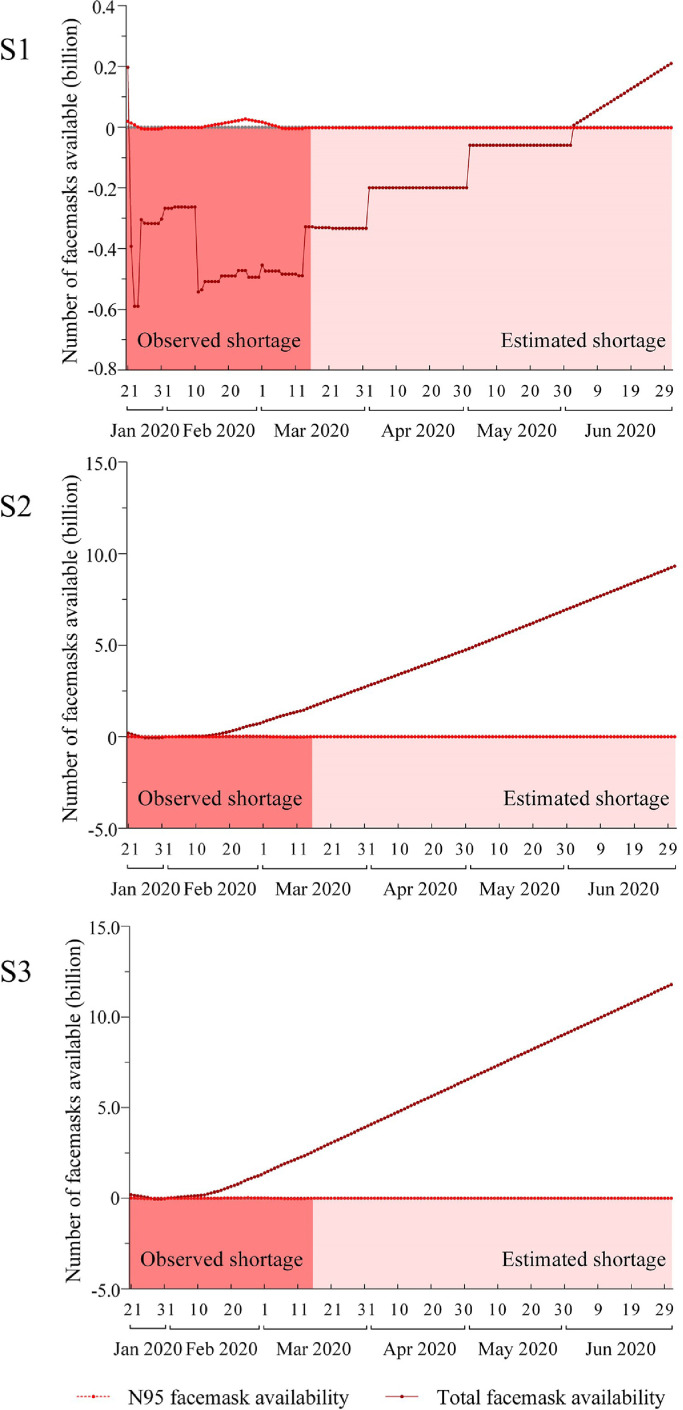
Findings: Regardless of different universal facemask wearing policy scenarios, facemask shortage would occur but eventually end during our prediction period (from 20 Jan 2020 to 30 Jun 2020). The duration of the facemask shortage described in the scenarios of a country-wide universal facemask wearing policy, a universal facemask wearing policy in the epicentre, and no universal facemask wearing policy were 132, seven, and four days, respectively. During the prediction period, the largest daily facemask shortages were predicted to be 589·5, 49·3, and 37·5 million in each of the three scenarios, respectively. In any scenario, an N95 mask shortage was predicted to occur on 24 January 2020 with a daily facemask shortage of 2·2 million.
Interpretation: Implementing a universal facemask wearing policy in the whole of China could lead to severe facemask shortage. Without effective public communication, a universal facemask wearing policy could result in societal panic and subsequently, increase the nationwide and worldwide demand for facemasks. These increased demands could cause a facemask shortage for healthcare workers and reduce the effectiveness of outbreak control in the affected regions, eventually leading to a pandemic. To fight novel infectious disease outbreaks, such as COVID-19, governments should monitor domestic facemask supplies and give priority to healthcare workers. The risk of asymptomatic transmission and facemask shortages should be carefully evaluated before introducing a universal facemask wearing policy in high-risk regions. Public health measures aimed at improving hand hygiene and effective public communication should be considered along with the facemask policy.
Keywords: COVID-19; Facemask shortage; Novel coronavirus-infected pneumonia; Public health intervention; SARS-CoV-2; Universal facemask wearing policy.
© 2020 The Author(s).
Figures
References
-
- Li Q., Guan X., Wu P. Early transmission dynamics in wuhan, china, of novel coronavirus-infected pneumonia. N Engl J Med. 2020 https://www.nejm.org/doi/full/10.1056/NEJMoa2001316#article_citing_articles - DOI - PMC - PubMed
-
- National Health Commission of the People 's Republic of China . 2020. Updates on pneumonia of new coronavirus infections as of march 13, 2020 (in Chinese)http://www.nhc.gov.cn/xcs/yqfkdt/202003/ec0119a5881543288efd5b5c8008387b... (accessed 14 Mar 2020)
LinkOut - more resources
Full Text Sources
Miscellaneous
