Association of Grandparental and Parental Age at Childbirth With Autism Spectrum Disorder in Children
- PMID: 32293683
- PMCID: PMC7160691
- DOI: 10.1001/jamanetworkopen.2020.2868
Association of Grandparental and Parental Age at Childbirth With Autism Spectrum Disorder in Children
Abstract
Importance: Advanced parental age has been associated with autism spectrum disorders (ASDs) in children. However, little is known about the association between grandparental age at the time of birth of the parent and the risk of ASD in the grandchildren.
Objective: To estimate the associations between parental and grandparental age and ASD risk in children.
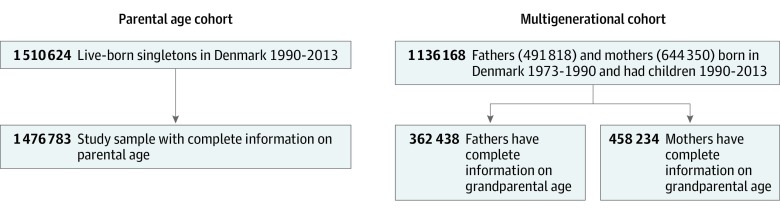
Design, setting, and participants: This population-based, multigenerational cohort study used data from Danish national health registries. A parental age cohort was constructed to evaluate the association between parental age and ASD in 1 476 783 singleton children born from 1990 to 2013, and a multigenerational cohort was also constructed including 362 438 fathers and 458 234 mothers born from 1973 to 1990 for whom information on grandparental age was available. Data analyses were conducted from November 1, 2018, through February 7, 2020.
Exposures: Parental age at childbirth and grandparental age at the time of the birth of the parent.
Main outcomes and measures: Diagnoses of ASD in children were obtained from the Danish Psychiatric Central Register (1994-2017). Logistic regression analysis was used to estimate the associations between parental or grandparental age and ASD in children.
Results: Of the 1 476 783 children born from 1990 to 2013, 758 066 (51.3%) were male, and 27 616 (1.9%) had ASD (20 467 [74.1%] were male). Advanced paternal or maternal age over 30 years was monotonically associated with increased ASD risk, with odds ratios (ORs) of 1.56 (95% CI, 1.45-1.68) for maternal age 40 years and older and 1.57 (95% CI, 1.39-1.78) for paternal age 50 years and older, compared with parents aged 25 to 29 years. In the multigenerational cohort, 9364 grandchildren (1.7%) had ASD. This study found U-shaped associations, in that ASD risk was higher among grandchildren of younger (≤19 years) maternal grandmothers (OR, 1.68; 95% CI, 1.52-1.85), younger maternal grandfathers (OR, 1.50; 95% CI, 1.26-1.78), and younger paternal grandmothers (OR, 1.18; 95% CI, 1.04-1.34), and older (≥40 years) paternal grandmothers (OR, 1.40; 95% CI, 1.03-1.90) compared with the grandchildren of grandparents who were aged 25 to 29 years at the time of giving birth to the parents.
Conclusions and relevance: These findings corroborate previous studies suggesting that advanced parental age is independently associated with increased ASD risk in children. This study also found that children with young maternal grandparents and children with young and old paternal grandparents had elevated ASD risk. Possible transmission of ASD risk across generations should be considered in etiological research on ASD.
Conflict of interest statement
Figures

References
-
- American Psychiatric Association Diagnostic and Statistical Manual of Mental Disorders. 4th ed American Psychiatric Association; 1994.
-
- Christensen DL, Braun KVN, Baio J, et al. Prevalence and characteristics of autism spectrum disorder among children aged 8 years: Autism and Developmental Disabilities Monitoring Network, 11 sites, United States, 2012. MMWR Surveill Summ. 2018;65(13):-. doi: 10.15585/mmwr.ss6513a1 - DOI - PMC - PubMed