Cross-Sectional Trajectories of Mental State Language Development in Children With Down Syndrome
- PMID: 32293911
- PMCID: PMC7842864
- DOI: 10.1044/2020_AJSLP-19-00035
Cross-Sectional Trajectories of Mental State Language Development in Children With Down Syndrome
Abstract
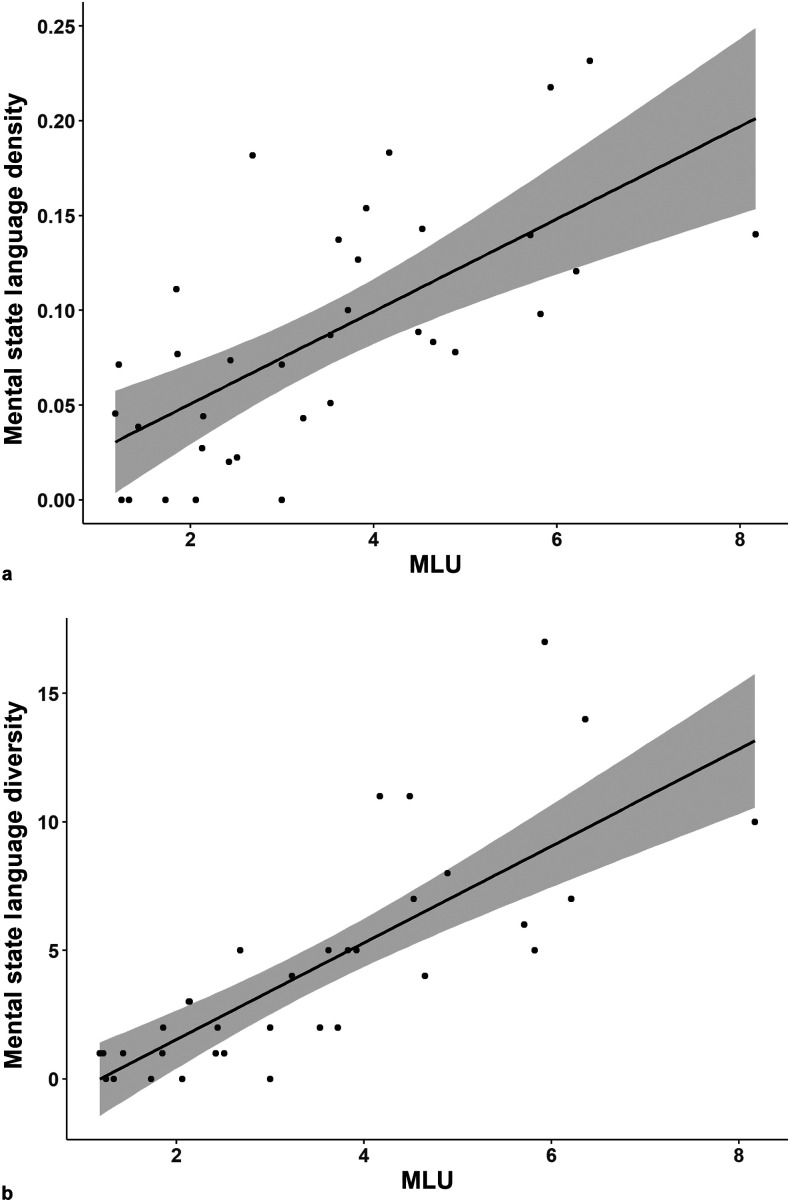
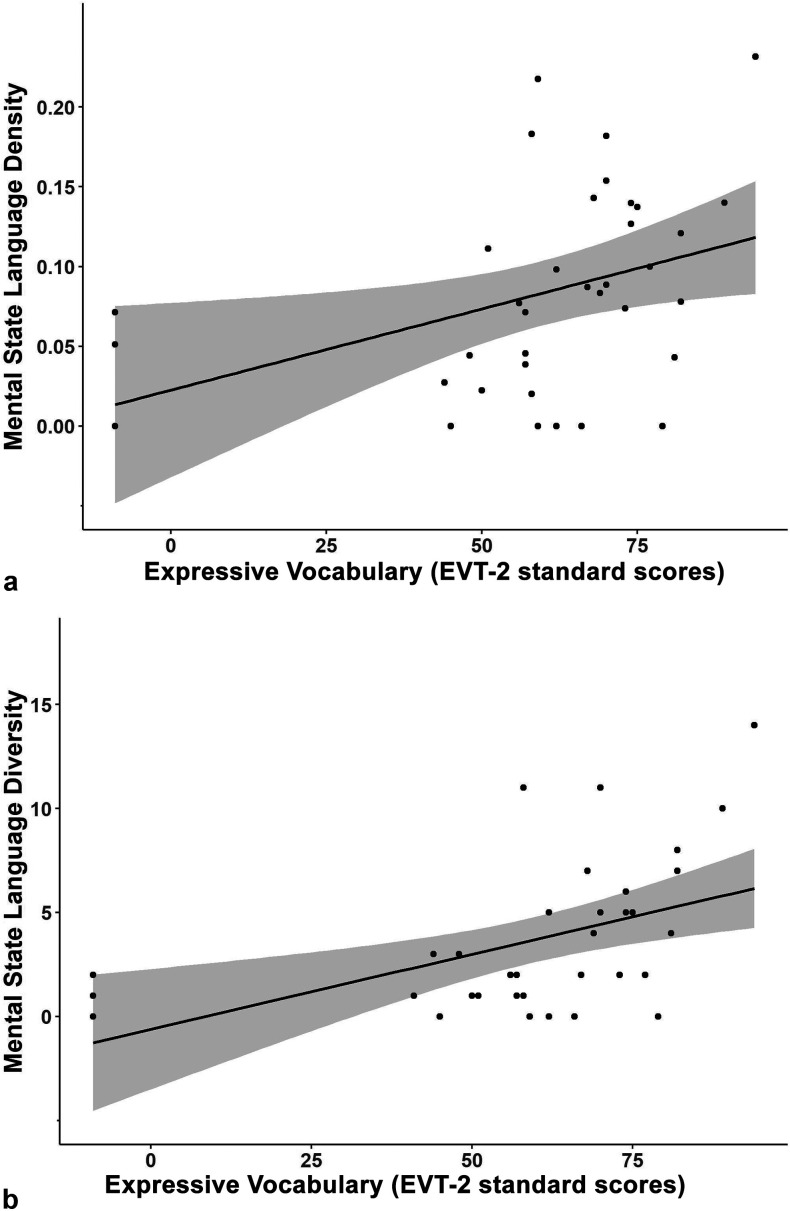
Purpose This article (a) examined the cross-sectional trajectories of mental state language use in children with Down syndrome (DS) and (b) identified developmental factors associated with its use. Method Forty children with DS aged 6-11 years generated stories from a wordless picture book and completed an assessment battery of other linguistic, cognitive, and social-emotional skills. Their narratives were coded for mental state language density (the proportion of utterances containing mental state references) and diversity (the number of different mental state terms used). Results The emergence of mental state language use during narrative storytelling was observed across the sample; 0%-24% of children's utterances included references to mental states, and a variety of mental state terms were produced. Cross-sectional developmental trajectory analysis revealed that expressive vocabulary and morphosyntax were significantly related to increased mental state language density and diversity. Nonverbal emotion knowledge was significantly related to greater diversity of mental state terms used. Age and nonverbal cognition were not significant factors. Conclusions This first in-depth, within-syndrome characterization of mental state language use by school-age children with DS provides an important next step for understanding mental state and narrative development in this population. By identifying skills associated with the development of mental state language, this study provides an avenue for future longitudinal research to determine causal relationships, ultimately informing intervention efforts.
Figures

Similar articles
-
Mental State Language Use in Children with Down Syndrome and the Role of Caregivers.Semin Speech Lang. 2021 Aug;42(4):318-329. doi: 10.1055/s-0041-1730990. Epub 2021 Jul 26. Semin Speech Lang. 2021. PMID: 34311483 Free PMC article. Review.
-
Maternal Input and Child Language Comprehension During Book Reading in Children With Down Syndrome.Am J Speech Lang Pathol. 2020 Aug 4;29(3):1475-1488. doi: 10.1044/2020_AJSLP-19-00156. Epub 2020 May 28. Am J Speech Lang Pathol. 2020. PMID: 32463706 Free PMC article.
-
Language gains in 4-6-year-old children with developmental language disorder and the relation with language profile, severity, multilingualism and non-verbal cognition.Int J Lang Commun Disord. 2023 May;58(3):765-785. doi: 10.1111/1460-6984.12821. Epub 2022 Dec 8. Int J Lang Commun Disord. 2023. PMID: 36478026
-
Word type and modality in the emerging expressive vocabularies of preschool children with Down syndrome.Int J Lang Commun Disord. 2023 May;58(3):864-878. doi: 10.1111/1460-6984.12828. Epub 2022 Dec 20. Int J Lang Commun Disord. 2023. PMID: 36537162
-
Parent-mediated interventions for promoting communication and language development in young children with Down syndrome.Cochrane Database Syst Rev. 2018 Oct 15;10(10):CD012089. doi: 10.1002/14651858.CD012089.pub2. Cochrane Database Syst Rev. 2018. PMID: 30321454 Free PMC article. Review.
Cited by
-
Narrative abilities in individuals with Down syndrome: single case-profiles.Front Psychol. 2023 Oct 3;14:1116567. doi: 10.3389/fpsyg.2023.1116567. eCollection 2023. Front Psychol. 2023. PMID: 37854146 Free PMC article.
-
Mental State Language Use in Children with Down Syndrome and the Role of Caregivers.Semin Speech Lang. 2021 Aug;42(4):318-329. doi: 10.1055/s-0041-1730990. Epub 2021 Jul 26. Semin Speech Lang. 2021. PMID: 34311483 Free PMC article. Review.
-
A Comparison of Developmental Profiles of Preschool Children with Down Syndrome, Global Developmental Delay, and Developmental Language Disorder.Healthcare (Basel). 2025 Jul 13;13(14):1684. doi: 10.3390/healthcare13141684. Healthcare (Basel). 2025. PMID: 40724709 Free PMC article.
-
How to Assess Oral Narrative Skills of Children and Adolescents with Intellectual Disabilities: A Systematic Review.Behav Sci (Basel). 2024 Apr 10;14(4):308. doi: 10.3390/bs14040308. Behav Sci (Basel). 2024. PMID: 38667104 Free PMC article. Review.
References
-
- Abbeduto L., Benson G., Short K., & Dolish J. (1995). Effects of sampling context on the expressive language of children and adolescents with mental retardation. Mental Retardation, 33(5), 279–288. - PubMed
-
- Abbeduto L., Warren S. F., & Conners F. A. (2007). Language development in Down syndrome: From the prelinguistic period to the acquisition of literacy. Mental Retardation and Developmental Disabilities Research Reviews, 13(3), 247–261. https://doi.org/10.1002/mrdd.20158 - PubMed
-
- Ashby S. A., Channell M. M., & Abbeduto L. (2017). Inferential language use by youth with Down syndrome during narration. Research in Developmental Disabilities, 71, 98–108. https://doi.org/10.1016/j.ridd.2017.10.002 - PMC - PubMed
-
- Bartsch K., & Wellman H. M. (1995). Children talk about the mind. Oxford University Press.
-
- Bassett H. H., Denham S., Mincic M., & Gralig K. (2012). The structure of preschoolers' emotion knowledge: Model equivalence and validity using a structural equation modeling approach. Early Education and Development, 23(3), 259–279. https://doi.org/10.1080/10409289.2012.630825
Publication types
MeSH terms
Grants and funding
LinkOut - more resources
Full Text Sources
Medical