


Presentation of pulmonary infection on CT in COVID-19: initial experience in Brazil
- PMID: 32294718
- PMCID: PMC7462704
- DOI: 10.36416/1806-3756/e20200121
Presentation of pulmonary infection on CT in COVID-19: initial experience in Brazil
Abstract
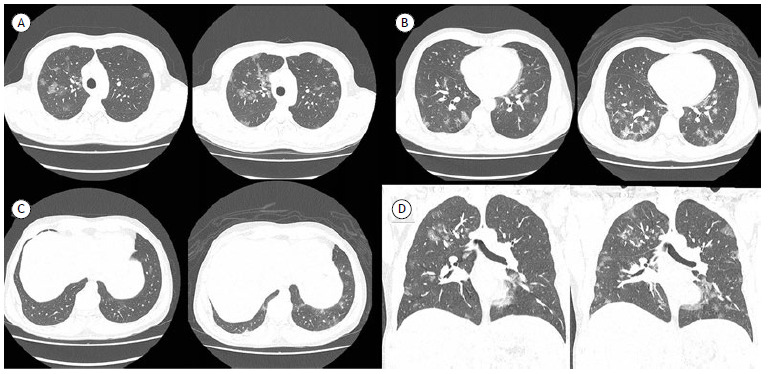
The disease caused by the new coronavirus (SARS-CoV-2), designated COVID-19, emerged in late 2019 in China, in the city of Wuhan (Hubei province), and showed exponential growth in that country. It subsequently spread to all continents, and infection with SARS-CoV-2 is now classified as a pandemic. Given the magnitude achieved, scientific interest in COVID-19 has also grown in the international literature, including its manifestations on imaging studies, particularly on CT. To date, no case series have been published in Brazil. Therefore, our objective was to describe the CT findings in an initial series of 12 patients.
A doença causada pelo novo coronavírus (SARS-CoV-2) surgiu no final de 2019 em Wuhan, província de Hubei, na China, e apresentou um crescimento exponencial naquele país, alastrando-se posteriormente para todos os continentes, sendo agora classificada como uma pandemia. Dada a magnitude alcançada, o interesse científico pela doença também tem crescido na literatura mundial, incluindo suas manifestações nos exames de imagem, particularmente na TC. Até o presente momento, não existem séries de casos publicadas no Brasil, motivo pelo qual nosso objetivo foi descrever os achados tomográficos em uma série inicial de doze pacientes.
Figures

References
-
- National Health Commission of the People’s Republic of China . New coronavirus cases rise to 571 in Chinese mainland. Beijing: The Commission; 2020. http://en.nhc.gov.cn/2020-01/23/c_76004
-
- World Health Organization . Novel Coronavirus - Republic of Korea (ex-China) Geneva: WHO; 2020. https://www.who.int/csr/don/21-january-2020-novel-coronavirus-republic-o...
-
- European Centre for Disease Prevention and Control (ECDC) Geographical distribution of 2019-nCov cases. Solna, Sweden: ECDC; 2020. https://www.ecdc.europa.eu/en/geographical-distribution-2019-ncov-cases
-
- Centers for Disease Control and Prevention . 2019 Novel Coronavirus (2019-nCoV) in the US. Atlanta: CDC; 2020. https://www.cdc.gov/coronavirus/2019-ncov/cases-in-us.html
-
- Wu Z, McGoogan JM. Characteristics of and Important Lessons From the Coronavirus Disease 2019 (COVID-19) Outbreak in China: Summary of a Report of 72 314 Cases From the Chinese Center for Disease Control and Prevention [published online ahead of print, 2020 Feb 24] JAMA. 2020 doi: 10.1001/jama.2020.2648. doi: 10.1001/jama.2020.2648. - DOI - DOI - PubMed
MeSH terms
LinkOut - more resources
Full Text Sources
Medical
Miscellaneous
