


Impact of Thermal and High-Pressure Treatments on the Microbiological Quality and In Vitro Digestibility of Black Soldier Fly (Hermetia illucens) Larvae
- PMID: 32295154
- PMCID: PMC7222827
- DOI: 10.3390/ani10040682
Impact of Thermal and High-Pressure Treatments on the Microbiological Quality and In Vitro Digestibility of Black Soldier Fly (Hermetia illucens) Larvae
Abstract
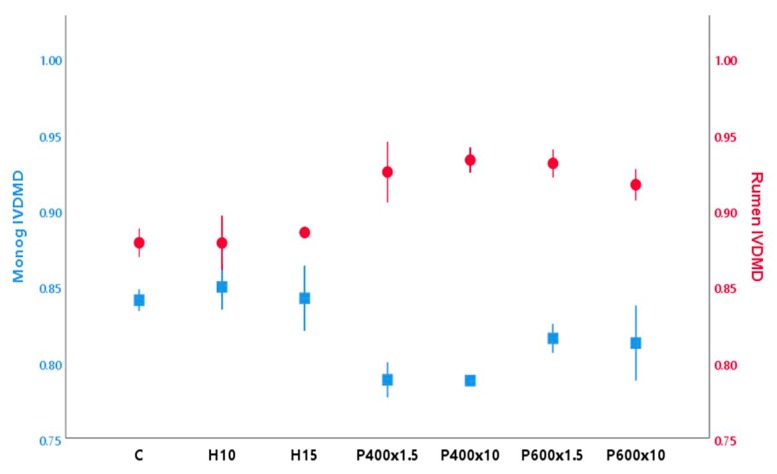
Black soldier fly larvae (BSFL) are gaining importance in animal feeding due to their ability to upcycle low-value agroindustry by-products into high-protein biomass. The present study evaluated the nutritional composition of BSFL reared on brewer's by-product (BBP) and the impact of thermal (90 °C for 10/15 min) and high-pressure processing (HPP; 400/600MPa for 1.5/10 min) treatments on the microbial levels and in vitro digestibility in both ruminant and monogastric models. BBP-reared BSFL contained a high level of protein, amino acids, lauric acid, and calcium, and high counts of total viable counts (TVC; 7.97), Enterobacteriaceae (7.65), lactic acid bacteria (LAB; 6.50), and yeasts and moulds (YM; 5.07). Thermal processing was more effective (p < 0.05) than any of the HPP treatments in reducing TVC. Both temperature of 90 °C and pressure of 600 MPa reduced the levels of Enterobacteriaceae, LAB, and YM below the detection limit. In contrast, the application of the 400 MPa showed a reduced inactivation (p < 0.05) potential. Heat-treated samples did not result in any significant changes (p > 0.05) on any of the in vitro digestibility models, whereas HPP showed increased and decreased ruminal and monogastric digestibility, respectively. HPP did not seem to be a suitable, cost-effective method as an alternative to heat-processing for the large-scale treatment of BSFL.
Keywords: animal feed; black soldier fly; high-pressure processing; in vitro digestibility; insects; microbial safety.
Conflict of interest statement
The authors declare no conflict of interest.
Figures
References
-
- European Commission Commission Regulation (EU) 2017/1151. Off. J. Eur. Union. 2017;L175:1–643.
-
- Makkar H.P.S., Tran G., Heuzé V., Ankers P. State-of-the-art on use of insects as animal feed. Anim. Feed Sci. Technol. 2014;197:1–33. doi: 10.1016/j.anifeedsci.2014.07.008. - DOI
-
- Pastor B., Velasquez Y., Gobbi P., Rojo S. Conversion of organic wastes into fly larval biomass: Bottlenecks and challenges. J. Insects Food Feed. 2015;1:179–193. doi: 10.3920/JIFF2014.0024. - DOI
Grants and funding
LinkOut - more resources
Full Text Sources
Miscellaneous
