Review
. 2020 Apr 15;19(1):77.
doi: 10.1186/s12943-020-01188-4.

The role of long noncoding RNAs in hepatocellular carcinoma

Affiliations
Review

The role of long noncoding RNAs in hepatocellular carcinoma

Zhao Huang et al. Mol Cancer. .

Abstract

Hepatocellular carcinoma (HCC) is the most frequent subtype of primary liver cancer and one of the leading causes of cancer-related death worldwide. However, the molecular mechanisms underlying HCC pathogenesis have not been fully understood. Emerging evidences have recently suggested the crucial role of long noncoding RNAs (lncRNAs) in the tumorigenesis and progression of HCC. Various HCC-related lncRNAs have been shown to possess aberrant expression and participate in cancerous phenotypes (e.g. persistent proliferation, evading apoptosis, accelerated vessel formation and gain of invasive capability) through their binding with DNA, RNA or proteins, or encoding small peptides. Thus, a deeper understanding of lncRNA dysregulation would provide new insights into HCC pathogenesis and novel tools for the early diagnosis and treatment of HCC. In this review, we summarize the dysregulation of lncRNAs expression in HCC and their tumor suppressive or oncogenic roles during HCC tumorigenesis. Moreover, we discuss the diagnostic and therapeutic potentials of lncRNAs in HCC.

Keywords: Biomarker; Hepatocellular carcinoma; Long noncoding RNA; Targeted therapy.


Conflict of interest statement

The authors declare that they have no competing interests.

Figures
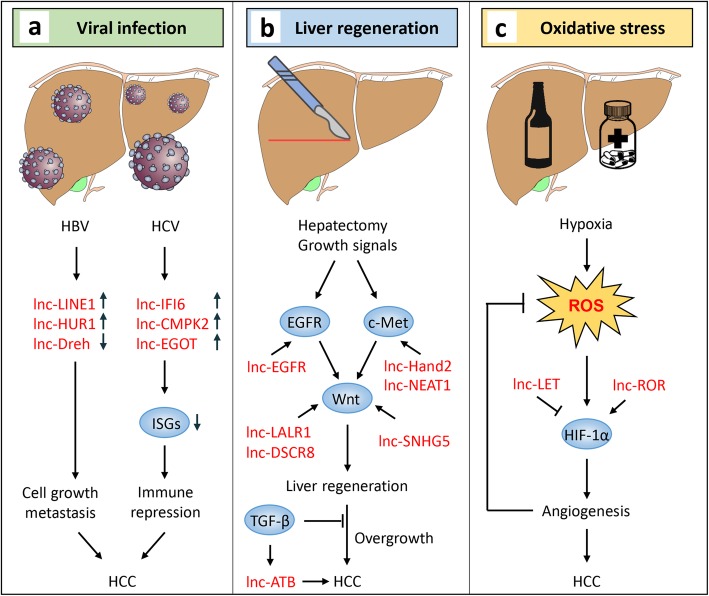
Fig. 1
Fig. 1
LncRNAs modulate liver microenvironment and chronic liver diseases. LncRNAs are involved in physiological and pathological processes, including (a) Viral infection and immune repression. Virus-induced lncRNAs are capable of promoting cell proliferation or suppressing host immune response, resulting in chronic infection and HCC formation. b Liver regeneration and outgrowth. In response to hepatectomy, liver is regenerated via activating proliferative signalings. These signalings can also be stimulated by certain lncRNAs independent of tissue loss, leading to liver overgrowth and HCC. c Hypoxic liver injury and oxidative stress. Drug detoxification induces ROS accumulation in liver, which upregulates HIF-1α to facilitate blood vessel formation therefore relief oxidative stress. To some similarities, several lncRNAs also activate HIF-1α to support HCC survival under hypoxic condition. ISGs, IFN-stimulated genes. ROS, reactive oxygen species
Fig. 2
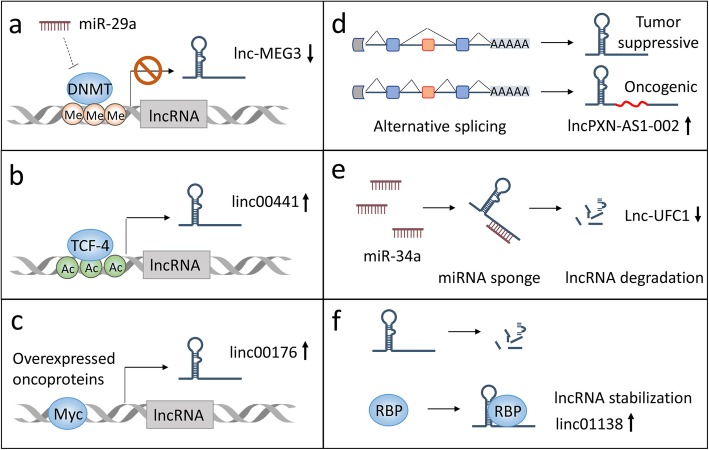
Fig. 2
Abnormal expression of lncRNA in HCC. a Epigenetic silencing of HCC-suppressive lncRNAs; b Epigenetic activation of HCC-promoting lncRNAs; c Transcriptional activation by HCC-related oncoproteins; d RNA processing that endows lncRNA with HCC-promoting properties; e Loss of tumor-suppressive miRNAs leads to re-expression of targeted oncogenic lncRNAs; f RBP-induced stabilization of HCC-promoting lncRNAs. RBP, RNA-binding protein
Fig. 3
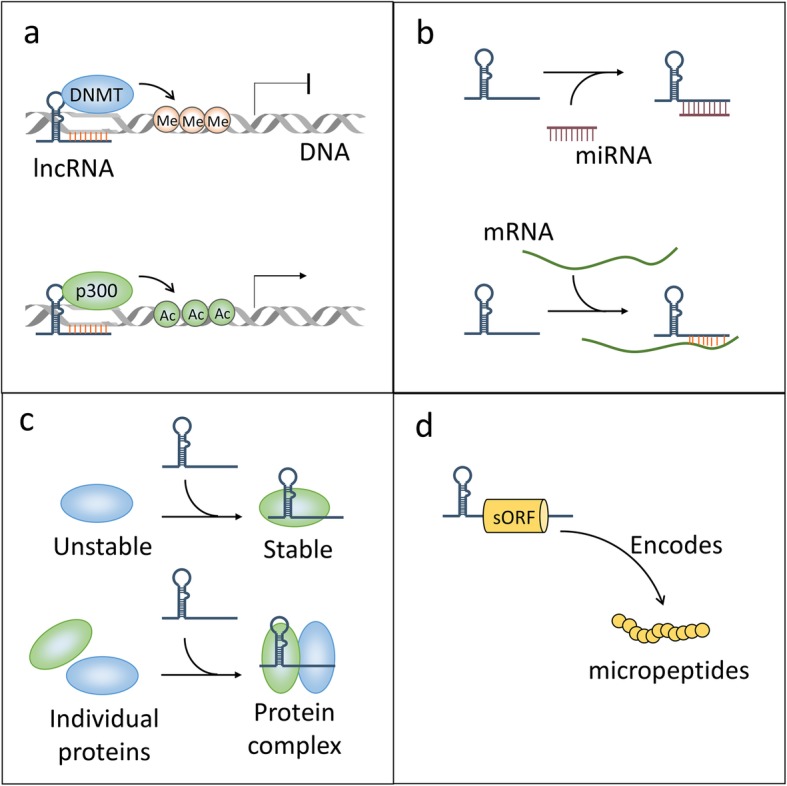
Fig. 3
Functional mechanisms of lncRNA in HCC. a LncRNAs interacts with DNA to regulate gene expression through binding with promoters or distal regulatory elements, where they recruit epigenetic modifiers to promote or repress gene expression. b LncRNAs bind to mRNAs to regulate their stability, thereby regulating gene expression. Besides, lncRNAs can also bind to miRNAs as molecular sponge, leading to the reactivation of genes targeted by miRNAs. c LncRNAs interact with proteins to regulate their stability or facilitate the formation of protein complex when they function as scaffold. d Several lncRNAs hold the potential to encode small peptide, through which exhibit their biological functions
Fig. 4
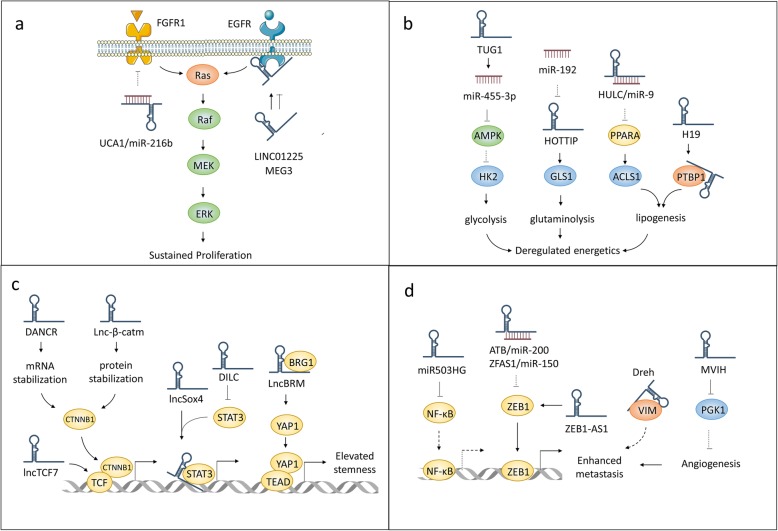
Fig. 4
Significance of lncRNA in HCC hallmarks. Dysregulated lncRNAs promote HCC through distinct mechanisms, leading to different phenotypes corresponding to every tumor stage. These hallmarks include (a) sustained proliferation due to aberrant regulation of growth factor receptor/RTK signaling or cell cycle progression; b dysregulated energetics induced by metabolic reprogramming; c elevated stemness due to the hyperactivation of CSC-related signaling; d enhanced metastasis induced by the overexpression of mesenchymal markers and formation of additional vessels

References

    1. Bertuccio P, Turati F, Carioli G, Rodriguez T, La Vecchia C, Malvezzi M, et al. Global trends and predictions in hepatocellular carcinoma mortality. J Hepatol. 2017;67(2):302–309. doi: 10.1016/j.jhep.2017.03.011. - DOI - PubMed
    1. Forner A, Llovet JM, Bruix J. Hepatocellular carcinoma. Lancet. 2012;379(9822):1245–1255. doi: 10.1016/S0140-6736(11)61347-0. - DOI - PubMed
    1. Cancer Genome Atlas Research Network. Electronic address wbe, Cancer Genome Atlas Research N Comprehensive and integrative genomic characterization of hepatocellular carcinoma. Cell. 2017;169(7):1327–41 e23. doi: 10.1016/j.cell.2017.05.046. - DOI - PMC - PubMed
    1. Nishida N, Nagasaka T, Nishimura T, Ikai I, Boland CR, Goel A. Aberrant methylation of multiple tumor suppressor genes in aging liver, chronic hepatitis, and hepatocellular carcinoma. Hepatology. 2008;47(3):908–918. doi: 10.1002/hep.22110. - DOI - PMC - PubMed
    1. Dang H, Takai A, Forgues M, Pomyen Y, Mou H, Xue W, et al. Oncogenic activation of the RNA binding protein NELFE and MYC signaling in hepatocellular carcinoma. Cancer Cell. 2017;32(1):101–14 e8. doi: 10.1016/j.ccell.2017.06.002. - DOI - PMC - PubMed

Publication types

MeSH terms