


Allocation of Scarce Resources in a Pandemic: A Systematic Review of US State Crisis Standards of Care Documents
- PMID: 32295662
- PMCID: PMC7198465
- DOI: 10.1017/dmp.2020.101
Allocation of Scarce Resources in a Pandemic: A Systematic Review of US State Crisis Standards of Care Documents
Abstract
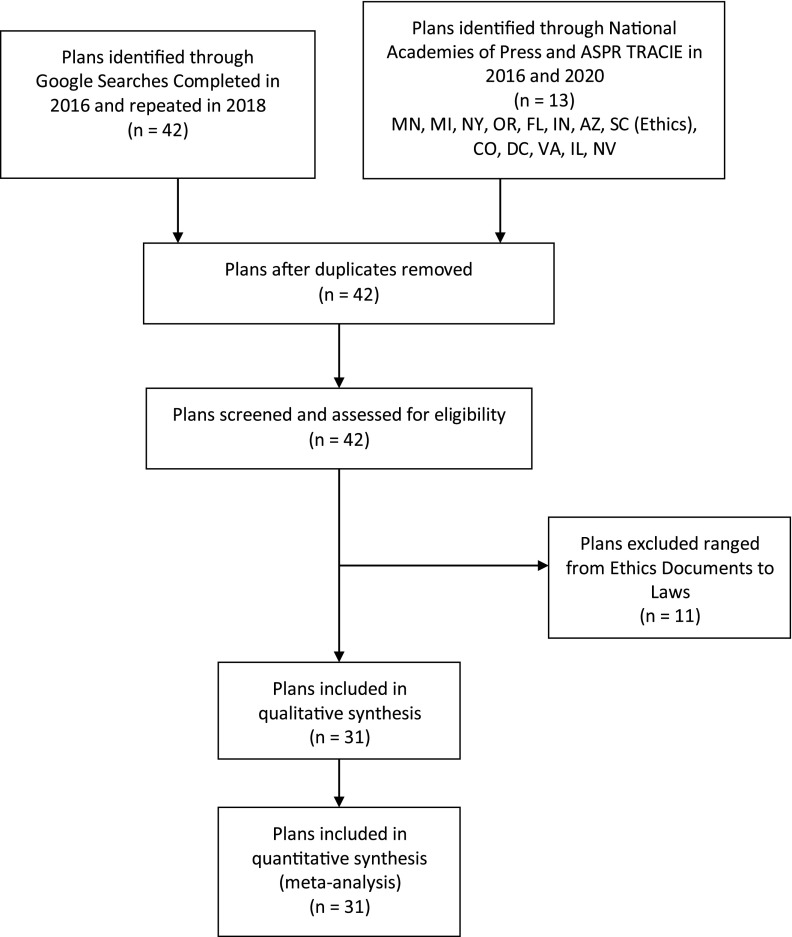
The aim of this systematic review was to locate and analyze United States state crisis standards of care (CSC) documents to determine their prevalence and quality. Following PRISMA guidelines, Google search for "allocation of scarce resources" and "crisis standards of care (CSC)" for each state. We analyzed the plans based on the 2009 Institute of Medicine (IOM) report, which provided guidance for establishing CSC for use in disaster situations, as well as the 2014 CHEST consensus statement's 11 core topic areas. The search yielded 42 state documents, and we excluded 11 that were not CSC plans. Of the 31 included plans, 13 plans were written for an "all hazards" approach, while 18 were pandemic influenza specific. Eighteen had strong ethical grounding. Twenty-one plans had integrated and ongoing community and provider engagement, education, and communication. Twenty-two had assurances regarding legal authority and environment. Sixteen plans had clear indicators, triggers, and lines of responsibility. Finally, 28 had evidence-based clinical processes and operations. Five plans contained all 5 IOM elements: Arizona, Colorado, Minnesota, Nevada, and Vermont. Colorado and Minnesota have all hazards documents and processes for both adult and pediatric populations and could be considered exemplars for other states.
Keywords: allocation of resources; coronavirus; disaster planning; pandemics.
References
-
- Committee on Guidance for Establishing Crisis Standards of Care for Use in Disaster Situations; Institute of Medicine. Crisis Standards of Care: A Systems Framework for Catastrophic Disaster Response. Washington, DC: National Academies Press; 2012. - PubMed
-
- Devereaux AV, Dichter JR, Christian MD, et al. Definitive care for the critically ill during a disaster: a framework for allocation of scarce resources in mass critical care: from a Task Force for Mass Critical Care summit meeting, January 26-27, 2007, Chicago, IL. Chest. 2008;133(5 Suppl):51S-66S. doi: 10.1378/chest.07-2693 - DOI - PubMed
-
- Christian MD, Joynt GM, Hick JL, et al. Chapter 7. Critical care triage. Recommendations and standard operating procedures for intensive care unit and hospital preparations for an influenza epidemic or mass disaster. Intensive Care Med. 2010;36(Suppl 1):S55-S64. doi: 10.1007/s00134-010-1765-0 - DOI - PMC - PubMed
-
- Schultz CH, Koenig KL, Whiteside M, Murray R; National Standardized All-Hazard Disaster Core Competencies Task Force. Development of national standardized all-hazard disaster core competencies for acute care physicians, nurses, and EMS professionals. Ann Emerg Med. 2012;59(3):196-208.e1. doi: 10.1016/j.annemergmed.2011.09.003 - DOI - PubMed
Publication types
MeSH terms
LinkOut - more resources
Full Text Sources
