. 2020 Mar 31:11:451.
doi: 10.3389/fmicb.2020.00451. eCollection 2020.

Genomics of Serratia marcescens Isolates Causing Outbreaks in the Same Pediatric Unit 47 Years Apart: Position in an Updated Phylogeny of the Species

Affiliations

Genomics of Serratia marcescens Isolates Causing Outbreaks in the Same Pediatric Unit 47 Years Apart: Position in an Updated Phylogeny of the Species

Claudia Saralegui et al. Front Microbiol. .

Abstract

The first documented nosocomial outbreak caused by Serratia marcescens in Spain occurred in 1969 at the neonatal intensive care unit (NICU) of the tertiary La Paz Children's Hospital in Madrid, Spain, and based on the available phenotyping techniques at this time, it was considered as a monoclonal outbreak. Only 47 years later, another S. marcescens outbreak of an equivalent dimension occurred at the same NICU. The aim of the present study was to study isolates from these historical and contemporary outbreaks by phenotypic analysis and whole-genome sequencing techniques and to position these strains along with 444 publicly available S. marcescens genomes, separately comparing core genome and accessory genome contents. Clades inferred by both approaches showed high correlation, indicating that core and accessory genomes seem to evolve in the same manner for S. marcescens. Nine S. marcescens clusters were identified, and isolates were grouped in two of them according to sampling year. One exception was isolate 13F-69, the most genetically distant strain, located in a different cluster. Categorical functions in the annotated accessory genes of both collections were preserved among all isolates. No significant differences in frequency of insertion sequences in historical (0.18-0.20)-excluding the outlier strain-versus contemporary isolates (0.11-0.19) were found despite the expected resting effect. The most dissimilar isolate, 13F-69, contains a highly preserved plasmid previously described in Bordetella bronchiseptica. This strain exhibited a few antibiotic resistance genes not resulting in a resistant phenotype, suggesting the value of gene down expression in adaptation to long-term starvation.

Keywords: Serratia marcescens; antibiotic susceptibility; nosocomial outbreak; phylogeny; resistome.


Figures

FIGURE 1
FIGURE 1
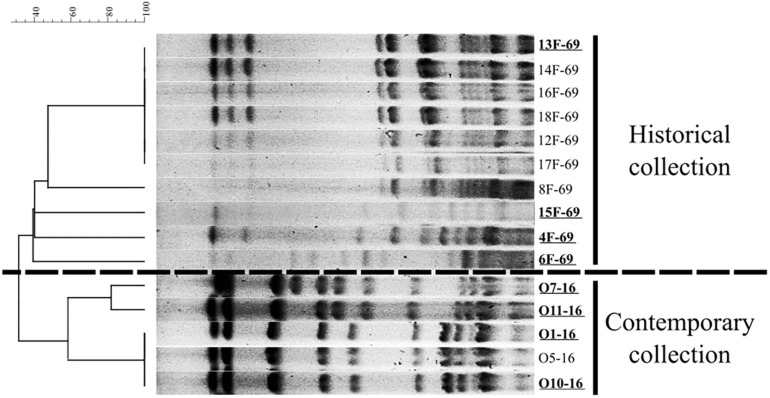
Dendrogram based on Dice’s coefficient showing the representative pulse-field gel electrophoresis (PFGE) pattern of the historical (10 out of 21 isolates) and the contemporary Serratia marcescens collections studied.
FIGURE 2
FIGURE 2
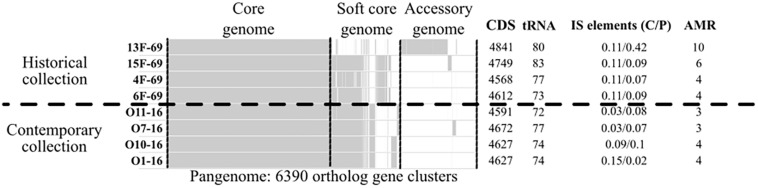
Nullarbor report of the pangenome of the eight Serratia marcescens studied strains, including as additional data the frequency of completely (C) or partially (P) present insertion sequences (ISs), and the number of antimicrobial resistance genes (AMR). Core genome is constituted by genes present in >99% of strains. Soft core genome is constituted by genes present in 99-15% of strains. Accessory genome is constituted by genes present in <15% of strains. CDS, protein-coding sequences.
FIGURE 3
FIGURE 3
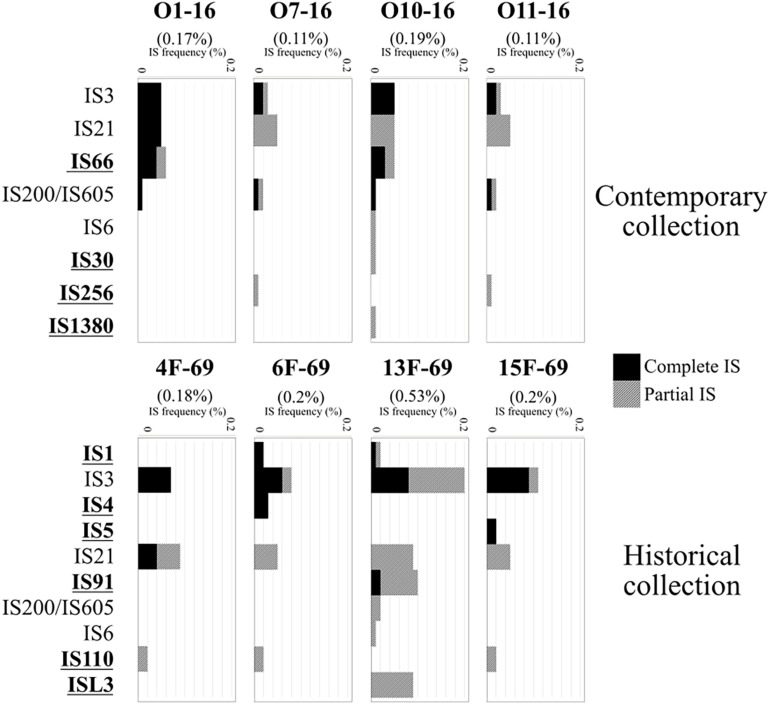
Insertion sequences (ISs) detected in the eight Serratia marcescens studied isolates and their frequency in the annotated genomes, represented as IS bp/total genome bp (%). Total IS frequency in each genome is expressed in parentheses. ISEScan output included integral ISs and partially present ISs (black and gray bars, respectively). Bold, underlined IS labels were found only in one collection but not in the other.
FIGURE 4
FIGURE 4
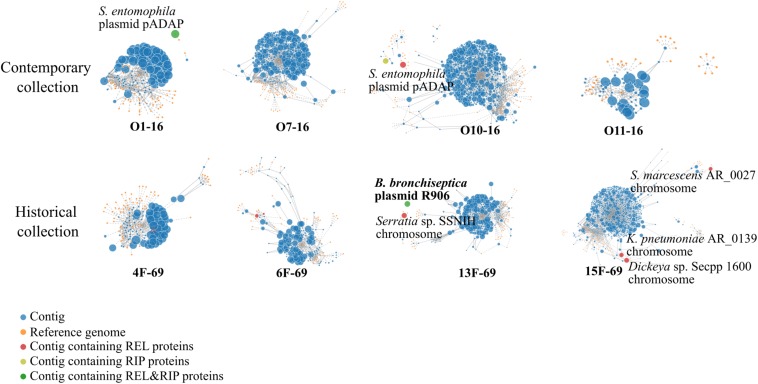
PlacnetW output reflecting the plasmid sequences detected. All contigs from each genome are represented as blue nodes connected by continued lines. Yellow nodes represent reference genomes from the NCBI BLAST database. Discontinued lines link each contig to their closest reference genome/s. Finally, each genome appears represented by all its contigs displayed around their closest reference genome identity. Contigs containing plasmid sequences are highlighted in different colored nodes. REL, relaxase; RIP, replication initiation protein.
FIGURE 5
FIGURE 5
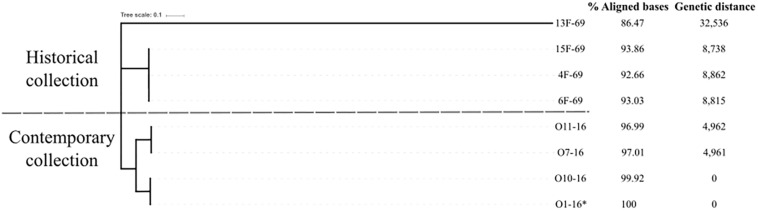
Phylogenetic tree based on single-nucleotide polymorphism (SNP) analysis of the mapped sequences of the eight Serratia marcescens studied strains using the O1-16 strain as reference (*). Genetic distance was obtained by dividing the number of SNPs present in each genome by the aligned megabases with the reference.
FIGURE 6
FIGURE 6
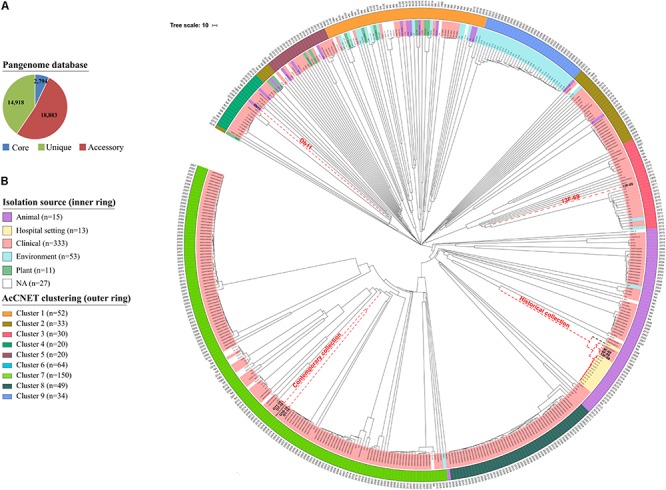
Phylogenetic analysis of 452 Serratia marcescens genomes. (A) Distribution of the total pangenome after core genome multilocus sequence typing (cgMLST) analysis in core (genes present it at least 95% of the isolates; 7.6%), accessory (genes present in >2 isolates and less than in 95%; 51.6%), and unique genes (genes exclusive of a single isolate; 40.8%). (B) Phylogenetic tree inferred from cgMLST approach, including metadata of source (colors) and year (text). Strains from our collections and the reference genome for S. marcescens species (Db11 strain, assembly accession GCA_000513215.1) are highlighted in red dashed nodes. External circle highlights clusters inferred by AcCNET analysis of accessory genome.
FIGURE 7
FIGURE 7
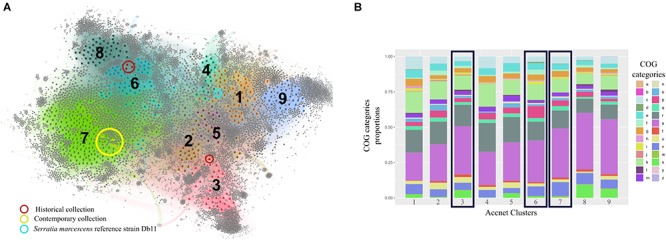
Clustering and analysis of the categorical functions of the accessory genome of the studied Serratia marcescens isolates (n = 8) and the 444 publicly available genomes by AcCNET software. (A) AcCNET pangenome network with detected clusters (n = 9) highlighted by colors and numbers. Colored and gray dots correspond to genomes and annotated proteins respectively and are linked by edges. Strains from our collections and the reference genome for S. marcescens species (Db11 strain, assembly accession GCA_000513215.1) are highlighted. (B) Accessory genome functional analysis of the nine detected clusters based on COGs proportions. Black rectangles depict the clusters where strains from our collections belong to. a, RNA processing and modification; b, chromatin structure and dynamics; c, energy production and conversion; d, cell cycle, control, mitosis; e, amino acid metabolism and transport; f, nucleotide metabolism and transport; g, carbohydrate metabolism and transport; h, coenzyme metabolism; i, lipid metabolism; j, translation; k, transcription; l, replication and repair; m, cell wall/membrane/envelope biogenesis; n, cell motility; o, post-translational modification, protein turnover, chaperon functions; p, inorganic ion transport and metabolism; q, secondary structure; r, general function prediction only; s, function unknown; t, signal transduction; u, intracellular trafficking and secretion; v, defense mechanisms; W, extracellular structures; x, mobilome, prophages, and transposons-related proteins; y, nuclear structure; z, cytoskeleton.

References

    1. Abreo E., Altier N. (2019). Pangenome of Serratia marcescens strains from nosocomial and environmental origins reveals different populations and the links between them. Sci. Rep. 9:46. 10.1038/s41598-018-37118-0 - DOI - PMC - PubMed
    1. Allen R. C., Engelstädter J., Bonhoeffer S., McDonald B. A., Hall A. R. (2017). Reversing resistance: different routes and common themes across pathogens. Proc. Biol. Sci. 284 20171619. 10.1098/rspb.2017.1619 - DOI - PMC - PubMed
    1. Arndt D., Grant J. R., Marcu A., Sajed T., Pon A., Liang Y., et al. (2016). PHASTER: a better, faster version of the PHAST phage search tool. Nucleic Acids Res. 44 W16–W21. 10.1093/nar/gkw387 - DOI - PMC - PubMed
    1. Baker K. S., Burnett E., McGregor H., Deheer-Graham A., Boinett C., Langridge G. C., et al. (2015). The Murray collection of pre-antibiotic era Enterobacteriacae: a unique research resource. Genome Med. 7:97. 10.1186/s13073-015-0222-7 - DOI - PMC - PubMed
    1. Baker K. S., Mather A. E., McGregor H., Coupland P., Langridge G. C., Day M., et al. (2014). The extant World War 1 dysentery Bacillus NCTC1: a genomic analysis. Lancet (Lond. Engl.) 384 1691–1697. 10.1016/S0140-6736(14)61789-X - DOI - PMC - PubMed

LinkOut - more resources