Review
. 2020 Mar 31:11:456.
doi: 10.3389/fimmu.2020.00456. eCollection 2020.

A Path Toward Precision Medicine for Neuroinflammatory Mechanisms in Alzheimer's Disease

Affiliations
Review

A Path Toward Precision Medicine for Neuroinflammatory Mechanisms in Alzheimer's Disease

Harald Hampel et al. Front Immunol. .

Abstract

Neuroinflammation commences decades before Alzheimer's disease (AD) clinical onset and represents one of the earliest pathomechanistic alterations throughout the AD continuum. Large-scale genome-wide association studies point out several genetic variants-TREM2, CD33, PILRA, CR1, MS4A, CLU, ABCA7, EPHA1, and HLA-DRB5-HLA-DRB1-potentially linked to neuroinflammation. Most of these genes are involved in proinflammatory intracellular signaling, cytokines/interleukins/cell turnover, synaptic activity, lipid metabolism, and vesicle trafficking. Proteomic studies indicate that a plethora of interconnected aberrant molecular pathways, set off and perpetuated by TNF-α, TGF-β, IL-1β, and the receptor protein TREM2, are involved in neuroinflammation. Microglia and astrocytes are key cellular drivers and regulators of neuroinflammation. Under physiological conditions, they are important for neurotransmission and synaptic homeostasis. In AD, there is a turning point throughout its pathophysiological evolution where glial cells sustain an overexpressed inflammatory response that synergizes with amyloid-β and tau accumulation, and drives synaptotoxicity and neurodegeneration in a self-reinforcing manner. Despite a strong therapeutic rationale, previous clinical trials investigating compounds with anti-inflammatory properties, including non-steroidal anti-inflammatory drugs (NSAIDs), did not achieve primary efficacy endpoints. It is conceivable that study design issues, including the lack of diagnostic accuracy and biomarkers for target population identification and proof of mechanism, may partially explain the negative outcomes. However, a recent meta-analysis indicates a potential biological effect of NSAIDs. In this regard, candidate fluid biomarkers of neuroinflammation are under analytical/clinical validation, i.e., TREM2, IL-1β, MCP-1, IL-6, TNF-α receptor complexes, TGF-β, and YKL-40. PET radio-ligands are investigated to accomplish in vivo and longitudinal regional exploration of neuroinflammation. Biomarkers tracking different molecular pathways (body fluid matrixes) along with brain neuroinflammatory endophenotypes (neuroimaging markers), can untangle temporal-spatial dynamics between neuroinflammation and other AD pathophysiological mechanisms. Robust biomarker-drug codevelopment pipelines are expected to enrich large-scale clinical trials testing new-generation compounds active, directly or indirectly, on neuroinflammatory targets and displaying putative disease-modifying effects: novel NSAIDs, AL002 (anti-TREM2 antibody), anti-Aβ protofibrils (BAN2401), and AL003 (anti-CD33 antibody). As a next step, taking advantage of breakthrough and multimodal techniques coupled with a systems biology approach is the path to pursue for developing individualized therapeutic strategies targeting neuroinflammation under the framework of precision medicine.

Keywords: Alzheimer's disease; anti-inflammatory therapy; biomarkers; microglia; neuroinflammation; neuroinflammatory pathways; precision medicine; systems biology.


Figures

Figure 1
Figure 1
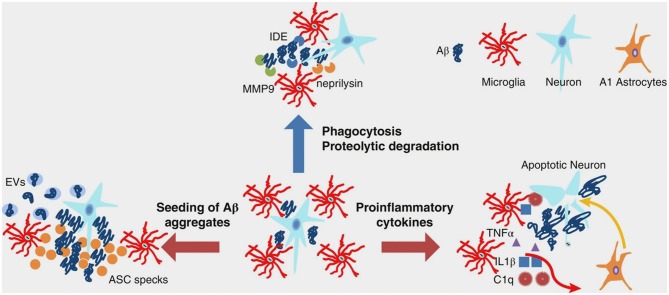
Multifaceted functions of microglia during Aβ pathology. In healthy brain and early stages of AD, microglia clear small aggregates of Aβ peptides by phagocytosis and by secreting proteolytic enzymes, such as IDE, neprilysin, and MMP9. During advanced AD, microglia exacerbate AD pathology by releasing proinflammatory cytokines that induce neuronal cell death as well as A1 astrocytes, which, in turn, affect neuronal survival. Moreover, during advanced AD, microglia-derived ASC specks and EVs promote seeding of Aβ aggregates. Aβ, amyloid beta; AD, Alzheimer's disease; ASC, apoptosis-associated speck-like protein containing a CARD; C1q, complement component 1q; EVs, extracellular vesicles; IDE, insulin degrading enzyme; IL-1β, interleukin-1 beta; MMP-9, metalloprotease-9; TNF-α, tumor necrosis factor-alpha. From Wang and Colonna (45). Copyright© 2019, Society for Leukocyte Biology. Reprinted with permission from Wiley.
Figure 2
Figure 2
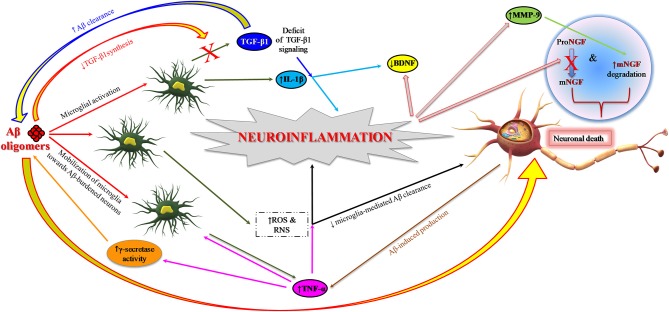
Role of neuroinflammation in AD pathogenesis: impairment of neurotrophin signaling. Aβ1−42 oligomers promote neuroinflammation and neuronal death in AD brain by eliciting the release of proinflammatory cytokines (IL-1β and TNF-α) from microglia and also interfering with the synthesis of anti-inflammatory cytokines such as TGF-β1. TNF-α inhibits microglia phagocytosis of Aβ and stimulates γ-secretase activity, thus facilitating Aβ accumulation and microglia-mediated neuroinflammation. Proinflammatory microglial activities promote neuronal death also through the formation of ROS and RNS. Neuroinflammatory phenomena can finally contribute to the pathogenesis of AD by impairing neurotrophin signaling function: (I) reducing the synthesis of BDNF and TGF-β1 and (II) causing an impairment of NGF metabolic pathway characterized by a reduced conversion of proNGF to biologically active mNGF and by an increased degradation of mNGF promoted by MMP-9. Aβ, amyloid beta; Aβ1−42, 42-amino acid-long amyloid beta peptide; BDNF, brain-derived neurotrophic factor; IL-1β, interleukin-1 beta; MMP-9, metalloprotease-9; NGF, nerve growth factor; mNGF, mature nerve growth factor; proNGF, precursor of the nerve growth factor; RNS, reactive nitrogen species; ROS, reactive oxygen species; TGF-β, transforming growth factor-beta; TNF-α, tumor necrosis factor-alpha.
Figure 3
Figure 3
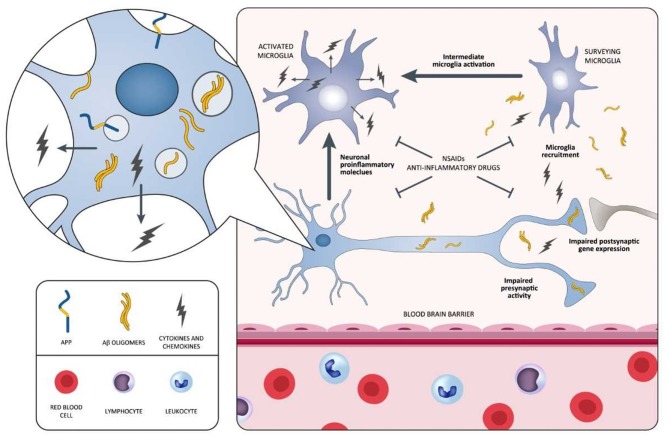
Schematic representation of neuroinflammatory process occurring during the early stages of the AD pathology and potential points of attack of NSAIDs and anti-inflammatory drugs. In this process, neurons surrounded by Aβ oligomers release proinflammatory cytokines triggering the intermediate activation of microglia and their mobilization toward Aβ-burdened neurons. Both Aβ-burdened neurons and activated microglia are responsible for a disease-aggravating process in which the release of proinflammatory cytokines and chemokines predominates. NSAIDs and anti-inflammatory drugs may be potentially effective during this early inflammatory phase, antagonizing the aggravating activity of proinflammatory mediators. Selective agents stabilizing microglia may also be effective in attenuating the inflammatory process. Aβ, amyloid beta; AD, Alzheimer's disease; NSAIDs, non-steroidal anti-inflammatory drugs.
Figure 4
Figure 4
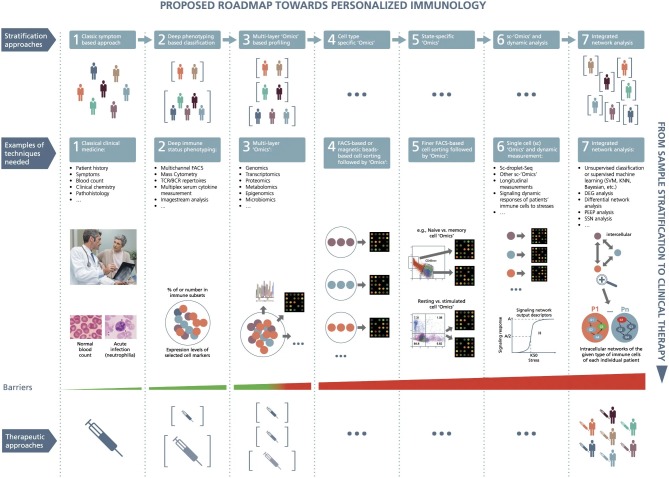
A roadmap proposed toward personalized immunology. There exist both horizontal and vertical roadmaps toward personalized immunology. Vertically, to translate sample stratification to clinical therapies, it is necessary to utilize the state-of-the-art “Omics” analysis and network integration approaches to stratify patients into subgroups and then implement personalized therapeutic approaches to treat individual patients, which needs to overcome various types of barriers at different steps. Horizontally, it might be necessary to go through at least seven steps to enable personalized immunotherapies: (1) classic symptom-based approach, (2) deep phenotyping approach, (3) multilayer “Omics”-based profiling, (4) cell-type-specific “Omics,” (5) state-specific “Omics,” (6) single-cell “Omics” and dynamic response analysis of immune cells, and (7) integrated network analysis. Under the first layer (the so-called stratification layer), different colors of patients indicate individual patients with different cellular and/or molecular profiles, while brackets represent patient subgroups; under the second layer (the so-called technique layers), different small circles with distinct colors indicate different immune cells, while big circles represent patient (sub)groups; under the technique layers, the snapshot of microarray representing either microarray-based or RNA-seq-based transcriptome analysis; under the third layer (the so-called therapeutic layer), the syringes with different colors or tonalities indicate different therapeutic approaches; P1,…, Pn at step 7 designate different patients; G1, G2, G3, and G4 represent different genes, the arrows between them representing regulatory relationships. DEG, differential expression gene; FACS, fluorescence-activated cell sorting; KNN, K-nearest neighbors; PEEP, personalized expression perturbation profile; sc, single-cell; SSN, sample-specific network; SVM, support vector machine; TCR/BCR, T-cell receptor/B-cell receptor. From Delhalle et al. (284). Copyright© 2018, Springer Nature. Reprinted with permission from Creative Commons CC BY. S.

References

    1. Association A. 2017 Alzheimer's disease facts and figures. Alzheimer's Dement. (2017) 13:325–73. 10.1016/j.jalz.2017.02.001 - DOI
    1. Panza F, Lozupone M, Logroscino G, Imbimbo BP. A critical appraisal of amyloid-β-targeting therapies for Alzheimer disease. Nat Rev Neurol. (2019) 15:73–88. 10.1038/s41582-018-0116-6 - DOI - PubMed
    1. Jack CR, Bennett DA, Blennow K, Carrillo MC, Dunn B, Haeberlein SB, et al. NIA-AA research framework: toward a biological definition of Alzheimer's disease. Alzheimers Dement. (2018) 14:535–62. 10.1016/j.jalz.2018.02.018 - DOI - PMC - PubMed
    1. Hampel H, Mesulam M-M, Cuello AC, Farlow MR, Giacobini E, Grossberg GT, et al. The cholinergic system in the pathophysiology and treatment of Alzheimer's disease. Brain. (2018) 141:1917–33. 10.1093/brain/awy132 - DOI - PMC - PubMed
    1. Sperling RA, Aisen PS, Beckett LA, Bennett DA, Craft S, Fagan AM, et al. Toward defining the preclinical stages of Alzheimer's disease: recommendations from the national institute on Aging-Alzheimer's association workgroups on diagnostic guidelines for Alzheimer's disease. Alzheimers Dement. (2011) 7:280–92. 10.1016/j.jalz.2011.03.003 - DOI - PMC - PubMed

Publication types