


Influence of gender and age on haemodialysis practices: a European multicentre analysis
- PMID: 32296527
- PMCID: PMC7147302
- DOI: 10.1093/ckj/sfz069
Influence of gender and age on haemodialysis practices: a European multicentre analysis
Abstract
Background: Women of all ages and elderly patients of both genders comprise an increasing proportion of the haemodialysis population. Worldwide, significant differences in practice patterns and treatment results exist between genders and among younger versus older patients. Although efforts to mitigate sex-based differences have been attempted, significant disparities still exist.
Methods: This retrospective cohort study included all 1247 prevalent haemodialysis patients in DaVita units in Portugal (five dialysis centres, n = 730) and Poland (seven centres, n = 517). Demographic data, dialysis practice patterns, vascular access prevalence and the achievement of a variety of Kidney Disease: Improving Global Outcomes (KDIGO) treatment targets were evaluated in relation to gender and age groups.
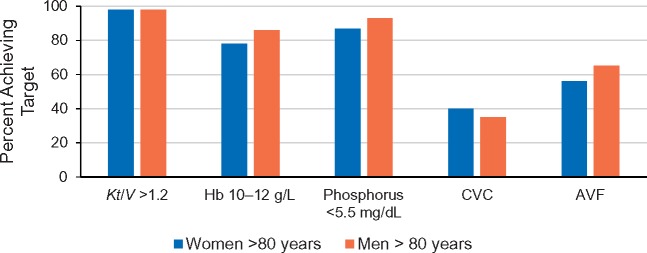
Results: Body weight and the prescribed dialysis blood flow rate were lower in women (P < 0.001), whereas treated blood volume per kilogram per session was higher (P < 0.01), resulting in higher single-pool Kt/V in women than in men (P < 0.001). Haemoglobin was significantly higher in men (P = 0.01), but the proportion of patients within target range (10-12 g/dL) was similar. Men more often had an arteriovenous fistula than women (80% versus 73%; P < 0.01) with a similar percentage of central venous catheters. There were no gender-specific differences in terms of dialysis adequacy, anaemia parameters or mineral and bone disorder parameters, or in the attainment of KDIGO targets between women and men >80 years of age.
Conclusions: This large, multicentre real-world analysis indicates that haemodialysis practices and treatment targets are similar for women and men, including the most elderly, in DaVita haemodialysis clinics in Europe.
Keywords: age; anemia; chronic haemodialysis; dialysis adequacy; gender.
© The Author(s) 2019. Published by Oxford University Press on behalf of ERA-EDTA.
Figures
References
-
- Obrador GT, Arora P, Kausz AT. et al. Level of renal function at the initiation of dialysis in the U.S. end-stage renal disease population. Kidney Int 1999; 56: 2227–2235 - PubMed
-
- USRDS annual data report: epidemiology of kidney disease in the United States Vol. 1: CKD in the United States, USRDS, 2016, pp. 1–216
-
- Miller CD, Robbin ML, Allon M.. Gender differences in outcomes of arteriovenous fistulas in hemodialysis patients. Kidney Int 2003; 63: 346–352 - PubMed
-
- Carrero JJ, de Jager DJ, Verduijn M. et al. Cardiovascular and noncardiovascular mortality among men and women starting dialysis. Clin J Am Soc Nephrol 2011; 6: 1722–1730 - PubMed
LinkOut - more resources
Full Text Sources
