


Mental Imagery in Social Anxiety in Children and Young People: A Systematic Review
- PMID: 32297091
- PMCID: PMC7366604
- DOI: 10.1007/s10567-020-00316-2
Mental Imagery in Social Anxiety in Children and Young People: A Systematic Review
Abstract
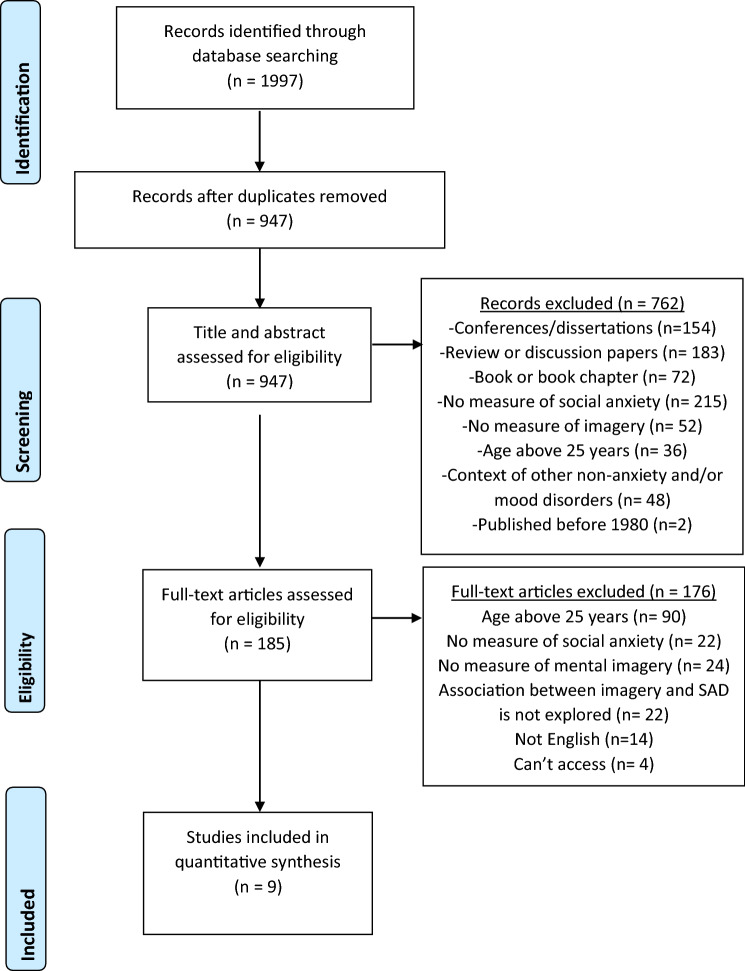
Current cognitive models of social anxiety disorder (SAD) in adults indicate that negative self-images play a pivotal role in maintaining the disorder. However, little is known about the role of negative imagery in the maintenance of social anxiety for children and young people. We systematically reviewed studies that have investigated the association between imagery and social anxiety in children and young people. Four databases were searched for 'social anxiety' and related terms (including 'social phobia' and 'performance anxiety') combined with 'imagery', 'representation*', and 'observer perspective'. The nine studies that met the inclusion criteria provided some evidence that children and young people with higher social anxiety report more negative, observer's perspective images, and some evidence to support the cognitive models of SAD's conceptualisation of imagery. Only two studies included samples with pre-adolescent children. The literature is limited by a number of methodological issues, including inconsistencies in, and a lack of good psychometric measures for, imagery in children and young people. More conclusive evidence is needed to develop significant and robust conclusions.
Keywords: Children and young people; Imagery; Social anxiety.
Conflict of interest statement
The authors declare that they have no conflict of interest.
Figures
References
-
- American Psychiatric Association . Diagnostic and statistical manual of mental disorders. 3. Washington, DC: APA; 1980.
-
- Clark DM. A cognitive perspective on social phobia. In: Crozier WR, Alden LE, editors. The essential handbook of social anxiety for clinicians. West Sussex: Wiley; 2005. pp. 193–218.
-
- Clark DM, Wells A. A cognitive model of social phobia. In: Heimberg RG, Liebowitz M, Hope D, Schneier F, editors. Social phobia: Diagnosis, assessment and treatment. New York: Guilford Press; 1995. pp. 69–93.
-
- Cohen J. Statistical power analysis for the behavioral sciences. 2. New York: Lawrence Erlbaum Associates; 1988.
Publication types
MeSH terms
Grants and funding
LinkOut - more resources
Full Text Sources
Miscellaneous
