


Green nephrology and eco-dialysis: a position statement by the Italian Society of Nephrology
- PMID: 32297293
- PMCID: PMC7381479
- DOI: 10.1007/s40620-020-00734-z
Green nephrology and eco-dialysis: a position statement by the Italian Society of Nephrology
Abstract
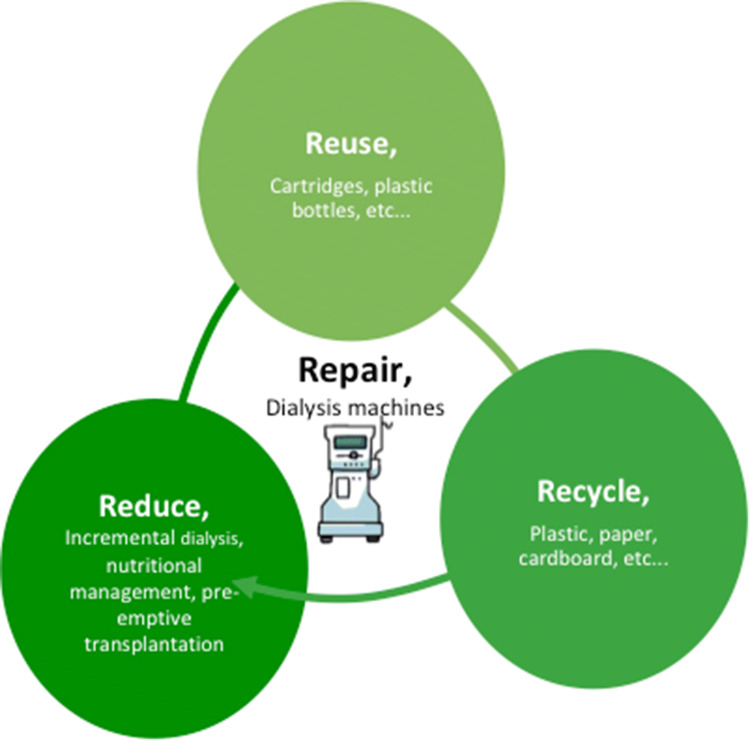
High-technology medicine saves lives and produces waste; this is the case of dialysis. The increasing amounts of waste products can be biologically dangerous in different ways: some represent a direct infectious or toxic danger for other living creatures (potentially contaminated or hazardous waste), while others are harmful for the planet (plastic and non-recycled waste). With the aim of increasing awareness, proposing joint actions and coordinating industrial and social interactions, the Italian Society of Nephrology is presenting this position statement on ways in which the environmental impact of caring for patients with kidney diseases can be reduced. Due to the particular relevance in waste management of dialysis, which produces up to 2 kg of potentially contaminated waste per session and about the same weight of potentially recyclable materials, together with technological waste (dialysis machines), and involves high water and electricity consumption, the position statement mainly focuses on dialysis management, identifying ten first affordable actions: (1) reducing the burden of dialysis (whenever possible adopting an intent to delay strategy, with wide use of incremental schedules); (2) limiting drugs and favouring "natural" medicine focussing on lifestyle and diet; (3) encouraging the reuse of "household" hospital material; (4) recycling paper and glass; (5) recycling non-contaminated plastic; (6) reducing water consumption; (7) reducing energy consumption; (8) introducing environmental-impact criteria in checklists for evaluating dialysis machines and supplies; (9) encouraging well-planned triage of contaminated and non-contaminated materials; (10) demanding planet-friendly approaches in the building of new facilities.
Keywords: Costs; Dialysis; Ecology; Pollution; Sustainability; Waste management.
Conflict of interest statement
On behalf of all authors, the corresponding author states that there is no conflict of interest.
Figures
References
-
- https://w2.vatican.va/content/francesco/en/encyclicals/documents/papa-fr.... Accessed 22nd Nov 2019
-
- https://www.dalailama.com/videos/ecology-ethics-and-interdependence-mind.... Accessed 22nd Nov 2019
-
- https://www.interfaithsustain.com/faith-ecology-conference-in-jerusalem/.... Accessed 22nd Nov 2019
-
- https://time.com/person-of-the-year-2019-greta-thunberg/. Accessed 31st Dec 2019
-
- https://www.collinsdictionary.com/dictionary/english/the-throwaway-socie.... Accessed 22nd Nov 2019
