


Association of bacteria in pancreatic fistula fluid with complications after pancreatic surgery
- PMID: 32297478
- PMCID: PMC7260411
- DOI: 10.1002/bjs5.50272
Association of bacteria in pancreatic fistula fluid with complications after pancreatic surgery
Abstract
Background: Pancreatic fistula (PF) is a common complication after pancreatic surgery. It is unclear how microbes in PF fluid affect outcomes and which microbes are present after pancreatoduodenectomy (PD) and distal pancreatectomy (DP). The aim of this study was to compare the microbiological spectrum of PF fluid after PD versus DP, and its association with postoperative complications.
Methods: Bacterial strains and antibiotic resistance rates of bacterial swabs obtained from the PF fluid of patients who underwent DP or PD were analysed. Cultured bacteria were classified as Enterobacterales and as 'other intestinal and non-intestinal microorganisms' based on whether they are typically part of the normal human intestinal flora.
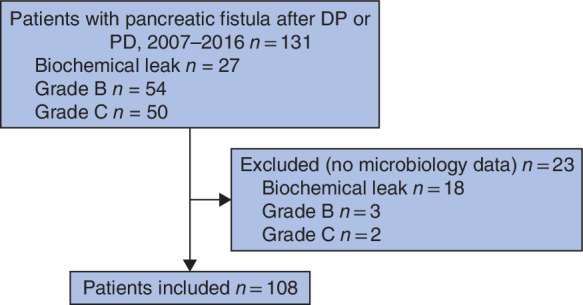
Results: A total of 847 patients had a pancreatic resection (PD 600; DP 247) between July 2007 and December 2016. Clinically relevant PF was detected in 131 patients (15·5 per cent). Bacterial swabs were obtained from 108 patients (DP 47; PD 61), of which 19 (17·6 per cent) were sterile. Enterobacterales were detected in 74 per cent of PF fluid swabs after PD, and in 34 per cent after DP. Infected, polymicrobial or multidrug-resistant PF fluid was more common after PD (rates of 95, 50 and 48 per cent respectively) than after DP (66, 26 and 6 per cent respectively). Patients with higher grade complications (Clavien-Dindo grade IV-V) or grade C PF had more Enterobacterales and multidrug-resistant Enterobacterales in the PF fluid after DP.
Conclusion: Enterobacterales and multidrug-resistant bacteria are detected frequently after PD and DP, and are associated with more severe complications and PF in patients undergoing DP.
Antecedentes: La fístula pancreática (pancreatic fistula, PF) es una complicación frecuente de la cirugía pancreática. No está claro cómo los microorganismos que se encuentran en el líquido de la PF (pancreatic fistula fluid, PFF) afectan los resultados y qué microbios están presentes después de la duodenopancreatectomía (pancreaticoduodenectomy, PD) y de la pancreatectomía distal (distal pancreatectomy, DP). El objetivo de este estudio fue comparar el espectro microbiológico del PFF después de PD versus DP y su asociación con las complicaciones postoperatorias. MÉTODOS: Se analizaron las cepas bacterianas y las tasas de resistencia a los antibióticos de las muestras bacterianas obtenidas del PFF de pacientes de nuestra institución que se sometieron a DP o PD. Las bacterias identificadas en los cultivos se clasificaron en "enterobacterias" y "otros microorganismos intestinales y no intestinales" en función de si típicamente forman parte de la flora intestinal humana normal o no.
Resultados: Un total de 847 pacientes se sometieron a resección pancreática (PD: 600, DP: 247) entre julio de 2007 y diciembre de 2016, y se detectó FP clínicamente relevante en 131 pacientes (15,5%). Se obtuvieron muestras bacterianas de 108 pacientes (DP n = 47, PD N = 61), de los cuales 19 (18%) eran estériles. Se detectaron enterobacterias en el 74% del PFF después de PD y en el 34% después de DP. El PFF infectado, con flora polimicrobiana o flora multirresistente fue más frecuente después de la PD (95,1%, 50%, 47,5%, respectivamente) que después de la DP (66,0%, 25,8%, 6,4%, respectivamente). Los pacientes con complicaciones de grado superior (Clavien-Dindo 4/5) o PF grado C presentaron más enterobacterias y enterobacterias multirresistentes en el PFF después de DP. CONCLUSIÓN: Las enterobacterias y las bacterias multirresistentes se detectaron con frecuencia después de la PD y la DP, y se asociaron a complicaciones más graves y PF en pacientes sometidos a DP.
© 2020 The Authors. BJS Open published by John Wiley & Sons Ltd on behalf of British Journal of Surgery Society.
Figures
References
-
- Bassi C, Marchegiani G, Dervenis C, Sarr M, Abu Hilal M, Adham M et al; International Study Group on Pancreatic Surgery (ISGPS). The 2016 update of the International Study Group (ISGPS) definition and grading of postoperative pancreatic fistula: 11 years after. Surgery 2017; 161: 584–591. - PubMed
-
- Frankard J, Rodriguez‐Villalobos H, Struelens MJ, Jacobs F. Haemophilus parainfluenzae: an underdiagnosed pathogen of biliary tract infections? Eur J Clin Microbiol Infect Dis 2004; 23: 46–48. - PubMed
-
- Whiley RA, Beighton D, Winstanley TG, Fraser HY, Hardie JM. Streptococcus intermedius, Streptococcus constellatus, and <styled-content style="fixed-case">Streptococcus anginosus</styled-content> (the Streptococcus milleri group): association with different body sites and clinical infections. J Clin Microbiol 1992; 30: 243–244. - PMC - PubMed
MeSH terms
LinkOut - more resources
Full Text Sources
Medical
