. 2020 Nov;149(11):2063-2083.
doi: 10.1037/xge0000765. Epub 2020 Apr 16.

Generalization and recovery of post-retrieval amnesia

Affiliations

Generalization and recovery of post-retrieval amnesia

Joaquín M Alfei et al. J Exp Psychol Gen. 2020 Nov.

Abstract

Selective amnesia for previously established memories can be induced by administering drugs that impair protein synthesis shortly after memory reactivation. Competing theoretical accounts attribute this selective post-retrieval amnesia to drug-induced engram degradation (reconsolidation blockade) or to incorporation of sensory features of the reactivation experience into the memory representation, hampering later retrieval in a drug-free state (memory integration). Here we present evidence that critically challenges both accounts. In contextual fear conditioning in rats, we find that amnesia induced by administration of midazolam (MDZ) after reexposure to the training context A generalizes readily to a similar context B. Amnesia is also observed when animals are exposed to the similar context B prior to MDZ administration and later tested for fear to context B but recovers when instead testing for fear to the original training context A or an equally similar but novel context C. Next to their theoretical implications for the nature of forgetting, our findings raise important questions about the viability of reconsolidation-based interventions for the treatment of emotional disorders. (PsycInfo Database Record (c) 2020 APA, all rights reserved).


Figures
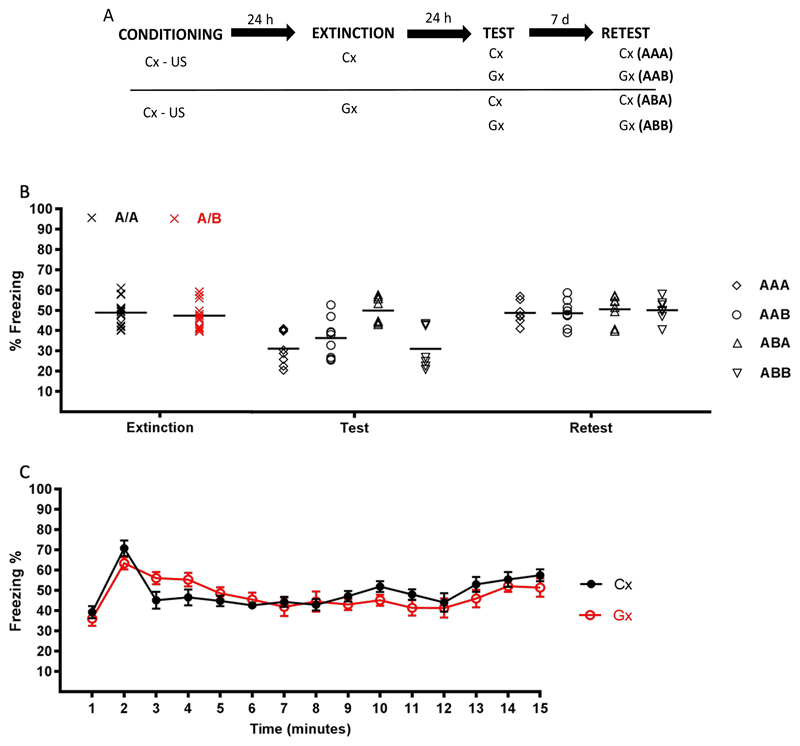
Figure 1
Figure 1
Experiment 1. (A) Design. (B) Conditioned freezing behavior during extinction, retention test and retest, by group. Extinction results in reduced fear expression at test in the AAA, AAB and ABB groups but not in the ABA group. (C) The min-by-min pattern of freezing during the 15-min exposure to A or B (extinction session). Data are expressed as means (+/- SEM in panel C), in panel B symbols represent individual data points.
Figure 2
Figure 2
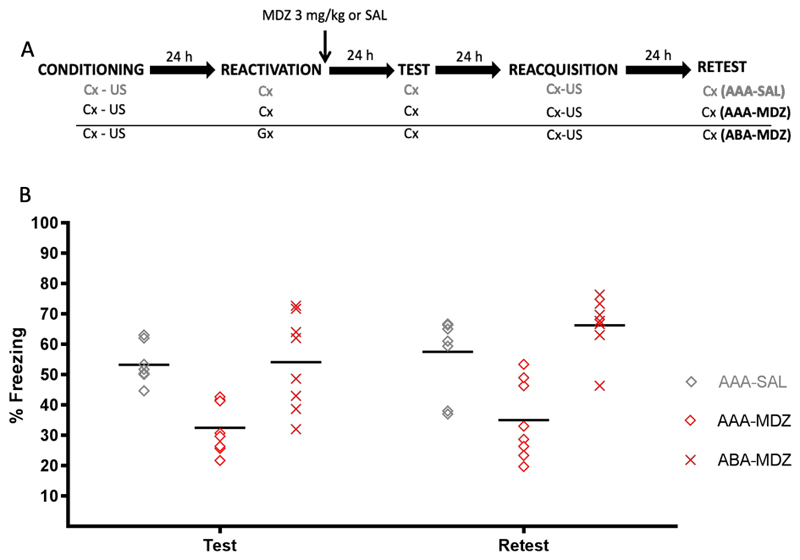
Experiment 2. (A) Design. (B) Conditioned freezing behavior during retention test and retest, by group. Amnesia was observed in the AAA-MDZ group (relative to the AAA-SAL group). No attenuation in memory expression was observed in the ABA-MDZ group. Data are expressed as means, symbols represent individual data points.
Figure 3
Figure 3
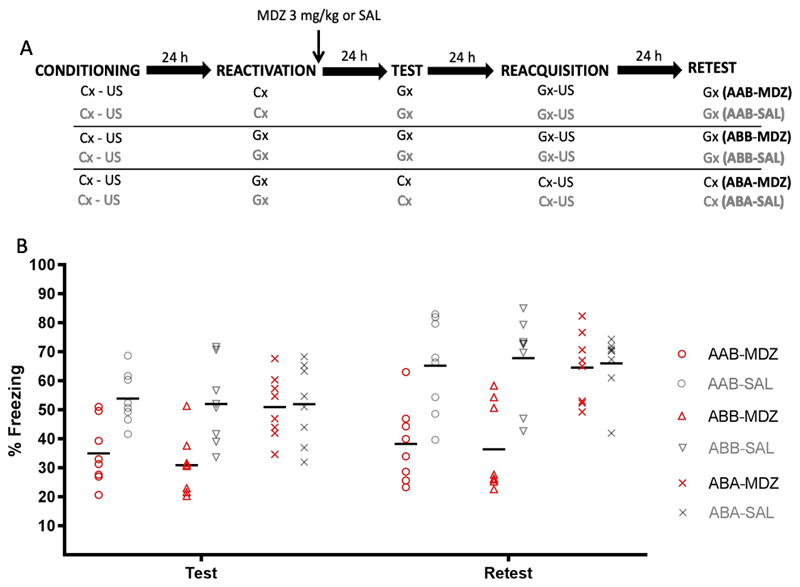
Experiment 3. (A) Design. (B) Conditioned freezing behavior during test and retest, by group. Rats that received reactivation through exposure to the initial training context and given MDZ showed a generalized memory impairment when tested in novel context B (AAB-MDZ). A similar memory deficit was observed in animals that received reactivation through exposure to context B prior to MDZ administration and were then tested in B (ABB-MDZ). However, when after memory reactivation using B, rats were re-exposed to the originally trained context (ABA groups), no MDZ-induced amnesia was found. Data are expressed as means, symbols represent individual data points.
Figure 4
Figure 4
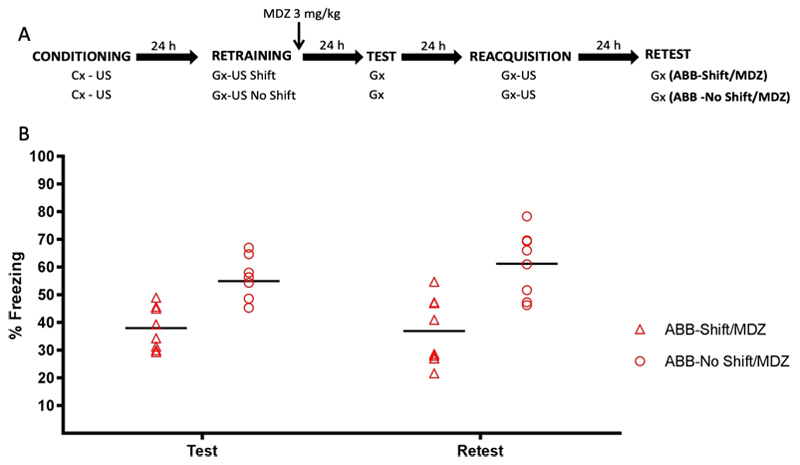
Experiment 4. (A) Design. (B) Conditioned freezing behavior during test and retest, by group. Animals in the ABB-Shift/MDZ group expressed significantly less fear than those in the AAB-No Shift/MDZ group at test and retest. Data are expressed as means, symbols represent individual data points.
Figure 5
Figure 5
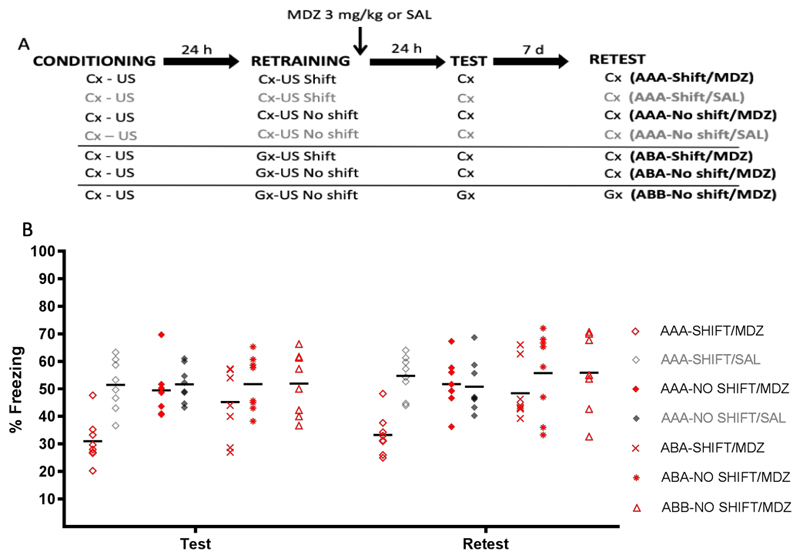
Experiment 5. (A) Design. (B) Conditioned freezing behavior during test and retest, by group. Only rats that experienced a shift in US timing during retraining to the originally trained context A showed a long-lasting impairment of memory retention (AAA-Shift/MDZ). When US timing was preserved for retraining, animals showed intact memory performance at test and retest (AAA-No shift groups, ABA-No shift/MDZ and ABB-No shift/MDZ). Critically, a shift in US timing during retraining in the generalization context did not produce generalized MDZ-induced amnesia for the original training context (ABA-Shift/MDZ). Data are expressed as means, symbols represent individual data points.
Figure 6
Figure 6
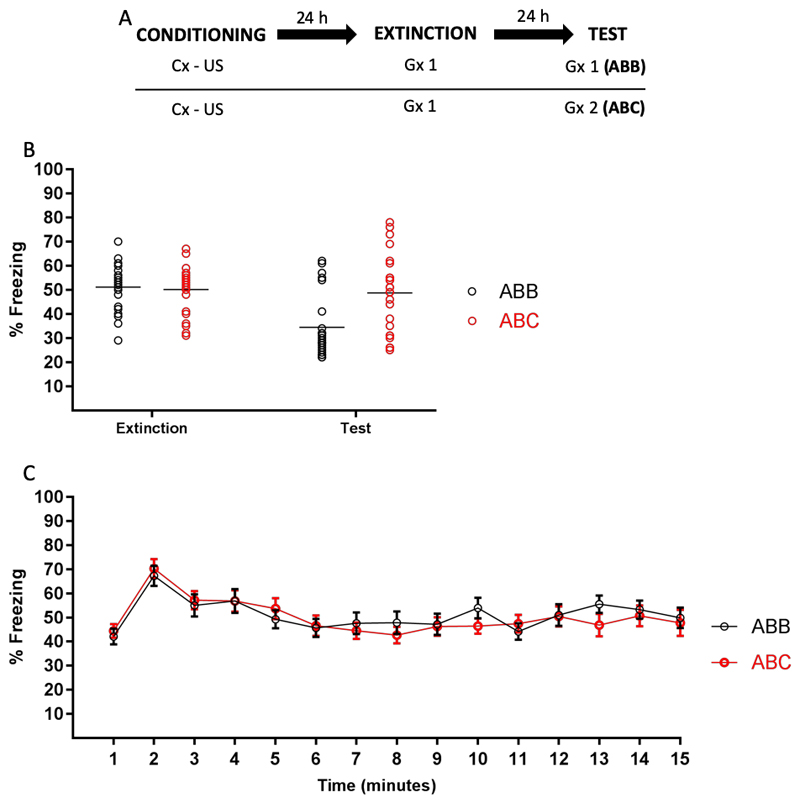
Experiment 6. (A) Design. (B) Conditioned freezing during extinction and retention test, by group. Extinction of generalized contextual fear was expressed only when subsequently tested in the extinction context (ABB). When the animals were tested in a different context than the one used for extinction, fear renewal was observed (ABC). (C) The min-by-min pattern of freezing during the 15-min exposure to context B (extinction session). Data are expressed as means (+/- SEM in panel B), symbols in panel B represent individual data points.
Figure 7
Figure 7
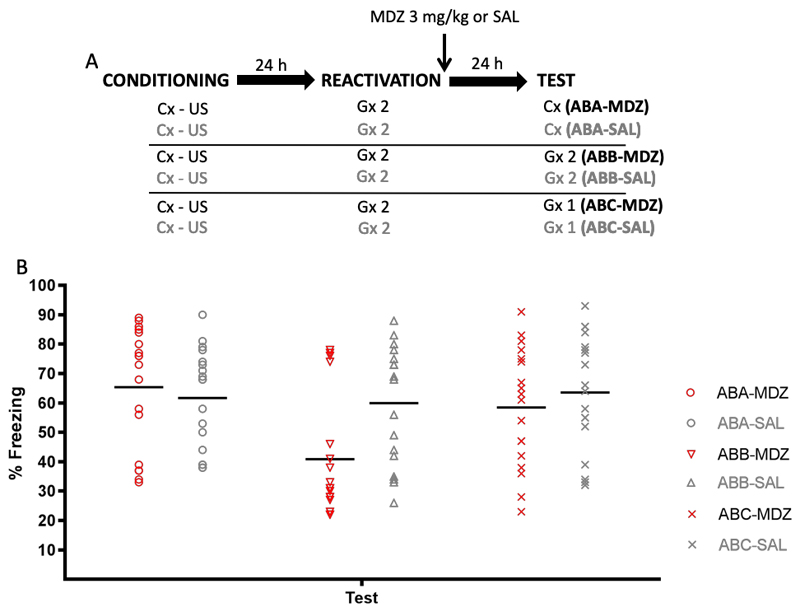
Experiment 7. (A) Design. (B) Conditioned freezing behavior during test, by group. Only in animals in which memory retention was tested for the same generalization context as used for reactivation, MDZ-induced amnesia was observed. Data are expressed as means, symbols represent individual data points.

References

    1. Alfei JM, Ferrer Monti RI, Molina VA, Bueno AM, Urcelay GP. Prediction error and trace dominance determine the fate of fear memories after post-training manipulations. Learning and Memory. 2015;22(8):385–400. doi: 10.1101/lm.038513.115. - DOI - PMC - PubMed
    1. Alfei JM, Luyten L, Beckers T, Ferrer Monti RI, Molina VA, De Bundel D. Generalization and recovery of post-retrieval amnesia. 2019 Nov 7; Retrieved from osf.io/fqajx. - PMC - PubMed

    1. Asok A, Kandel ER, Rayman JB. The Neurobiology of Fear Generalization. Frontiers in Behavioral Neuroscience. 2019;12(329):1–15. doi: 10.3389/fnbeh.2018.00329. - DOI - PMC - PubMed
    1. Beckers T, Kindt M. Memory Reconsolidation Interference as an Emerging Treatment for Emotional Disorders: Strengths, Limitations, Challenges, and Opportunities. Annual Review of Clinical Psychology. 2017;13:99–121. doi: 10.1146/annurev-clinpsy-032816-045209. - DOI - PMC - PubMed
    1. Boddez Y, Callaerts-Vegh Z, Vervliet B, Baeyens F, D’Hooge R, Hermans D, Beckers T. Stimulus generalization and return of fear in C57BL/6J mice. Frontiers in Behavioral Neuroscience. 2012 Jul;6:1–5. doi: 10.3389/fnbeh.2012.00041. - DOI - PMC - PubMed